
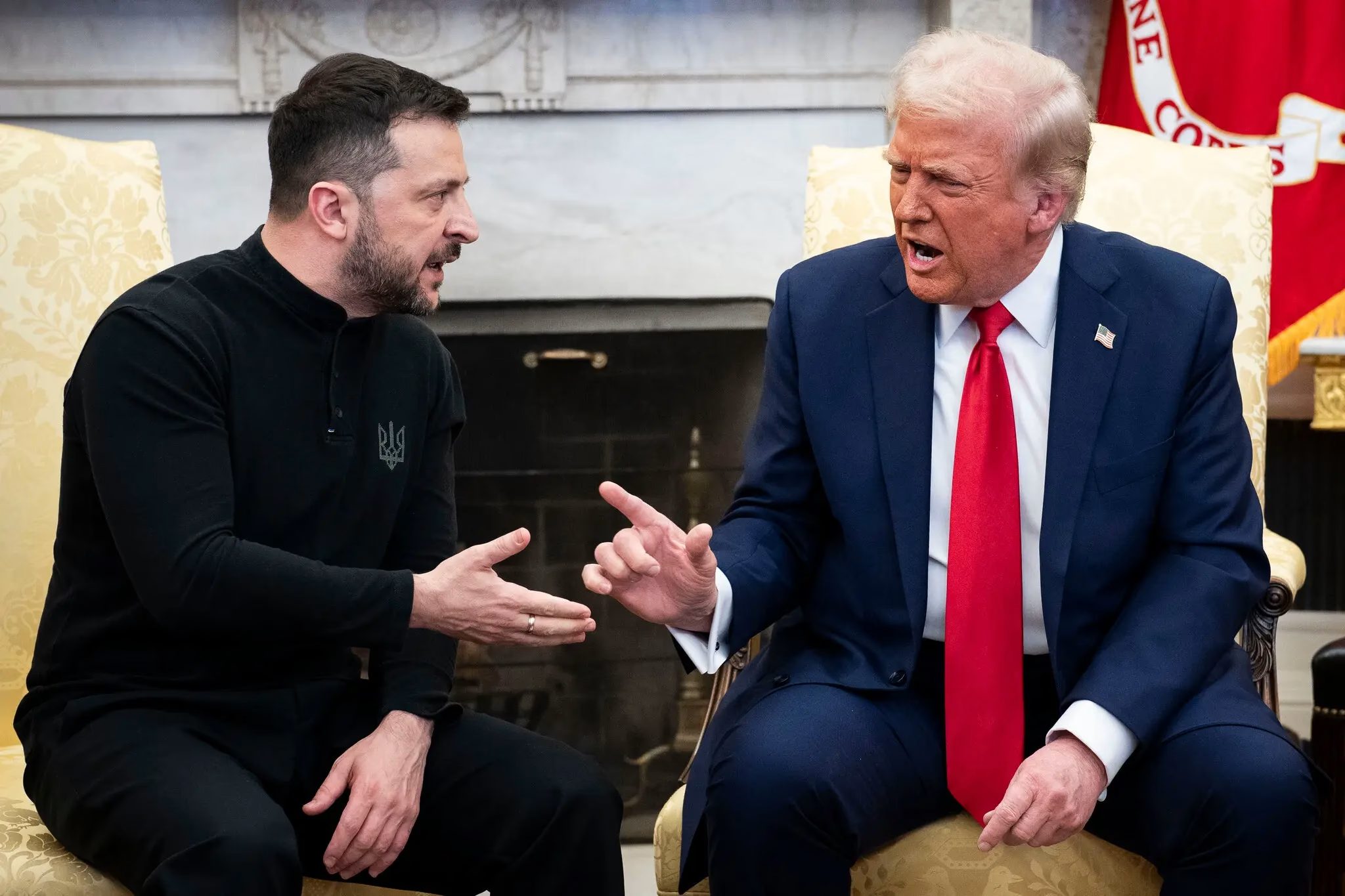
Yesterday’s Oval Office meeting between President Trump and President Zelensky was supposed to result in a deal giving the United States rights to vital Ukrainian minerals in exchange for some modest security guarantees. Instead, it became a made-for-TV spectacle.
The NYT has a transcription of the most contentious bits (“Excerpts From the Fiery Exchange Between Trump and Zelensky at the White House“) but even the excerpts are too long to post here. The analysis is all over the place, but none of it positive.
David Sanger (“Behind the Collision: Trump Jettisons Ukraine on His Way to a Larger Goal“):
After five weeks in which President Trump made clear his determination to scrap America’s traditional sources of power — its alliances among like-minded democracies — and return the country to an era of raw great-power negotiations, he left one question hanging: How far would he go in sacrificing Ukraine to his vision?
The remarkable showdown that played out in front of the cameras early Friday afternoon from the Oval Office provided the answer.
As Mr. Trump admonished President Volodymyr Zelensky and warned him that “you don’t have the cards” to deal with President Vladimir V. Putin of Russia, and as Vice President JD Vance dressed down the Ukrainian leader as being “disrespectful” and ungrateful, it was clear that the three-year wartime partnership between Washington and Kyiv was shattered.
Whether it can be repaired, and whether a deal to provide the United States revenue from Ukrainian minerals that was the ostensible reason for the visit can be pieced back together, remains to be seen.
But the larger truth is that the venomous exchanges — broadcast not only to an astounded audience of Americans and Europeans who had never seen such open attacks on each other, but to Mr. Putin and his Kremlin aides — made evident that Mr. Trump regards Ukraine as an obstacle to what he sees as a far more vital project.
What Mr. Trump really wants, one senior European official said this week before the blowup, is a normalization of the relationship with Russia. If that means rewriting the history of Moscow’s illegal invasion three years ago, dropping investigations of Russian war crimes or refusing to offer Ukraine long-lasting security guarantees, then Mr. Trump, in this assessment of his intentions, is willing to make that deal.
To anyone listening carefully, that goal was bubbling just beneath the surface as Mr. Zelensky headed to Washington for his disastrous visit.
Secretary of State Marco Rubio — once a defender of Ukraine and its territorial sovereignty, now a convert to the Trump power plays — made clear in an interview with Breitbart News that it was time to move beyond the war in the interest of establishing a triangular relationship between the United States, Russia and China.
[…]
Mr. Trump makes no secret of his view that the post-World War II system, created by Washington, ate away at American power.
Above all else, that system prized relationships with allies committed to democratic capitalism, even maintaining those alliances that came with a cost to American consumers. It was a system that sought to avoid power grabs by making the observance of international law, and respect for established international boundaries, a goal unto itself.
To Mr. Trump, such a system gave smaller and less powerful countries leverage over the United States, leaving Americans to pick up far too much of the tab for defending allies and promoting their prosperity.
While his predecessors — both Democrats and Republicans — insisted that alliances in Europe and Asia were America’s greatest force multiplier, keeping the peace and allowing trade to flourish, Mr. Trump viewed them as a bleeding wound. In the 2016 presidential campaign, he repeatedly asked why America should defend countries running trade surpluses with the United States.
In the five weeks since his second inauguration, Mr. Trump has begun exercising a plan to destroy that system. It explains his demand that Denmark cede control of Greenland to the United States, and that Panama return a canal that Americans built. When asked how he could seize sovereign territory in Gaza for redevelopment in his plan for a “Riviera of the Middle East,” he shot back, “Under the U.S. authority.”
[…]
Of course, it is far easier to repeat Mr. Trump’s favorite slogan, and to blow up an existing world order, than to create a new one. It took decades to assemble the post-World War II rules of global engagement, and for all its faults, the system succeeded at its primary objectives: avoiding great power war and encouraging economic interdependence.
Mr. Trump has never articulated at any length what he would replace those rules with, other than that he would use America’s military and economic power to strike deals — essentially an argument that keeping the peace is as simple as weaving together minerals agreements and trade pacts, maybe with a few real estate transactions thrown in.
There is little precedent to suggest that approach alone works, especially in dealing with authoritarian leaders like Mr. Putin and President Xi Jinping of China, who take a long view in dealing with democracies that they view as lacking the sustained will necessary to achieve difficult objectives.
But judging by Friday’s display in the Oval Office, Mr. Trump seems convinced that as long as he is at the helm, the world will order itself as he commands.
His colleague Shawn McCreesh (“‘This Is Going to Be Great Television’: Trump Sums Up His Zelensky Showdown“) sees something different going on:
One of the most surreal moments of Friday’s Oval Office showdown between President Trump and President Volodymyr Zelensky of Ukraine came at the very end.
After all the shouting and the saber-rattling and the lecturing and the pleading and the politicking had ceased, the American president shifted a little in his seat and shared an observation.
“This is going to be great television,” he remarked. “I will say that.”
It was a conclusion as startling as it was fundamentally Trumpian.
This was not a season finale boardroom scene of “The Apprentice” that had just taken place. It was the highest of high-stakes talks — one that could determine the fate of millions, the existence of a sovereign nation and the security of a continent — going wildly off the rails.
But for Mr. Trump, one thing that was on his mind, as always, was the ratings. He sounded almost excited by the drama of the spectacle, as though he could feel the front pages of the world’s newspapers being written in real time.
This is a man who spent years yelling at people on TV as a way to make a living. He is wired to think about things in terms of “great television.” He is a highly conscious performer. But playacting as a tough guy on NBC on Thursday nights between 9 and 10 p.m. is not the same thing as bossing around an ally before the eyes of the world, even if Mr. Trump uses the same language to describe one performance as he would the other.
Still, how one postures before the cameras is of paramount importance in this White House.
After the meeting, the president did an imitation of Mr. Zelensky in front of the cameras and said: “All of a sudden, he’s a big shot.” Where Mr. Trump is involved, there is usually room enough for one big shot.
The other European leaders who had come to Washington over the past few weeks to reason with him about Russia understood this. They knew how to play their parts in the Oval Office while the cameras were rolling. President Emmanuel Macron of France literally held Mr. Trump’s hand at one point. Britain’s Prime Minister Keir Starmer presented a letter from King Charles III to Mr. Trump for all to see. It went over so well that Mr. Trump brought the letter out to wave around again a little while later at their joint news conference.
The Atlantic‘s Jonathan Chait (“The Real Reason Trump Berated Zelensky“) offers yet another take:
Of the many bizarre and uncomfortable moments during today’s Oval Office meeting between Donald Trump, J. D. Vance, and Volodymyr Zelensky—during which Trump finally shattered the American alliance with Ukraine—one was particularly revealing: What, a reporter asked, would happen if the cease-fire Trump is trying to negotiate were to be violated by Russia? “What if anything? What if a bomb drops on your head right now?” Trump spat back, as if Russia violating a neighbor’s sovereignty were the wildest and most unlikely possibility, rather than a frequently recurring event.
Then Trump explained just why he deemed such an event so unlikely. “They respect me,” he thundered. “Let me tell you, Putin went through a hell of a lot with me. He went through a phony witch hunt, where they used him and Russia. Russia, Russia, Russia, you ever hear of that deal? … It was a phony Democrat scam. He had to go through it. And he did go through it.”
Trump seems to genuinely feel that he and Vladimir Putin forged a personal bond through the shared trauma of being persecuted by the Democratic Party. Trump is known for his cold-eyed, transactional approach, and yet here he was, displaying affection and loyalty. (At another point, Trump complained that Zelensky has “tremendous hatred” toward Putin and insisted, “It’s very tough for me to make a deal with that kind of hate.”) He was not explaining why a deal with Russia would advance America’s interests, or why honoring it would advance Russia’s. He was defending Russia’s integrity by vouching for Putin’s character.
In recent years, the kinship between Trump and Putin has become somewhat unfashionable to point out. After Robert Mueller disappointed liberals by failing to prove a criminal conspiracy between the Trump campaign and Russia, conventional wisdom on much of the center and left of the political spectrum came to treat the scandal as overblown. But even the facts Mueller was able to produce, despite noncooperation from Trump’s top lieutenants, were astonishing. Putin dangled a Moscow building deal in front of the Trump Organization worth hundreds of millions of dollars, and Trump lied about it, giving Putin leverage over him. Trump’s campaign chair, Paul Manafort, was in business with a Russian intelligence officer. Russia published hacked Democratic emails at a time when they were maximally useful to Trump’s campaign, and made another hacking attempt after he asked it on television to find missing emails from Hillary Clinton. The pattern of cooperation between Trump and Putin may not have been provably criminal, but it was extraordinarily damning.
Conservatives have invested even more heavily in denying any basis for the Trump-Russia scandal. A handful of MAGA devotees have openly endorsed Russian propaganda, but more Republicans have explained away Trump’s behavior as reflecting some motivation other than outright sympathy for Moscow: He is transactional, he is a nationalist, he admires strength and holds weakness in contempt.
And it is all true: Trump does admire dictators. He does instinctively side with bullies over victims. He does lack any values-based framework for American foreign policy. But many Republicans who acknowledged these traits nonetheless believed that Trump could be persuaded to stay in Ukraine’s corner. They were wrong. The reason they were wrong is that, in addition to his generalized amorality, Trump exhibits a particular affection for Putin and Russia.
His colleague Tom Nichols (“It Was an Ambush“) agrees but more forcefully:
Leave aside, if only for a moment, the utter boorishness with which President Donald Trump and Vice President J. D. Vance treated Ukrainian President Volodymyr Zelensky at the White House today. Also leave aside the spectacle of American leaders publicly pummeling a friend as if he were an enemy. All of the ghastliness inflicted on Zelensky today should not obscure the geopolitical reality of what just happened: The president of the United States ambushed a loyal ally, presumably so that he can soon make a deal with the dictator of Russia to sell out a European nation fighting for its very existence.
Trump’s advisers have already declared the meeting a win for “putting America first,” and his apologists will likely spin and rationalize this shameful moment as just a heated conversation—the kind of thing that in Washington-speak used to be called a “frank and candid exchange.” But this meeting reeked of a planned attack, with Trump unloading Russian talking points on Zelensky (such as blaming Ukraine for risking global war), all of it designed to humiliate the Ukrainian leader on national television and give Trump the pretext to do what he has indicated repeatedly he wants to do: side with Russian President Vladimir Putin and bring the war to an end on Russia’s terms. Trump is now reportedly considering the immediate end of all military aid to Ukraine because of Zelensky’s supposed intransigence during the meeting.
[…]
Today’s meeting and America’s shameful vote in the United Nations on Monday confirmed that the United States is now aligned with Russia and against Ukraine, Europe, and most of the planet. I felt physically sick watching the president of the United States yell at a brave ally, fulminating in the Oval Office as if he were an addled old man shaking his fist at a television. Zelensky has endured tragedies, and risked his life, in ways that men such as Trump and Vance cannot imagine.
[…]
But no matter how disgusted anyone might be at Trump and Vance’s behavior, the strategic reality is that this meeting is a catastrophe for the United States and the free world. America’s alliances are now in danger, and should be: Trump is openly, and gleefully, betraying everything America has tried to defend since the defeat of the Axis 80 years ago. The entire international order of peace and security is now in danger, as Russian autocrats, after slaughtering innocent people for three years, look forward to enjoying the spoils of their invasion instead of standing trial for their crimes. (Shortly after Trump dismissed Zelensky from the White House, Putin’s homunculus, former Russian President Dmitry Medvedev, posted on X: “The insolent pig finally got a proper slap down in the Oval Office.”)
Friday, February 28, 2025, will go into the history books as one of the grimmest days in American diplomacy, the beginning of a long-term disaster that every American, every U.S. ally, and anyone who cares about the future of democracy will have to endure. With the White House’s betrayal of Ukraine capping a month of authoritarian chaos in America, Putin, along with other dictators around the world, can finally look at Trump with confidence and think: one of us.
Thomas Friedman (“This Never Happened With an American President Before“) is beside himself:
What happened in the Oval Office on Friday — the obviously planned ambush of President Volodymyr Zelensky of Ukraine by President Trump and Vice President JD Vance — was something that had never happened in the nearly 250-year history of this country: In a major war in Europe, our president clearly sided with the aggressor, the dictator and the invader against the democrat, the freedom fighter and the invaded.
[…]
It is hard to express what a break this is in American foreign policy. We stood on the side of liberty and those fighting for it around the world. There are times the isolationist forces in our population have held us back and had to be persuaded. There have been times when — in support of the larger cause of liberty — against dangerous foes like Nazi Germany and the Soviet Union, we had to align ourselves temporarily with dictators.
But I can’t think of a single time when an American president declared that the democratically elected leader of a country preserving liberty was a “dictator” who started the war with his neighbor — when it was the vicious neighboring dictator who actually started the war.
If you listen to Trump, everything we have done for Ukraine is pure altruism. We have no actual interests at stake ourselves in its fate or the triumph of liberty there. We have no actual interest in the fact that Ukraine is protecting the European Union — a giant, pro-American alliance of free markets and free people. It doesn’t matter a whit to Trump what happens to the E.U. or Ukraine. All that matters is that Zelensky says “thank you” louder for our altruism and that, in the middle of his war of survival, sign over a generation of Ukraine’s mineral wealth to us.
This is a total perversion of U.S. foreign policy practiced by every president since World War I. My fellow Americans, we are in completely uncharted waters, led by a president, who — well, I cannot believe he is a Russian agent, but he sure plays one on TV.
Even the Wall Street Journal Editorial Board (“Putin Wins the Trump-Zelensky Oval Office Spectacle“) is shocked:
Toward the end of his on-camera, Oval Office brawl with Ukraine’s Volodymyr Zelensky on Friday, President Trump quipped that it was “great television.” He’s right about that. But the point of the meeting was supposed to be progress toward an honorable peace for Ukraine, and in the event the winner was Russia’s Vladimir Putin.
[…]
It is bewildering to see Mr. Trump’s allies defending this debacle as some show of American strength. The U.S. interest in Ukraine is shutting down Mr. Putin’s imperial project of reassembling a lost Soviet empire without U.S. soldiers ever having to fire a shot. That core interest hasn’t changed, but berating Ukraine in front of the entire world will make it harder to achieve.
Turning Ukraine over to Mr. Putin would be catastrophic for that country and Europe, but it would be a political calamity for Mr. Trump too. The U.S. President can’t simply walk away from that conflict, much as he would like to. Ukraine has enough weapons support to last until sometime this summer. But as the war stands, Mr. Putin sees little reason to make any concessions as his forces gain ground inch by bloody inch in Ukraine’s east.
WaPo (“Tears and shock in Ukraine and Europe after heated Zelensky-Trump meeting“) notes the angry reaction of America’s erstwhile allies:
European officials, meanwhile, rallied around Zelensky on Friday night, with several lawmakers and diplomats expressing shock and dismay. European leaders, including in Spain, Lithuania, Moldova, Sweden, Latvia and Norway, among others, all posted messages in solidarity with Zelensky.
Polish Prime Minister Donald Tusk wrote on X: “Dear Zelensky, dear Ukrainian friends, you are not alone.”
French President Emmanuel Macron reiterated his support for Ukraine in remarks to reporters Friday evening: “I think we were all right to help Ukraine and sanction Russia three years ago and to continue to do so. And when I say we, it’s the United States of America, the Europeans, the Canadians, the Japanese and many others.”
“We must thank all those who helped and respect those who have been fighting from the start because they are fighting for their dignity, their independence, for their children and for the security of Europe,” he added. “These are simple things, but they are good to recall at this moment.”
German election winner Friedrich Merz, probably the country’s new chancellor, wrote to Zelensky: “We stand with Ukraine in good and in testing times.” Dutch Prime Minister Dick Schoof said his country continues to support Ukraine, “especially now.”
Even Italian Prime Minister Giorgia Meloni, a Trump ally, said that “division would not suit anyone” in a statement calling for leaders in Ukraine, Europe and the United States to meet to discuss “today’s great challenges, starting with Ukraine.” Meloni’s statement did not directly reference Trump, Zelensky, or Friday’s Oval Office meeting, only obliquely referring to those outside of the West “who would like to see the decline of our civilization.”
There was one prominent exception to the chorus of supporting voices among European leaders: Moscow-friendly Hungarian Prime Minister Viktor Orban, who commended Trump on Friday, saying he “stood bravely for peace.”
“Strong men make peace, weak men make war,” he said.
The combative exchange was also met with shock, and in many cases fury, across the political spectrum in the United Kingdom. The White House fireworks came one day after British Prime Minister Keir Starmer’s own meeting with Trump. The meeting highlighted mutual good feelings with the mercurial president that were greeted as at least tentatively hopeful signs that Washington could be brought along in support not just for U.S.-U.K. relations but for Ukraine, as well.
That optimism was quickly swept away as news of the Oval Office shouting match spread. A Conservative Party member described Trump’s and Vice President JD Vance’s treatment of Zelensky “stomach churning.” Several members of parliament called on Starmer to revoke the invitation for a visit with King Charles that he had extended to Trump a day earlier.
Senior Conservative Party leader Robert Jenrick said in a post on X that he was “sickened by that degrading spectacle.”
“And to think the bust of Winston Churchill was in the same room as it unfolded,” Jenrick posted. “He would be turning in his grave if he saw that happen. Ukraine’s people, led by President Zelensky, have fought bravely to hold off Putin.”
Ed Davey, the leader of the Liberal Democrats Party, posted on X: “This is thuggery from Trump and Vance, plain and simple. They are bullying the brave true patriot Zelensky into accepting a deal which effectively hands victory to Russia. Unless the UK and Europe step up, we are facing a betrayal of Ukraine.”
To the extent there’s a rational American foreign policy goal here, it’s to get European nations to pick up a larger share of the burden of defending Ukraine and containing Russia so that our resources can be allocated to the threat in the Indo-Pacific. And that might in fact happen as a result of all of this.
The Guardian (“‘Free world needs a new leader’, says EU foreign chief after Trump Zelenskyy row“):
The EU foreign policy chief has declared that “the free world needs a new leader”, as European leaders threw their support behind Ukraine’s president, Volodymyr Zelenskyy, after the stunning White House confrontation between him and Donald Trump.
Leaders from across Europe expressed their solidarity with the Ukrainian leader after the fractious exchange with JD Vance, the US vice-president, and Trump, who claimed he was not “ready for peace” and accused him of “gambling with world war three”.
Although in general the European leaders did not name the US president, their comments late on Friday laid bare the gaping rift between the US and its traditional allies in Europe over the war in Ukraine.
In a social media post Kaja Kallas, the EU high representative for foreign affairs and security policy, wrote: “Ukraine is Europe! We stand by Ukraine. We will step up our support to Ukraine so that they can continue to fight back the aggressor.
“Today, it became clear that the free world needs a new leader. It’s up to us, Europeans, to take this challenge.”
Addressing Zelenskyy directly, Ursula von der Leyen, the president of the EU Commission, wrote: “Your dignity honors the bravery of the Ukrainian people. Be strong, be brave, be fearless. You are never alone.”
She added: “We will continue working with you for a just and lasting peace.”
Like Friedman and Nichols, my strong bias is toward American leadership in a values-based alliance. A purely transactional foreign policy might well generate short-term gains, given our significant power advantage. In the longer term, though, I fear this will undermine our ability to lead. Further, I fear that we will never be able to recover our reputation.








