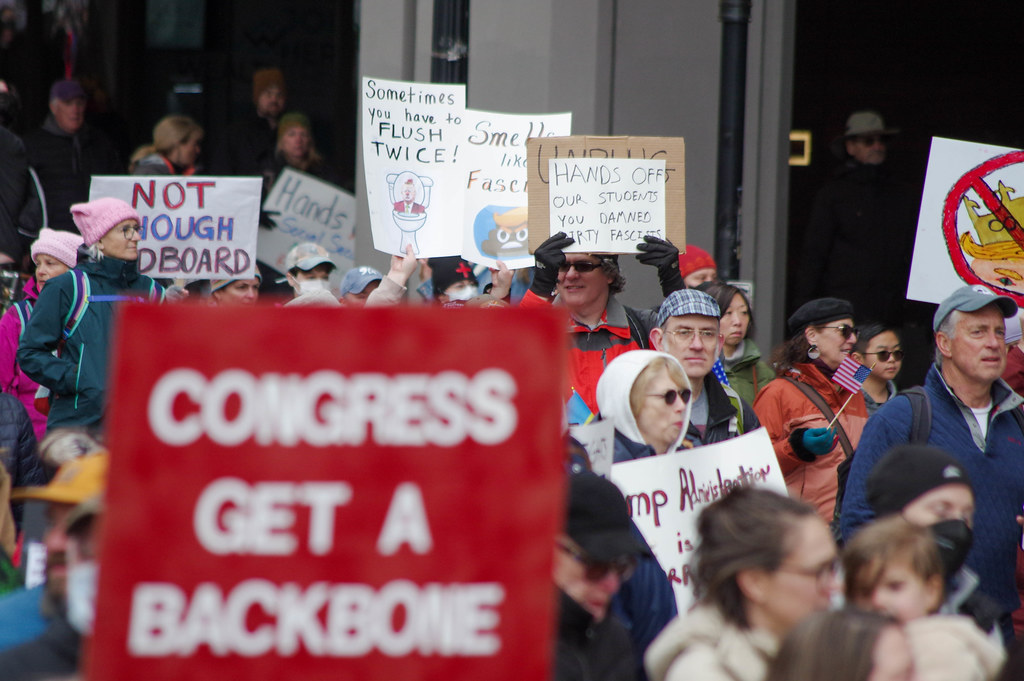

NPR (“Nationwide ‘Hands Off!’ protests erupt against Trump and Musk“):
Demonstrators gathered across the country on Saturday, many animated by differing issues, but united in opposition to the Trump administration with the single message: “Hands off!”
Organizers said more than 1,300 “Hands Off!” rallies of varying sizes took place on Saturday.
Since President Trump took office in January, various protests have taken place against his administration’s plans and policies — from the mass firing of federal workers to immigration raids to the involvement of billionaire Elon Musk in the federal government.
Saturday’s protests appeared to be the most widespread to date of Trump’s second term.
“There are so many issues,” said Kelley Laird from Rockville, Md., who attended a rally in Washington, D.C., on Saturday. “They’re coming after education, coming after health care, coming after the arts, coming after the press.”
In Boston, protesters gathered to push back against the federal cuts on research and against the arrest of Rümeysa Öztürk, a Tufts University doctoral student who was arrested by federal agents in plain clothes, as member station WBUR reported.
In Sylva, N.C., over 300 people came together to oppose cuts to national parks, education and veteran services, according to BPR News. And in Portland, Ore., several thousand people rallied against what they describe as an “illegal, billionaire power grab” by Trump and Musk, OPB reported.
In D.C., thousands filled the grass near the Washington Monument, holding up signs supporting reproductive rights, LGBTQ rights, Social Security, veterans benefits, and opposing tariffs.
Laird and her neighbors said they formed a group chat after Trump took office this year. They use the group chat, named “Sisters of the resistance,” to coordinate attending protests together and offer support.
“We need to form community to bolster each other up because we have to be in this for the long run,” said Emily Peck, who started the group chat.
Many attendees who spoke to NPR said they felt compelled to show up, because new concerns keep emerging.
“This is first time that I am trying to regularly participate,” said Patty Kim, a retired federal worker, who attended the D.C. rally with her husband. “I felt so frustrated and paralyzed by the bunch of things that are going on that undermine human rights and humanity in this country that I love, that I had to do something.”
Mother Jones‘ Tim Murphy writes, “You Can Stop Asking Where the Mass Opposition Is. It’s Everywhere.”
It is a cliche to begin a story about a rally with a quote from a funny sign, but one small piece of floppy brown cardboard floating down 40th Street in Manhattan on Saturday seemed to capture the mood of this weekend’s “Hands Off” protests against President Donald Trump: “Where do I start?”
You could meet a dozen people and hear at least a dozen different existential threats. Hands off Social Security. Hands off public health grants. Hands off student visas. Hands off women. Hands off trans people. Hands off our tax dollars. Hands off Greenland. Hands off books. Hands off 401ks. Hands off immigrants. Hands off Mahmoud Khalil. Hands off grocery prices. Hands off unions. I even talked to a woman clutching a sign that said “Hands off Libby”—the popular e-reader for public library systems which is now in jeopardy thanks to massive cuts to the federal Institute of Museum and Library Services.
This barrage of grievances offered a snapshot of the new Trump administration’s multi-front war on modernity. But it also got at something essential about the current anti-Trump movement. People weren’t taking action just to protest what the president and his movement represented, but because of visceral fear—real fear—of what he had already done, and that once impossible things were now very much possible. People had lived through a Trump administration before. They were taking to the streets now, in part, because they had not lived through this.
[…]
I spent a lot of time at anti-Trump demonstrations eight years ago, and the aesthetics now are, in a lot of ways, pretty similar to what they were back then. Saturday’s rallies were organized, in part, by Indivisible, the ur-Resistance group of the first Trump administration that grew from a Google Doc into a nationwide network. Cardboard signs displayed straight-from-social media nicknames (Cheeto, Muskrat, etc.) and droll complaints (“I’ve seen better cabinets at Ikea”). Attendees leaned white and boomer. I even saw a few pussy hats.
But if the crowd was similar, marchers I spoke with were responding to a threat they considered considerably more dangerous than the first time around. Trump 1.0 was chaotic and mean and ultimately quite destructive, but it was also—in hindsight—a shell of what it could have been. The administration was filled with a lot of weird guys with short attention spans. “Infrastructure week” became a punchline because it never really happened. But this time around, protestors were stunned by the speed of Trump and Musk’s demolition.
The Atlantic‘s Elaine Godfrey is more muted in “The Cardboard-Carrying Opposition Arrives.”
The opposition arrived in a flurry of painted cardboard.
Until this week, the 11th of Donald Trump’s second presidency, the resistance has not exactly been uppercase R. Any show of dissent by Democratic leadership has been virtually nonexistent, and protests against Trump’s policies have been small and sporadic. Citizen frustration with the new administration has registered nationally as little more than a distant rumble.
Today’s “Hands Off” protest, organized by a coalition of left-wing groups, was an attempt to raise the volume.
[…]
In interviews with some of those gathered today on the National Mall, demonstrators told me that they were under no illusion that Trump or Elon Musk would be much swayed by their anger or creative signage. The point, they said, was to show the rest of America that the opposition exists—and is widespread. “This is not for them,” Gina King, a retired teacher from New York City, told me. “This is for us.”
Her colleague Gal Beckerman declares, “Protest in Trump 2.0 Looks Different.” Writing before the event, he observed:
Today, a coalition of liberal groups under the banner “Hands Off!” is planning hundreds of such actions around the country. This is the kind of activity that has led members of Harvard’s Crowd Counting Consortium, which tracks acts of civil dissent, to conclude recently that the resistance is “alive and well,” with protests “far more numerous and frequent than skeptics might suggest.”
[…]
What this suggests, at best, is a different model of protest movement: highly decentralized, moving at a snail’s pace, more a slog than a resistance. “Something is happening,” the journalist Ali Velshi wrote on MSNBC last week, “a different kind of movement building right now, one that has had steady and sustained momentum.” In The Bulwark, Jonathan V. Last emphasized the strategic advantage of a movement that makes its way from the hinterlands toward Washington.
It is different, but is it better? Is a single protest of 100,000 people equal to 1,000 actions with 100 people at each? I posed this zen koan of a question to Erica Chenoweth, a Harvard professor and Consortium co-director who coined the idea that if any protest movement drew 3.5 percent of a country’s population, it could achieve its goals. (That would equal nearly 12 million people in the United States today.) Does it matter how you get to this figure, all at once or bit by bit? “We don’t really know,” Chenoweth told me, “and conceivably either path produces momentum.”
So far into Trump 2.0, though, the path of decentralized slowness has had a paradoxical effect: It’s giving activists lots to do but is leaving a much larger population of dissenters without an expressive outlet. What makes a disaffected Gen Zer or a busy Millennial parent drop what they are doing and head into the streets is very different from what motivates hard-core protesters to pick up their cymbals. That much larger group needs to feel both the safety and the collective impact that comes with a mass march. “Power springs up between men when they act together and vanishes the moment they disperse,” the philosopher Hannah Arendt wrote in The Human Condition. Most people join protests to express that power, not to emphasize their marginality. And it is precisely this type of action that, in the face of one barrier after another, feels more difficult than it ever did.
Trump’s first term was punctuated by a series of monster gatherings: the Women’s March that greeted his inauguration (estimated at as many as 4.6 million people all over the country), the March for Our Lives following the 2018 Parkland shooting (1.2 million), and—dwarfing all previous American protest movements—the Black Lives Matter demonstrations after the killing of George Floyd (anywhere from 15 million to 26 million people, according to polls taken at the time). The Women’s March was highly organized and concentrated, while the protests in June 2020 were largely spontaneous and spread out. But what made all of these significant was the measure by which protest has long been judged: the overwhelming numbers of people who took part.
The BLM protests certainly seemed impactful at the time, drawing sustained attention to longstanding problems. Yet, here we are years later and we’re almost certainly in a much darker place in American race relations than we were the day before George Floyd’s murder.
On Day 1 of his new term, President Trump signed an Executive Order titled “Ending Radical And Wasteful Government DEI Programs And Preferencing.” The next day, he signed another “Ending Illegal Discrimination and Restoring Merit-Based Opportunity.” A few days later, yet another “Restoring America’s Fighting Force,” that targeted, among other things, DEI programs in the Defense Department. He fired the second Black Chairman of the Joint Chiefs of Staff because, obviously, he was a “DEI hire.” He was, after all, Black. QED.
That people are outraged about this and other outrages is all well and good. But I tend to be skeptical of movements that are organized against things rather than for them.
Right now, these protests are easy to dismiss. One imagines 99% of them supported Kamala Harris in the last election and, indeed, have never supported a Republican President. Trump certainly doessn’t care what they think. Ditto most Congressional Republicans and Republican-appointed judges.
We may be close to a tipping point, though. There are strong hints that DOGE is going to start hitting programs popular with Trump voters, including Social Security and Medicare. And the tariffs sure look like they’re about the wreck the economy and put a lot of folks to work. Which will really put a strain on their ability to buy eggs.
It has not yet materialized, though. Looking at the latest polls that provide breakdowns, Republicans still overwhelmingly support Trump’s actions.
The Reuters/Ipsos poll conducted March 31-April 2 shows 70% saying we’re on the Right Track overall, with 49% strongly approving of his job performance and 35% somewhat approving. Still, only 47% think we’re on the right track on cost of living and only 48% on inflation. Those are the only issues where his approval numbers aren’t really high among self-identified Republicans—and even there, the bulk on non-supporters are in the Don’t Know rather Wrong Track camp.
The Economist/YouGov poll (March 30-April 1) is harder to read, since it does the breakdowns the other way: showing which percentage of the responses come from the party rather than vice versa. Still, it’s clear that Republicans overwhelming support the direction in which things are going.
More weirdly, Trump is actually considerably more popular with the country now than he was at any point in his first term.

Indeed, he’s only just finally moved back underwater—a condition he was in all but the first couple of days of his first administration. Like it or not, Joe Biden was considerably less popular much of his term.
Again, though, an economic collapse and/or targeting of popular middle class entitlements could change all of this in a heartbeat. Whether that will finally be enough to get Congressional Republicans to stand up to him is another question altogether.