
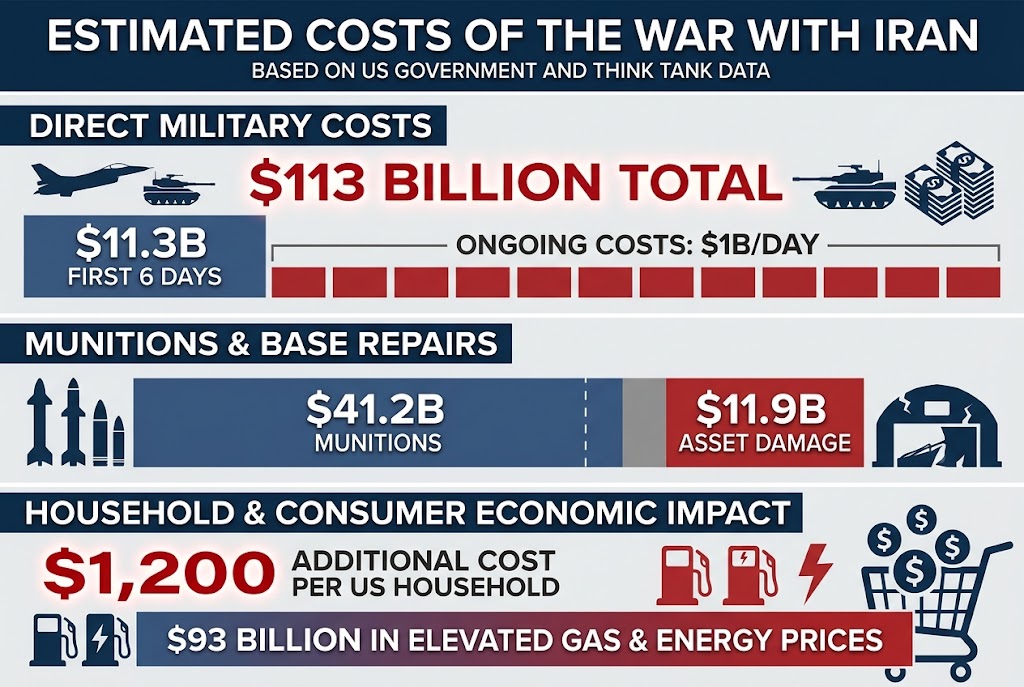
New Yorker (“How Much Is the Iran War Costing Americans?”):
With no end in sight, the costs of Trump’s war are mounting. Some of them can’t be expressed in dollars and cents. According to the Pentagon, eighteen U.S. service members have been killed and more than seven hundred and fifty wounded. The Iranian death toll is in the thousands, including more than two hundred children, according to estimates from UNICEF and the Iranian government. The war has spilled over into other countries, causing hundreds more deaths—thousands, if you include Israel’s assault on Lebanon.
In principle, it’s easier to estimate the economic costs of the war; in practice, the task is far from straightforward. Even if the calculation is restricted to the United States, you first have to count the military outlays on things such as munitions, additional troop deployments, and repairing the extensive damage that Iranian counterstrikes have done to American bases in the Middle East. Then there are the financial costs that higher energy prices have imposed on American households and businesses. Plus, there are more indirect costs, such as the penalties that Americans have paid in terms of higher inflation and rising interest rates. Only by putting all these things together is it possible to estimate the total cost. But let’s start with the bill for military expenditures, which will ultimately fall on taxpayers.
One issue with tallying them is that the Pentagon has been less than forthright about many aspects of the conflict. In July, Defense Secretary Pete Hegseth told the Senate Appropriations Committee that the conflict had cost roughly $37.5 billion, but he didn’t provide much in the way of detail. Shortly before Hegseth’s appearance, NBC News reported that internal Pentagon estimates put the true figure, including military-base reconstruction costs, at somewhere between eighty billion and a hundred billion dollars. Earlier this summer, the White House asked Congress to provide an extra $67.2 billion for the Pentagon, and House Republicans approved a spending framework that included an additional seventy-three billion dollars for defense and intelligence. The Senate is expected to take up the measure when it returns in mid-September.
So, $80-100 billion? That’s a small price to pay for ending Iran’s nuclear program, installing a US-friendly regime that’s not murdering its citizens, and gaining control of the Strait of Hormuz (aka Trump Strait)!
In air wars, the biggest single expense is often munitions, and that is true in this conflict. The Pentagon has made extensive use of precision missiles, such as Tomahawks, which cost $2.6 million each, according to the Center for Strategic and International Studies (C.S.I.S.), and advanced air-defense systems, such as Patriot-missile batteries, which cost $4.9 million. A C.S.I.S. analysis of the war’s cost, published earlier this summer, said that the Pentagon has used more than a thousand Tomahawks and as many as fourteen hundred Patriots, in addition to roughly ten thousand unguided “dumb” bombs. This dramatic rundown in munitions accounts for $26.1 billion of a total military cost of about forty billion dollars, the analysis said.
The more pressing concern here isn’t so much the cost, but the fact that we can’t quickly replace them. More on that later.
It identified the second-largest cost item as damage to U.S. bases in places such as Bahrain, Qatar, Saudi Arabia, and the United Arab Emirates, which it estimated at up to $9.2 billion. Although the Pentagon has tried to play down the effectiveness of Iran’s attacks, they appear to have destroyed, wholly or partially, hundreds of structures, including aircraft hangars, fuel depots, radar facilities, warehouses, and barracks—delivering a blow to U.S. military infrastructure without precedent in recent times. “You’d have to go back to the Second World War to see something like that,” Mark Cancian, a former Marine colonel and White House budget official who co-authored the C.S.I.S. study, told me. When the conflict ends, Cancian went on, the Pentagon will have to think seriously about whether to rebuild or abandon the damaged facilities, given their vulnerability to future attacks.
Most notably, according to multiple published reports, they incapacitated our main supply hub in Bahrain—-which is why the publicized incidents on the USS Abraham Lincoln took place.
Some online estimates, which Cancian dismissed as unreliable, put the military cost at more than a hundred billion dollars. Whatever the true figure is, it’s a considerable sum that comes on top of the bloated trillion-dollar Pentagon budget that has already been approved for 2026, and it is money that could, in theory, be used for other purposes. Take the seventy-three billion dollars in extra funding that House Republicans approved. The authors of an analysis published last week by the Center for American Progress (CAP), a liberal think tank, pointed out that this amount of money would “provide full Medicaid coverage for 5 million more people, with $33 billion left over.” That money, in turn, could be used to substantially raise SNAP benefits (formerly known as food stamps) for children from poor families and double the funding for the National Park Service and for emergency food-and-shelter assistance, the CAP authors said.
In fairness, the present Congress and administration were not going to fund these things.
In broader economic terms, the biggest burden that the war has created is sharply higher energy prices. Since late February, the cost of gasoline has risen by more than a dollar a gallon, on average, across the fifty states: that’s more than a third. And petroleum isn’t the only fuel that has become more expensive. The price of diesel, which powers the trucks that traverse the country carrying goods of all types and sizes, has risen by roughly half. According to an energy-cost tracker maintained by the Climate Solutions Lab at Brown University’s Watson School of International and Public Affairs, if you combine the rising prices of gas and diesel, the financial hit to Americans since the war began is about ninety-three billion dollars—more than seven hundred dollars per household.
To which I would retort: “For you to pay a tiny little bit more for your gasoline, just remember you’re doing it so that a very evil country cannot have” a nuclear weapon. Trump will “never apologize” because he “did the right thing… you just have to remember what we’re doing is a great service for the world.”
That isn’t the final economic tally. The price of heating oil has shot up by about seventy per cent.
Who needs heating oil? It’s going to be 93 degrees today in Northern Virginia!
The cost of fertilizers, which are largely made from methane gas, the price of which spiked after the war began, has also risen sharply, contributing to higher food prices. Given the complicated interconnections between the prices of inputs (such as energy and fertilizers) and outputs (such as food, consumer goods, and air travel), it’s hard to estimate the extent to which the war has raised the over-all price level. But the fact remains that, since February, the rate of inflation has risen from 2.4 per cent to 3.4 per cent. Market interest rates, which are influenced by inflation and inflation expectations, have also jumped up, raising the costs of mortgages, car loans, and other types of consumer credit.
A small price to pay!
Adding all these things together, Mark Zandi, the chief economist at Moody’s Analytics, put the total cost of the war for the typical American household at a thousand dollars—a figure he described as conservative. That was at the end of June. More recently, Zandi has raised his estimate to more than twelve hundred dollars. Rather than being taken as a precise number, this figure should be understood as a rough sketch that conveys the magnitude of Trump’s folly. “The war has been hugely expensive,” Allison McManus, the managing director for national security and international policy at CAP, told me. “Trump decided to launch it, and Americans are paying for it.”
But we can just put it on our credit cards!
As noted above and in previous posts, the bigger concern is that we’re depleting critical munitions. A recent Economist piece (“What happens when interceptor missiles run out“) notes:
Shortages of munitions are common in wartime, especially in big, attritional wars. Yet America is running short after a brief war against a medium-sized power. What if it had to fight mighty China? It would exhaust its interceptors within days, and be unable to use its bases in Japan and Guam, reckons a recent study by the Heritage Foundation, a think-tank in Washington.
The proximate cause of the crisis is the prodigious use of interceptors by America and its Middle Eastern allies during Mr Trump’s war against Iran this year. The Centre for Strategic and International Studies (CSIS), another think-tank, thinks the Pentagon has fired nearly two-thirds of its pre-war stock of Patriots, as well as big shares of other interceptors (see chart).
But the war merely hastened a reckoning that has been decades in the making. On both sides of the Atlantic defence industries work to a peacetime rhythm, though the drums of war have been beating faster. That error has been compounded by the global proliferation of missiles, generals’ tendency to spend more on flashy weapons than on the munitions they consume, America’s dysfunctional budget process and complacency about American military supremacy in the air.
The CSIS reckons it will take until 2029 to rebuild Patriot stocks to pre-war levels. That is assuming Congress approves Mr Trump’s gargantuan $1.5trn defence-budget request (a 50% increase on current spending), which is unlikely. Yet Patriots have become the prime system for point-defence—that is, to protect a specific target such as an air base—for 19 countries. “Patriot is a dinner-jacket solution: you don’t need it very often, but when you do, very little else will do,” explains Justin Bronk of the Royal United Services Institute (RUSI), a British think-tank.
The hitch is that ballistic missiles are generally cheaper than the interceptors trying to hit them (PAC-3 MSE rounds costs $4m-5m apiece). Iran’s Shahed drones (or other unmanned aerial vehicles, UAVs) are two orders of magnitude cheaper still. “If your adversary can field a one-way attack UAV for the price of a used car, and your answer is a surface-to-air missile that costs the same as a small apartment here in London, you’re losing the exchange even though you’re winning every single engagement,” Colonel Sabah Al Sabah, a Kuwaiti officer, argued at a recent RUSI event. What is more, defenders typically fire at least two interceptors at an incoming missile to improve the odds of success.
Ukraine has improvised a system of layered defences. It has a world-class network to counter swarms of Russian drones. It can also take out most larger cruise missiles, thanks in part to European air-defence systems. But only the precious Patriots can take on Russia’s Iskander-M and Kinzhal ballistic missiles. In March Ukraine boasted of intercepting about 70% of ballistic missiles. In July it was 20%. In August the rate will be even more dire. On one night—August 5th—there were no interceptions. The air force has stopped issuing regular updates. Russia, taking note, is increasing missile production.
With winter approaching, Ukraine has asked for at least 300 Patriot interceptors. Some countries still have them in reasonable numbers, including Germany, Greece, Poland and Spain. But they are increasingly unwilling to part with them.
Another solution is to build them faster. The manufacturers agreed this year to increase PAC-3 production from 600 a year to around 2,000 by the early 2030s. The Pentagon has since solicited ideas to go faster still. But Tom Karako of CSIS notes that it has not yet signed actual contracts for stepped-up output.
But it’ll all be worth it becasue of the regime change, unconditional surrender, and the Strait of Trump. And the aquaducts!









