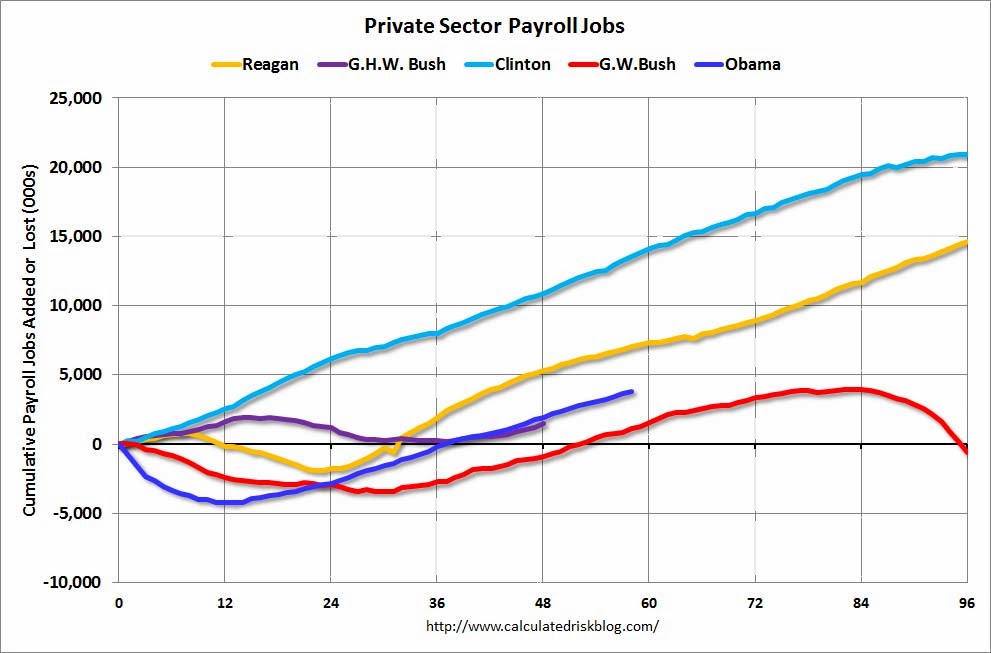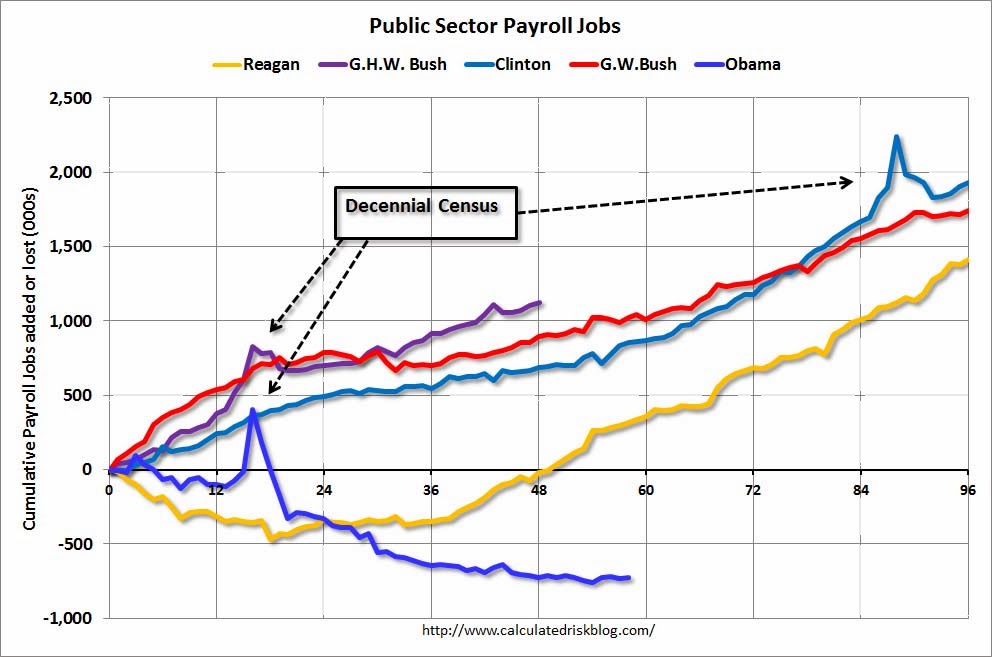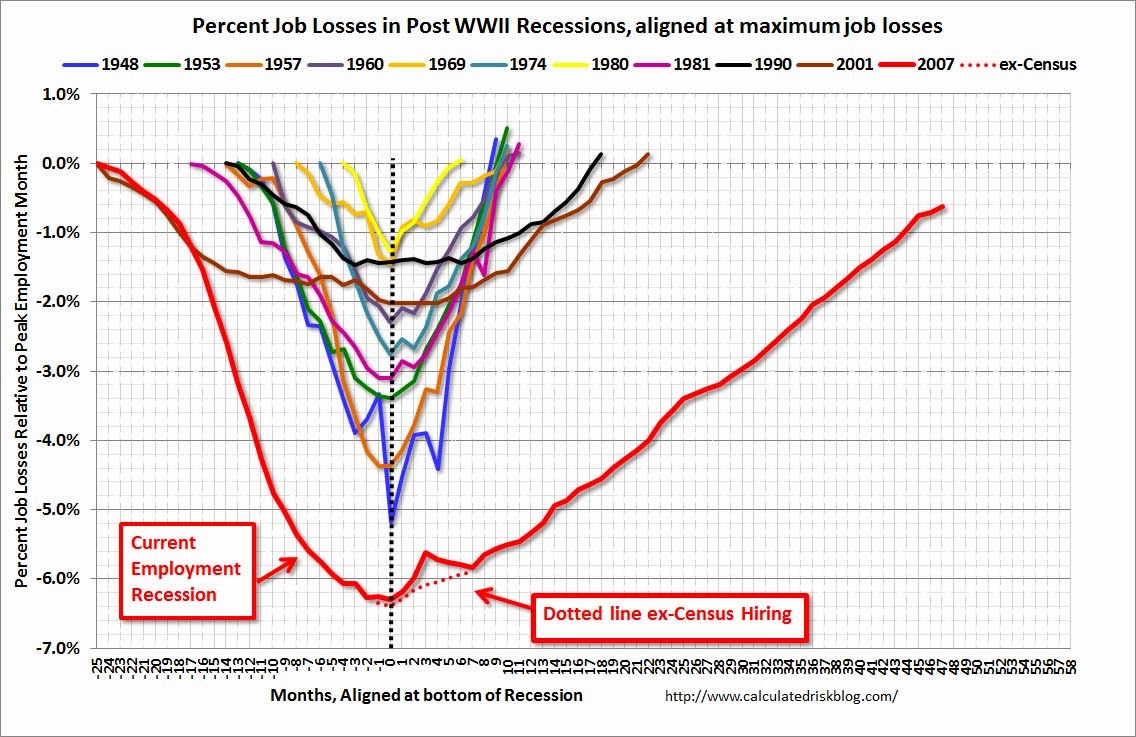

A provocative piece in The Economist tries to explain the “productivity puzzle” which is manifesting itself in different ways among the Western economies. In short form, “R.A.” argues that, “because we rely on market wages to allocate purchasing power we have resisted technology-driven reductions in employment, and because we have resisted that decline in work we have trapped ourselves in a world of self-limiting productivity growth.” It’s a long piece that is self-described as “wonkish” but makes several interesting observations and conjectures.
The setup:
The immediate motivation for the argument presented here is work done on the diverging fortunes of the British and American economies over the past six years. A recent Free exchange column explored the case. Two rich economies, relatively similar in structure, reacted very differently to the global financial shock of late 2008. In America output sank sharply but then rebounded to new highs. Employment, by contrast, fell dramatically and has recovered much more slowly; it has yet to regain the pre-crisis peak. In Britain the trends were reversed; employment is setting new highs while output suffered an L-shaped recovery.
The key difference appears to be rates of inflation. Higher inflation in Britain reduced real wages. That, in turn, allowed firms to meet a given level of demand by using more workers less intensively—at lower productivities. In America, by contrast, lower inflation meant that real wages rose over the course of the recession and recovery. Some research results suggests that firms respond to sticky real wages by wringing more output out of existing workers—raising productivity. Firms meet a given level of demand using fewer workers more intensively, resulting in a jobless recovery.
One possible takeaway from this divergence is that productivity is often endogenous to the real wage. Confronted with high real wages, firms reorganise production, invest in training and capital, and take other steps to boost productivity and economise on labour. When real wages are falling, by contrast, the incentive to economise is reduced and productivity lags.
That stands to reason, right? If labor is cheap, there’s little incentive to try to replace it with technology, since doing so requires an initial outlay. But, piecing together several seemingly unrelated bits of research, R.A. sees this simple observation as the reason for the concentration of wealth at the top and the concomitant demise of the middle class.
Since the early 1980s, labour markets have polarised or “hollowed out”.
Work published in 2006 by David Autor, Lawrence Katz, and Melissa Kearney argued that employment and wage growth in America have “polarised” in recent decades, a conclusion that has been reinforced by subsequent research. Employment in high- and low-skill positions has risen substantially relative to middle-skill jobs. The resulting employment distribution generates a distribution of wages that is similarly polarised and more unequal than that which prevailed prior to this period.
Polarisation is mostly attributable to elimination of “routine” tasks by trade and technology.
Daron Acemoglu and Mr Autor pioneered a “task approach” to labour markets. Tasks can be completed by either labour or capital. The more routine a task is, the more susceptible it is to automation. But whether or not a task is automated depends upon the relative supply—and the real wage—of workers of various skill levels. Subsequent work has shown that automation and trade are responsible for displacement of routine tasks previously done by middle-skill workers, in both manufacturing and clerical or service activities, leading to polarisation of local and national labour markets.
Since the early 1980s, polarisation has occurred almost entirely during recessions.
Examining patterns of polarisation in America, Nir Jaimovich and Henry Siu find that displacement of routine work is not a gradual process but occurs almost entirely during recessions. Since the mid-1980s, roughly 92% of job loss in middle-skill, routine jobs has taken place during or within a year of recessions (as dated by the National Bureau of Economic Research). This pattern is linked to the phenomenon of “jobless recoveries”, which followed the recessions of 1990-1, 2001, and 2007-9 but not earlier downturns.
The jobless recoveries of the past generation have been characterised by a change in the cyclical behaviour of productivity.
Prior to the mid-1980s both output and productivity growth tended to fall relative to trend in recessions and rise relative to trend in expansions. Beginning with the recovery from the 1981-2 recession, however, the behaviour of productivity flipped. It has since risen relative to trend in recessions and fallen relative to trend in expansions.
Productivity-rich recessions, and jobless recoveries, are a product of sticky wages.
Mark Bils, Yongsung Chang, and Sun-Bin Kim find that sticky wages push firms to wring more output from existing employees when confronted by a decline in demand. Productivity therefore rises during recessions—rising most in industries where wage rigidity is most binding—reducing the incentive to take on new workers despite relative wage flexibility among the unemployed.
Taken together, these observations imply that in the presence of moderate inflation, real wages will be more flexible and productivity will flip back to falling, rather than rising, amid weak demand. That brings us back to the motivating example of the Britain versus America comparison, where that implication seems to have verified.
Presumably, the process has been more pronounced in the United States than in Europe because of different public policy choices. Most notably, our tax system incentivizes capital investment, making replacing workers with technology less expensive, and also concentrates wealth since we tax it at much lower rates.
Regardless, R.A. conjectures that,
As technology improves, an ever larger share of the universe of tasks becomes potentially automatable, in that the cost of using capital to complete a task falls below typical labour costs to complete the task.
Rising incomes, in this story, are a result of substitution of capital for labour: of raising the ratio of capital to labour across the economy and in doing so boosting the level of output per worker. In the early stages of technological advance, technological progress need not reduce overall labour demand, and might well raise it, since the share of all tasks that can be completed by capital is low. Some substitution of capital for labour raises incomes. That raises consumer demand, which in turn leads producers to draw on a broader range of tasks. Because there are so many more non-automatable tasks than automatable ones, technological advance raises labour demand.
Note that this story assumes that there is a finite number of different tasks, all of which are theoretically automatable. At sufficiently high levels of technological progress, in other words, there is nothing a human can do that a machine can’t.
Human labour is necessary in order to do required tasks that aren’t yet automatable. At a very low level of technological progress that’s basically everything. At a very high level of technological progress that’s basically nothing. But the process of substitution is uneven. Easy-to-automate tasks tend to involve mildly challenging but routine work done by middle-skill labour. Automation begins from the middle and works outward, because difficult-to-automate tasks fall into two categories: those that must be done by highly skilled workers (like inventing iPhones) and those that are manually challenging (like navigating and cleaning a cluttered office).
So, imagine that the labour force exists along a skill continuum. As technology improves, opportunities to substitute capital for labour grow. Periodically there is reorganisation and some workers are displaced. Workers above some skill threshold are reallocated to a new high-skill task. Workers below that skill threshold are reallocated into competition for low-skill jobs. Technological advance will tend to raise that threshold while educational attainment will tend to lower it (so that a larger share of the labour force, when displaced, is reallocated into relatively high-skill work rather than into competition for low-skill jobs).
But: the real wage varies with labour supply at various skill levels. When many workers are shunted into competition for low-skill jobs, the real wage at which low-skill work is done falls. That, in turn, makes further automation of low-skill work less attractive. Technological advance can become self-limiting. Substitution of capital for labour raises productivity growth but displaces workers and places downward pressure on wages. That, in turn, tends to slow productivity growth by reducing the incentive for further substitution of capital for labour. Note that rapid increases in educational attainment could help attenuate this effect, by slowing the growth in the glut of workers competing for low-skill work. But rapid increases in educational attainment are no longer nearly as cheap or easy to come by as was the case in the 19th and early 20th centuries.
Worse, monetary policy can’t fix any of this. In fact, the Fed faces a sticky dilemma.
If we assume that purchasing power is allocated via market wages, then the task facing central banks immediately becomes impossible. If they try to maintain low and stable inflation, then competition for low-skill work will place downward pressure on the wages of low-skill workers, but wages will be too rigid to provide employment for all willing workers. The result is a stagnant real wage for all but those at the high end of the income spectrum and a growing number of frustrated workers pushed out of the labour force due to lack of work. Productivity growth will follow a middle path. It will be lower than it could be, because society will still be trying to employ everyone by reducing the real wage of less skilled workers until they are competitive at tasks machines could reasonably do. Indeed, efforts to employ everyone by reducing their real wage will retard cost declines in industries, like health care or education, that should be subject to rapid displacement of workers by capital, thereby leaving real wages for workers not immediately at risk of displacement lower than they could be. But productivity will be higher than it would be in a high inflation scenario.
But in general, the benefits of growth will flow to high-income workers and owners of capital. Since they have low propensities to spend, central banks will find it difficult to generate adequate demand, except by nurturing unsustainable borrowing by workers with stagnant incomes. Central banks cannot have adequate demand and low inflation.
On the other hand, if central banks are willing and able to raise inflation rates, then real wages will be more flexible, and firms will be more willing to use labour to do tasks that could reasonably, or even easily, be automated. In this scenario the central bank succeeds in generating adequate demand; because low real wages encourage less substitution of capital for labour, a higher share of income flows to labour, to workers with a high propensity to spend. But adequate demand is incompatible with a low rate of inflation. It may also be unsustainable, since many central banks will interpret the high inflation necessary to boost employment as evidence the economy is running at capacity.
But of course, the economy isn’t running at capacity; it’s running farther below capacity than in the inadequate demand case, because firms are using capital much less intensively than they could. (One question central banks may face is how to generate higher inflation given excess capacity; the British case points to one tried and true method: depreciation.) Nonetheless, the concept of full employment becomes divorced from the concept of maximum sustainable output growth. The central bank is forced to choose between two undesirable outcomes.
If this is right—and it certainly seems plausible—then we’re left with a choice between an economy that’s operating at maximum productivity and one that employs a maximum number of people. If so, then the solution is an unsettling one that has come up from time to time in the comments section here, offered by Michael Reynolds and others: an economy where the most talented work and subsidize an increasingly large pool of less talented people who don’t.
What might a potential solution look like? Fiscal expansion could help, but the gain from fiscal policy is likely to be limited unless it is structured to try and reduce labour supply. That’s right, reduce labour supply.
The most attractive options to accomplish this are probably those which seek tovoluntarily reduce the number of hours of “full-time” work. John Maynard Keynes was right; a 15-hour work week should be sufficient to provide a worker with a “full-time” income. But this will require subsidies from the state; in the form of wage top-ups, perhaps, or a universal basic income.
Why are subsidies necessary now when they weren’t a century ago, when rising productivity was allowing workers to work less but still earn a good living via a market wage? You could say that technological progress was labour-augmenting then and has since become labour-substituting, but that’s not quite right. Technological progress is always capital-augmenting, but when it augments capital in tasks that are complementary to those done by labour, it looks labour-augmenting. As the share of tasks completed by labour falls, any given technological change is more likely to appear to be labour-substituting, since the share of workers that could potentially benefit from the change as a result of working on complementary tasks keeps dropping.
The transition would, naturally, be difficult:
Redistribution at the scale described above would be very difficult to engineer. Society would face two main challenges (among a pile of others). First, if the tax code were going to raise enough money to support non-workers from a dwindling pool of people earning high market incomes, then the tax code would need to become much more efficient. Otherwise, taxpayers would face intense pressure to reduce their tax burden in any way possible and would generally succeed: enough, anyway, to break the system. The second challenge is related; however efficient the tax code, the social conflict arising from an effort to reorganise society in this fashion would probably be intense and unpleasant.
This would be a bizarre world from the perspective of most of us. But, R.A. rightly notes, maybe not in the grand scheme of things:
The upside to managing the transition would be enormous, however. What we are talking about here is a world which is much, much richer. Everyone should be able to enjoy much higher incomes while doing much less work. The endpoint would not be a socialist paradise, necessarily. But it might seem a bit like one, in the way that a 19th century worker putting in 70 hours per week in an attempt to earn enough to keep his family from starving might view a world in which people are able to live in extraordinary comfort (by comparison) working just 40 hours per week as something like heaven.
Getting from 19th century misery to 20th century prosperity took a lot of social and governmental reform and investment. It is unreasonable to think that similarly grand shifts would not be necessary now. It is also unreasonable to expect that this transition should require qualitatively similar reforms to those which did the trick in the 20th century.
This all assumes that recent trends aren’t some bizarre anomaly and the we are indeed seeing a “new normal.” But this strikes me as a reasonable bet. The nature of information and communications technologies, especially, are such that the economy in now truly global and the opportunities for the best of the best to become fantastically rich have been realized. But we’re also seeing the down side: there’s much less call for local mediocrities.
Much of this was obvious to even non-specialists like myself two decades ago. But the scale and pace of change has been beyond my expectations. Most notably, the degree to which the new economy is impacting even the very highly educated was something I did not anticipate. It’s conceivable, for example, that online delivery of courses will displace the vast majority of university professors over time. While recorded lectures and computer-graded tests will never be able to replicate the classroom experience, it’s not obvious that many outside the academic profession much care. And even universities themselves have long since undermined their own argument by replacing full-time faculty with a vested interest in the students and their institutions with minimum wage adjuncts. Not to mention offering half-assed online courses. Similarly, physicians and attorneys could either be replaced entirely by automated systems or be reduced to much-lower-paid technicians.
Utopian novelists in the latter part of the nineteenth century envisioned a world where most work was essentially a hobby, with people doing it for the purpose of self-actualization and stimulation rather than as a necessity for meeting life’s needs. I don’t know that we’ll get there. But we certainly seem to be making workers obsolete at a rapid clip.