
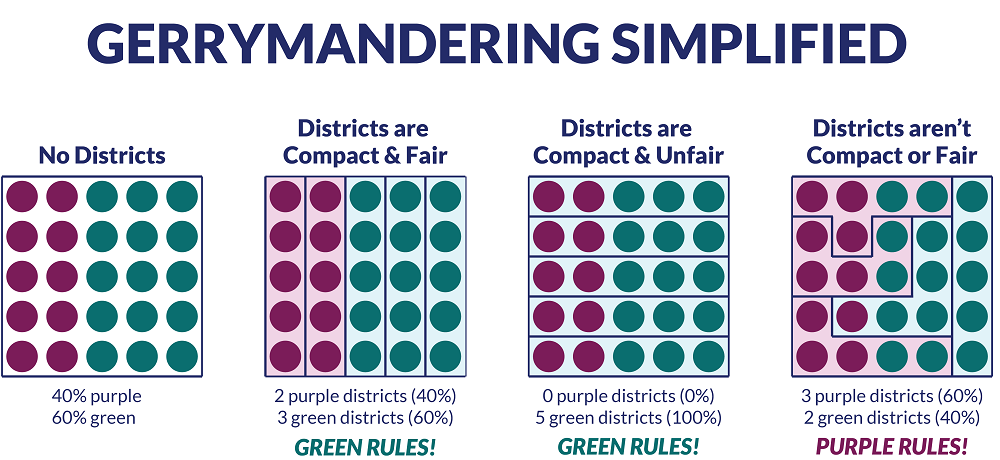

Years ending in 2 are always fraught for US Representatives, as the decennial Census reapportions the 435 seats among the states and sets off a cycle of redistricting. But the pandemic-induced delays in the 2020 collection have made 2022 even more interesting.
POLITICO (“Redistricting disarray nudges House Democrats toward statewide bids“):
Many of the House’s most vulnerable Democrats won’t know for several months if their seats will be winnable next year. And for some, a once-daunting statewide run just got a lot more appealing.
So far, a half-dozen Democrats who could face some of the toughest redistricting prospects have floated bids for Senate or governor — all in states where Republicans have the ability to doom their House careers with new maps next year.
This year’s once-a-decade redraw of congressional maps is made far more complicated by coronavirus-related delays in the process. And that uncertainty — on top of a 2022 election that could plunge Democrats back into the minority — is leading some lawmakers to seriously consider political options beyond the House.
“Everyone in this place is always thinking about what they’re going to do in the future. But certainly, I know that’s affecting the thinking of a lot of people,” said Rep. Scott Peters (D-Calif.), who is close to many swing-district Democrats in the House.
“The most frustrating thing is everything is so delayed. It’s really hard for people to know how to plan.”
For some members — such as Reps. Conor Lamb of Pennsylvania and Tim Ryan of Ohio — an already-challenging district has a real chance to suddenly become a lot redder. For others, like Reps. Stephanie Murphy of Florida or Ron Kind of Wisconsin, the outcome is less certain though still potentially perilous.
The House is, of course, a natural launchpad for higher office. But lawmakers seem to be taking a closer look at statewide bids given the uncertainty of the cycle — including some, like Ryan in Ohio, who have resisted entreaties to run in the past.
Democratic lawmakers’ ambitions this cycle could clash with their party’s hopes of maintaining their meager, five-seat majority in the House. And the departure of any swing-district Democrats would deprive Speaker Nancy Pelosi and her leadership team of a crop of battle-tested incumbents, who might be the only ones that can hang on to their districts should they become tougher to win in redistricting.
But their runs could also boost Democrats’ chances at flipping GOP-held Senate seats and Republican-controlled governorships, although they could face competitive primaries as well as challenging general elections.
A lot of this is anecdotal but folks are having to make these calculations in the blind. As the National Conference of State Legislatures explains,
The Census Bureau ended the self-response and field data collection operations for the 2020 census on Oct. 15, 2020. The statutory deadline for the delivery of apportionment data was missed because of the delays cause by the pandemic and the anomalies found in the census data. On Jan. 27, 2021, the Census Bureau announced the apportionment data is expected to be delivered by April 30. On Feb.12, the Bureau announced the timeline for releasing the more user friendly redistricting data (with tables) to the states by September 30.
So, while we have pretty good guesses as to which states will gain and lose seats next cycle, Congress won’t get the official numbers until April 30, a month from now. And state legislatures won’t have the granular information necessary to draw districts (to, among other things, ensure that all of their districts are roughly equal in population) until September 30. With primaries kicking off as early as May and many states having filing deadlines in March, that’s not much of a window. (Indeed, for reasons unknown to me, Illionois filing deadlines are this November 29!)
In the olden days, state legislators would protect the seats of longtime incumbents when drawing district lines. But that sensibility is long gone, with partisan advantage the sole driving force aside from legal requirements (equality of size, compactness, contiguity, etc.) imposed by the Supreme Court and federal election laws. So, Democratic incumbents in states with Republican legislatures drawing the district lines are rightly concerned.
And, since statewide races like governor and US Senator can’t be gerrymandered, it’s an obvious consideration for a popular Representative who might have a hard time winning in a district drawn to concentrate Republican strength.









