WaPo (“Kamala Harris has a 2028 opening — and a 2024 problem“):
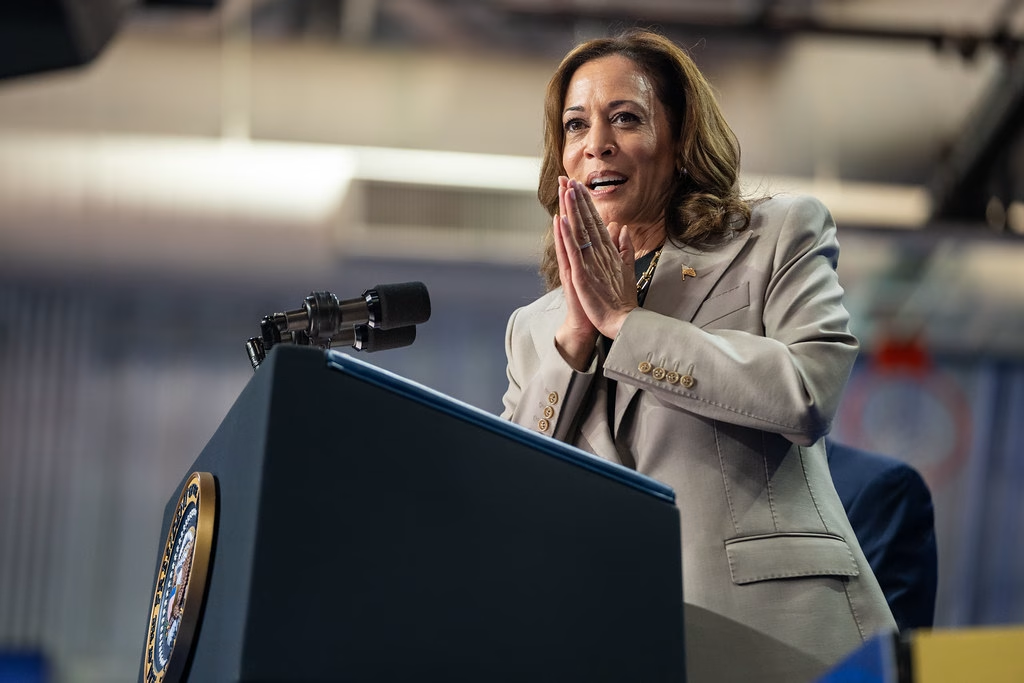
If Kamala Harris runs for president again, she would begin with advantages no rival could match: near-universal name recognition, experience in the White House and the hard-earned lessons of already having carried the party’s banner.
And, well, dropped it.
For many Democrats, that still may not be enough.
Ya think?
With roughly a dozen Democrats maneuvering toward possible 2028 bids, Harris retains considerable affection and respect inside the party. But interviews with 18 strategists, donors, former Harris surrogates and other Democrats — including some who backed her in 2024 — revealed persistent uncertainty about whether her moment was cut short or her time has passed, and whether she can lead Democrats back to power.
Some see a former vice president with an unmatched résumé in the still-forming field — a candidate who, her supporters argue, deserves a fairer shot than the 107 frantic days she had to take over and try to rescue Joe Biden’s faltering campaign.
Others see a defeated nominee inextricably tied to the party’s recent past confronting Democrats hungry for new leaders, sharper ideas and a more decisive break from the political order that preceded Donald Trump’s return to power.
She spent four years as a Senate backbencher and four years as Joe Biden’s spare tire. Which was quite the reward for being the among the first candidates out in the 2020 Democratic primaries. She was then handed the 2024 nomination because it was too late to have primaries, going on to lose to a man ranting about Haitians eating our pets.
Beneath the respect for the former Democratic standard bearer is a striking anxiety about the potential consequences of her return to the political conversation. Her stature could instantly reorder the field, discouraging some candidates from running and forcing others to define themselves around her. For some in the party, the concern is not simply that Harris could lose again. It is that her candidacy could pull Democrats back toward a painful political era before they have fully reckoned with what happened and how to move beyond it.
“She’s extraordinarily popular in the party and people are very fond of her and want her to be treated with a lot of respect and deference — given all the due of someone in her position,” said Jamal Simmons, a Democratic strategist who was Harris’s communications director for a year starting in January 2022. “Many people see it as a service what she did in 2024, where she really stepped up for the party, stepped up for Joe Biden, stepped up for the country. There’s a lot of respect for her. But it’s yet to be seen how much of that becomes support for another presidential run.”
Look, accepting a nomination she would almost certainly not have won in an open primary—did I mention she didn’t even make it to Iowa in 2020?—handed to her on a silver platter was hardly a heroic sacrifice. Nobody owes her anything.
Former transportation secretary Pete Buttigieg, Maryland Gov. Wes Moore and California Gov. Gavin Newsom have already begun making appearances in South Carolina, which will host the Democrats’ first presidential primary in 2028 — a change designed in part to give Black voters and the party’s broader coalition a larger voice in choosing the nominee.
Newsom, who has made a pair of recent visits there, said last month he would not run if Harris enters the race, wary of forcing their overlapping political bases to choose between them.
Newsom has spent the last 24 years in senior elected executive posts, with eight years each as mayor of San Francisco, lieutenant governor, and governor of California. Why he would defer to Harris, let alone indefinitely, is beyond me.
Through a spokesperson, Harris declined multiple requests to comment on this story. She revisited the frustrations of her abbreviated campaign in full last year with a memoir, “107 Days,” that included the difficulty of distinguishing herself from Biden while serving as his vice president.
She has left open the possibility of another presidential run. This spring she said she was “thinking about it.” She has expanded her public appearances as the midterms have approached, campaigning in key battleground states — in Michigan for U.S. Senate candidate Abdul El-Sayed and, soon, in Georgia for incumbent Sen. Jon Ossoff.
Because of her name recognition and connections, she has longer to make a decision than most. Still, the 2028 race begins in earnest on November 4.
I haven’t seen much speculation on Ossoff, who’s just 39 years old. But a second win in Georgia would have to make him a possibility.
For those eager for Harris to run again, her experience is an argument for another chance.
Harris has been a senator, presidential candidate, vice president and presidential nominee — a résumé that would ordinarily be an enormous asset and, many Democrats say, make her an instant front-runner should she enter the race.
As a general rule, a failed presidential nominee is toast. Al Gore and Hillary Clinton both won the popular vote and didn’t get a second bite at the apple. The last Democrat loser to get renominated was Adlai Stevenson in 1956. That was before the primary era. And he lost the second time as well. Republicans have ben slighly more generous, giving Richard Nixon a second go in 1968, after having sat out 1964. It worked out well for them. And, of course, Donald Trump got a third straight nomination after losing to Biden in 2020.
Harris and her allies have long viewed the 2024 loss through the constraints of the campaign she inherited: an unpopular incumbent, deep voter frustration over inflation and the economy, and barely three months to persuade voters that she represented change while still serving as Biden’s vice president.
And that’s fair. Aside from some occasional “word salad” when she had to go off script, she was actually a rather strong campaigner. Her choice of Tim Wald as her running mate, which looked really shrewd at first, turned out to be a dud.
Maria Cardona, a longtime Democratic strategist and friend of Harris, said the former vice president faces less time pressure than other potential candidates. Given her 2024 experience, Harris would be able to scale up campaign operations faster than other potential contenders who have never appeared on a national ballot, Cardona said.
Another go-round would look different than the 2024 campaign that she assembled in a pinch after Biden dropped out, Cardona said: “If she decides to run, she will run as an unapologetic, unabridged version of Kamala Harris. And I don’t think any of us know what that looks like.”
We got a glimpse in 2020. But four years in the White House, even as second banana, have surely given her a different perspective. She never really had to think of national or international interests in her previous roles.
Ashley Etienne, who was Harris’s first communications director as vice president, acknowledged that Harris would need to create some distance from a Democratic establishment facing an increasingly anti-status quo sentiment. But she argued that Harris’s critics discount something none of her potential rivals has yet demonstrated: that she can withstand the personal scrutiny, political pressure and sheer intensity of a national presidential campaign.
“It’s almost like, why not her? She has proven, unlike anyone else in the race, that she’s got these advantages that will matter in a national election,” Etienne said.
Except that, well, she lost literally every swing state when she last had the chance.
Some Democrats warned that moving too quickly past Harris would carry its own political cost, particularly among Black women, one of the party’s most loyal constituencies.
L. Louise Lucas (D-Portsmouth), the first woman and first Black person to be president pro tempore of the Virginia state Senate, said she would back whoever becomes the Democratic nominee. But she said Black women she knows could see Democrats’ rejection of Harris as another painful rebuff of a Black woman who had earned her chance to lead.
“There’s no question that people would be upset because you see what happened last time,” Lucas said. “It could very well be that some folks would be so disillusioned that they would just say, ‘I give up on this process’ — especially people who’ve been fighting as many years as I have, who have come through the civil rights movement and just experienced so much, endured so much, and then to see this happen again would be quite painful.”
I mean, she got her chance. The voters rejected her.
The 2024 campaign gave Harris unequaled name recognition, said Clay Middleton, a former senior adviser to the Biden-Harris campaign in South Carolina and a longtime Democratic operative in the state.
“She is instantly the front-runner because she was our nominee the last time, she has an infrastructure that was in place that she can turn on quickly,” Middleton said. “But can you stay up through the course of the entire cycle?”
She is indeed the current frontrunner. She and J.D. Vance lead pretty much every poll I’ve seen by significant margins. Vice President comes with more name recognition than Senator or governor. But then there’s a campaign.
Those advantages may help less as the party searches for new language, new fights and new political identities. To some Democrats, Harris looks less like the beginning of the next Democratic era than a vestige of the last one.
Harris turns 62 later this month and would be 64 on Election Day 2028. That’s young compared to Trump and Biden, but not exactly a spring chicken, either. Newsom is about to turn 59, but he’s a comparatively fresh face on the national stage. At 44, Buttigieg would indeed mark a generational change; I remain skeptical that a gay man whose biggest job to date has been Transportation Secretary will get the nomination. Alexandria Ocasio-Cortez, who’s about to turn 37,* is the poster child for Woke 2.0. She would certainly represent a break from the Clinton-Obama-Biden era.
A Democratic autopsy of the 2024 race argued that the White House, under Biden, did not do enough to set Harris up for political success, a frequent, if whispered gripe among people in Harris’s camp. But the report, which party leadership has said did not meet its standards, also faulted the campaign for assuming that negative views of Trump were baked in and for not doing enough to win the economic argument.
The notion that Harris could have persuaded voters that their personal sense of a bad economy was mistaken is just absurd. Similarly, I don’t know what more she could have done to hammer home Trump’s negatives. They were, in fact, “baked in.” People knew who he was and either didn’t care or were already not going to vote for him.
We shall see. Harris already decided not to run for governor. Realistically, 2028 is her last shot if she wants to be President. It’s not obvious who can beat her for the nomination, especially if Newsom refuses to oppose her. Maybe she’ll have better luck challenging someone other than Trump.
*Oddly, all the polling frontrunners have October birthdays.