
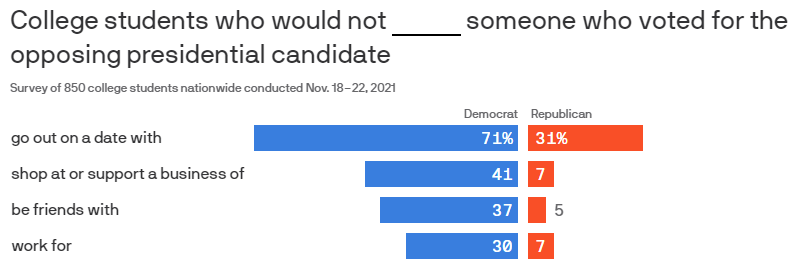
An odd survey is being reported by Axios under the headline “Young Dems more likely to despise the other party.”

Nearly a quarter of college students wouldn’t be friends with someone who voted for the other presidential candidate — with Democrats far more likely to dismiss people than Republicans — according to new Generation Lab/Axios polling.
Why it matters: Partisan divides — as each side inhabits parallel political, cultural and media universes —make a future of discord and distrust in the U.S. all the more likely.
By the numbers: 5% of Republicans said they wouldn’t be friends with someone from the opposite party, compared to 37% of Democrats.
*71% of Democrats wouldn’t go on a date with someone with opposing views, versus 31% of Republicans.
*30% of Democrats — and 7% of Republicans — wouldn’t work for someone who voted differently from them.
This . . . seems odd. While I get why Democrats see Trumpers as more evil than Republicans see Biden supporters, the size of the disparity is surprising. After all, the nature of polarization is that it goes both ways.
This provides some partial explanation:
Democrats argue that modern GOP positions, spearheaded by former President Trump — are far outside of the mainstream and polite conversation.
Some have expressed unyielding positions on matters of identity — including abortion, LGBTQ rights and immigration — where they argue human rights, and not just policy differences, are at stake.
But, again, I would expect those who strongly believed that gays and lesbians are gross or that transgenderism is an abomination would not want to hang out with those who strongly disagreed. But it may simply be a function of the out-group having fewer options.
Women are more likely than men to take a strong partisan stance in their personal choices.
*41% of women would go on a date with someone who voted for the opposing candidate, compared to 67% of men.
*76% of women would work for someone who voted for the other candidate, vs. 86% of men.
*Just 68% of women — compared to 84% of men — would shop at or support the business of someone of the other party.
I get the dating piece. Men are simply less choosy at that age. I’m not sure the work for/shop at data are that meaningful
From the data, I can’t tell how many college students they polled and what the percentage breakdown was along party ID. The footer of the report says it was “a representative sample of 850 students nationwide from 2-year and 4-year schools.”









