

CNN reports: Speaker Johnson faces narrowest House majority in nearly 100 years.
Speaker Mike Johnson will face a major challenge in the new Congress – the narrowest House majority in nearly 100 years.
[…]
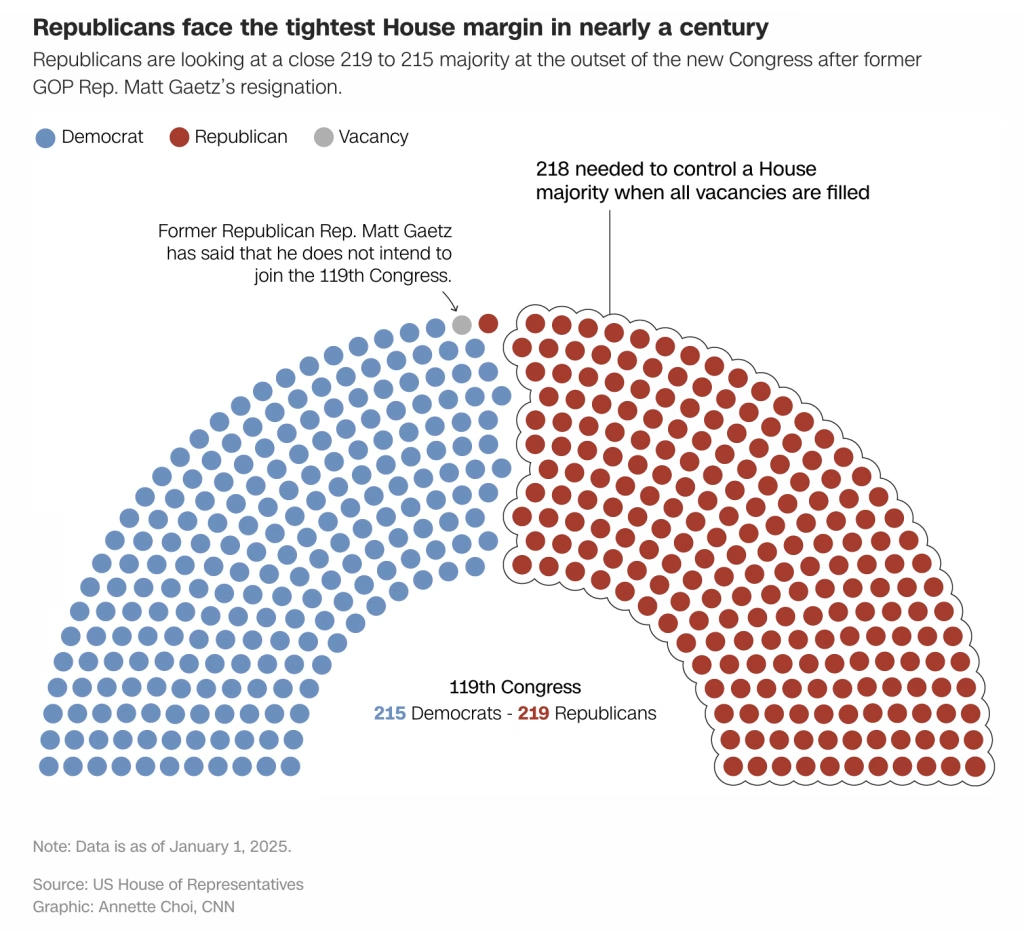
Republicans won 220 House seats in the November elections, while Democrats won 215, the most narrowly divided House majority since the outset of the Great Depression, almost a century ago.
And the margin is set to quickly shrink even further.
When the House convenes, the partisan breakdown is expected to be 219 to 215 since former GOP Rep. Matt Gaetz of Florida has said he’s not returning to Congress.
From there, the majority is on track to drop to 217 to 215 with two GOP lawmakers expected to join the Trump administration.
Here’s a graphical breakdown:
BTW: Trump’s appointment of two House members under these circumstances underscores that he is not an especially strategic thinker.
There are a number of additional graphics of interest in the CNN piece, so I recommend a click-through.
I write this on opening day of the 119th Congress, which includes the need for the House to elect a new Speaker. For most of American history, this would not be an especially dramatic event. And yet, there is a non-zero chance that there will be some chaos today.
One member, Thomas Massie (R-KY) has said he won’t vote for Johnson (see The Hill, Massie says he won’t vote for Johnson: ‘You can pull all my fingernails out’).
I expect that there are a number of House members currently lobbying for various concessions out of Johnson since every single member currently has maximum leverage. On an individual level such negotiations are smart politics, but they also show the weakness of US parties as the tail often wags the dog and therefore not good party-level politics (see, e.g., Machin, Joe). And while I expect Johnson to be elected (as I see no alternative), the fact that there is some drama here is a sign of Republican disunity and the ongoing tensions within the party. Governing is going to be a challenge. All of this, of course, further highlights that there are significant portions of the party that simply don’t want to actually govern.
I would note two really important observations about the nature of the House majority.
First, I think that we continue to see that if we had a more proportional, and hence more representative (in terms of reflecting the political factions of the country) electoral system, the Republicans would break into at least two parties. The ongoing internal tensions over leadership, of all things, demonstrate real divisions within the GOP.
Second, if Trump, and the broader GOP by extension, really had anything approximating an electoral “mandate” (a dubious analytical category) then we would expect that the House, in particular, would not be this closely divided in terms of the party split (i,.e., if the GOP really had an electoral mandate, their majority would be far larger). Moreover, a mandate suggests clarity in terms of political purpose, and yet the House GOP clearly lacks a unified approach to governing. If the House Republicans themselves don’t agree on the basics, it is rather difficult to assert that there’s some broadly understood mandate that the people have given the Republicans to pursue.









