


I have been arguing here at OTB for quite some time that the key variable for understanding electoral outcomes in the United States is partisan identity, not messaging or the ideological viewpoint of candidates. While yes, candidate quality is a legitimate variable, it is not as important as most contemporary discussions of politics would indicate. This has become an issue of discussion of late because of the Welcome PAC analysis that I discussed last week.
Lee Drutman, a political scientist and democracy reform advocate, has done the math, and it rather dramatically backs up what I have been arguing. I would highly recommend his post, The moderation debate fiddles with 2% while democracy’s dimensionality collapses.
In a recent post, Stanford political scientist Adam Bonica argued that once you control for money and incumbency, the moderation advantage vanishes. But his broader point resonates with me: “the moderation advantage that once existed has faded… because the electoral landscape has changed.” That’s exactly right.
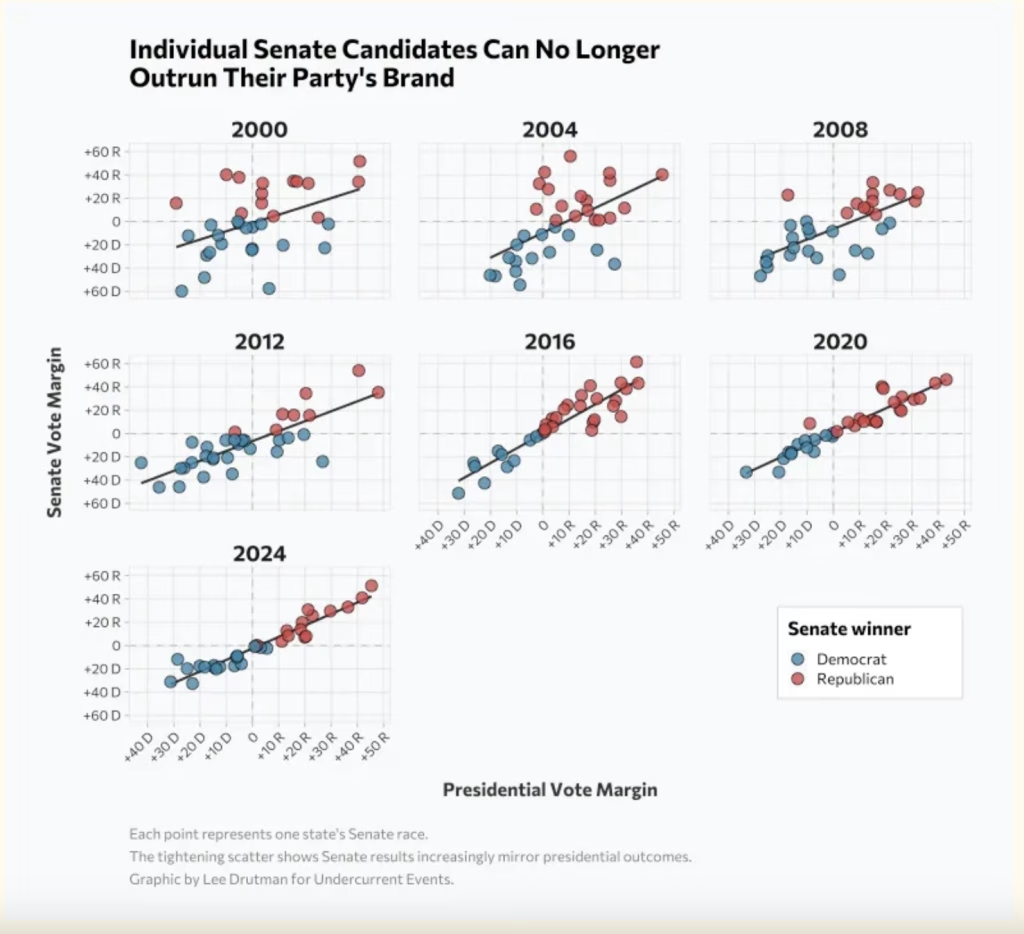
By my analysis (below), presidential vote share now explains 98% of House outcomes. In the Senate, it’s 91%. In 2000, roughly half of Senate races were competitive enough that candidate quality could flip them. By 2024, only 12% were.
[…]
Candidate quality, local factors, ideological nuance, local organizing forces—all those dimensions that used to create competition and accountability have been crushed down to near-irrelevance. In an age of hyper-partisan, hyper-nationalized voting and calcified politics, the big problem is that nothing matters.
This all intersects with my ongoing concerns about the competitiveness and responsiveness (or, in fact, lack thereof) within our politics.
He provides some stunning graphs.
For example:
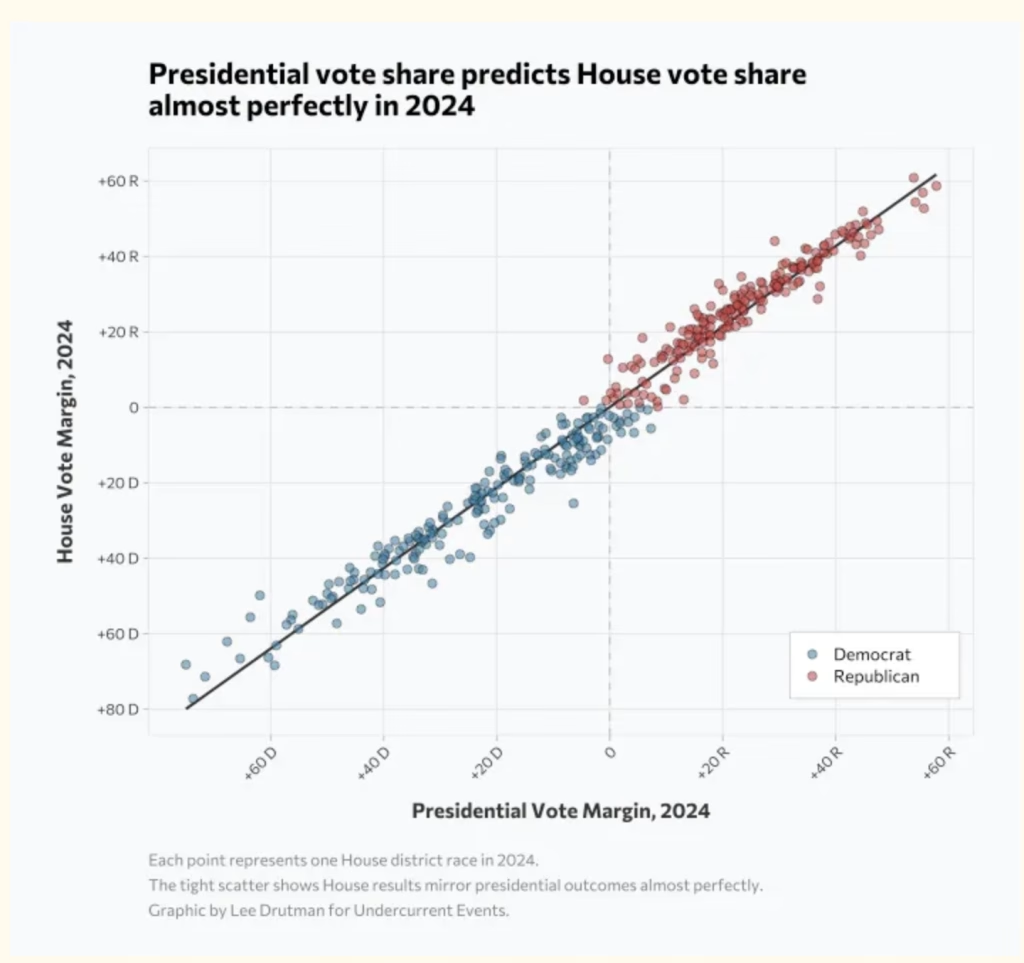
He explains:
The big story: Presidential vote share determines House vote share with near-perfect precision. Or, more specifically, if you knew how the district voted in the presidential election, you could tell me with 98 percent accuracy how the district voted for the House. Yes, candidate quality matters, on the margins. But those margins are very very very very very tiny in today’s politics.
All those dots? They represent candidates of many different types of quality. And yet, they all hug the same line. Put another way: In today’s electoral environment, almost nothing individual candidates do matters. Only super-candidates can distinguish themselves from their party’s presidential candidate. And only barely.
Check out the evolution of Senate elections over time.
What does this mean?
Today, few voters consider the distinct qualities of the candidate. They are looking at the D or the R next to the candidate. Even the best candidates struggle against the crushing weight of partisan gravity.
[…]
In 2000, an R-squared of 0.20 meant that presidential vote share explained about 20 percent of the variance in Senate vote share across states. The remaining 80 percent of variance was attributable to candidate-specific effects and state-level factors.
Fast forward to 2024: the R-squared reached 0.90, meaning presidential vote share now explained 90 percent of the variance in Senate vote share. Less than 10 percent of the variance remained for the candidate effect or state-specific factors. Fewer states remained legitimately competitive.
Two big inter-related trends explain the collapse: partisan polarization and nationalization of politics. Party sorting means most voters now live in one coalition or the other. Fewer and fewer consider voting for the other side. Just Democratic voters and Republican voters.
This is all pretty damn compelling and illustrates why messaging and moderation strategies don’t impress me much.
I would note that this is also why I argue that the way our parties are run leads to substantial problems for our politics. Since a given president can come in and reshape what it means to be an R or a D without changing who is an R or a D in any mass way, it means we can get situations like Trump. And Drutman talks at length in this post about the authoritarian consequences of what he is observing.
All of this, too, speaks to the general deficiencies of our institutions.
Lee and I agree that the core problem is the party system, and we agree that the long-term solution is proportional representation. Lee makes an argument in the piece on fusion voting, which I do not oppose but am skeptical of in terms of party system evolution/any kind of solution to our current predicament. I will leave that for some future discussion.
I do recommend the entire piece.








