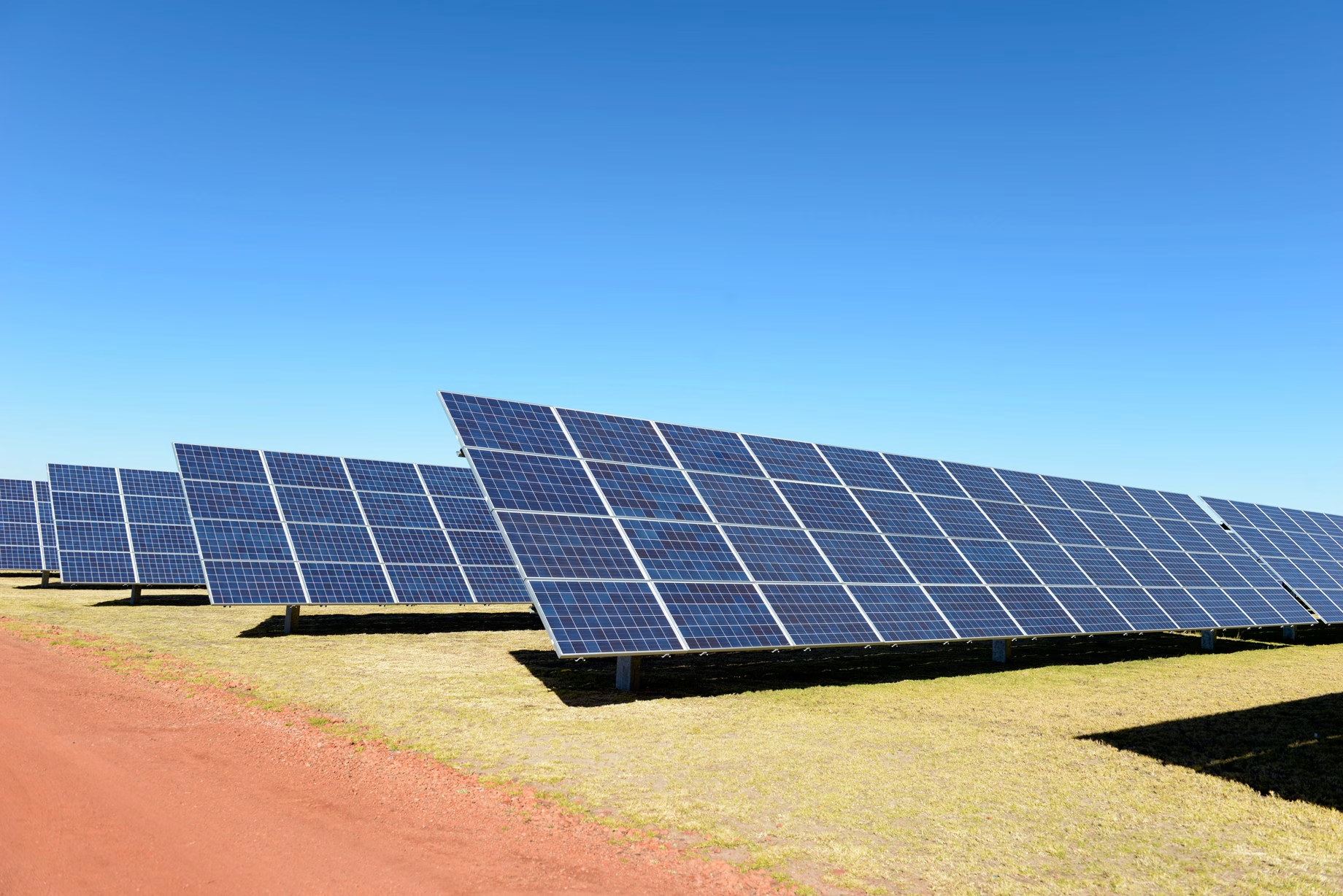
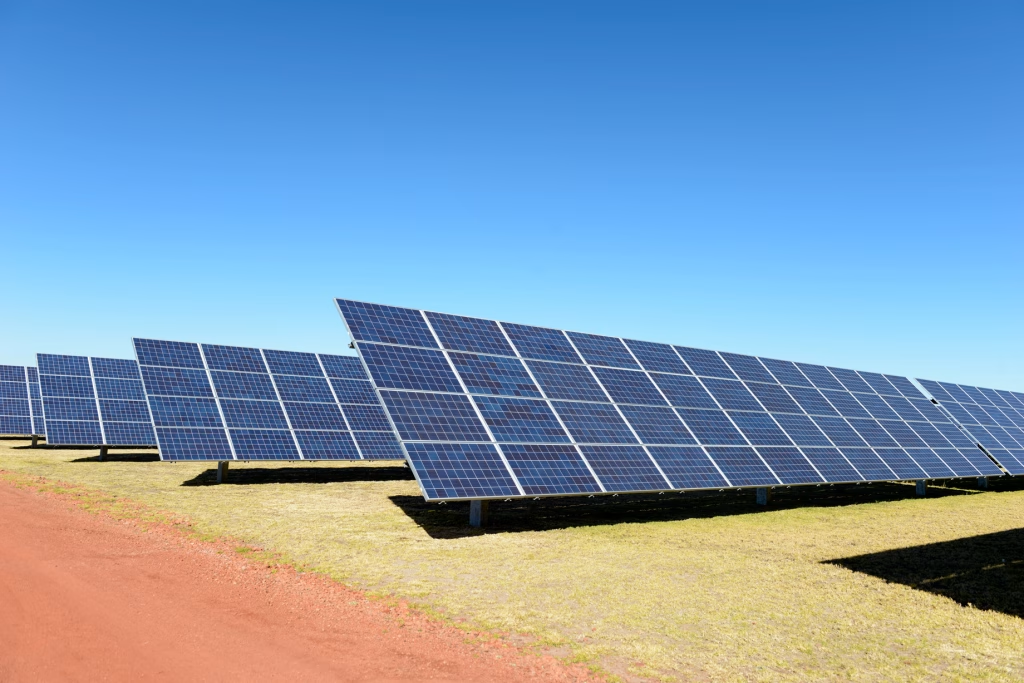
About a year ago, I saw a sign on the side of the road at a rural intersection near my house: “Stop Big Solar!” it exclaimed. I saw a few other such signs, which led to some Googling to find the following from the Alabama Gazette: Opponents speak out on Montgomery County solar farms project.
Over one hundred members of the community crowded into the Montgomery County Commission seeking information about a proposed massive 1,600 acre solar panel farm near the Snowden Community.
[…]
“There is not a lot ADEM [Alabame Department of Environmental Management] can do until the facility is built,” Singleton informed the residents. “The county can’t tell people in an unincorporated area what they can or cannot do on their property.”
Many of the residents wanted the commission to simply pass a ban on new solar farms.
“That would be breaking the law,” Singleton said.
[…]
Moore-Zeigler said that this situation is due to county voters voting down zoning in 2016.
“It doesn’t matter what it is, this is on you,” said Moore-Zeigler. “I am as much against these solar farms, but the truth is that a solar farm is not the only thing that can ruin your property value.”
“You voted it down in 2016,” said Moore-Zeigler. “We cannot outlaw solar farms.”
“We can put it back on the ballot,” said Moore-Zeigler.
“If it weren’t for the solar farms, you would be crucifying me for bringing it up,” said Singleton of county wide zoning.
In regard to the 2016 reference above, the Black Belt News Network clarifies (emphasis mine):
Despite Singleton’s sympathies, he said that a proposal allowing the County Commission to limit zoning was struck down in 2016, though he said that he has spoken with County Attorney Michael Armistead about possible alternatives.
“But the way that it is written right now, in the unincorporated (areas) there is no zoning,” he said. “You can do anything you want on your property.”
Commissioner Daniel Harris said that the commission can still try the proposal first made in 2016 and rejected again later. He suggested getting input from communities to help the commission draft a policy that would give the commission limited zoning authority.
The policy could then be sent to the Alabama Legislature to be possibly approved and then voted on by the commission.
A clarification: as best as I can tell, the 2016 reference was not about the voters, but about the Commission itself voting down a chance to ask the voters (I have no recollection of, nor can I find reference to, a 2016 initiative). The last attempt to create county-wide zoning (which failed) was in 1974. Let me stress, therefore, that the County Commission lacks zoning authority, and that people often like that fact very much except when they don’t.
Any drive around any incorporated area in Alabama will confirm the lack of zoning control.
All of this came to mind when listening to the Ezra Klein Show yesterday (coincidentally, I was approaching the intersection cites above as I heard this).
The topic of the episode is the urban-rural divide in US politics, and was an interview with political scientist Suzanne Mettler, co-author (with Trevor Brown) of the book Rural Versus Urban: The Growing Divide That Threatens Democracy. Numerous potential posts leaped to mind as I listened, but for this post, I want to focus on the following.
Klein asks the following:
The way you describe it is: “It was not any one issue that tipped the scales but rather the persistent commonality that ran across them. From 2008 onward, rural Americans perceived an urban elite that sought to impose itself on far-flung places, controlling residents’ lives through new rules and procedures, in which they felt they had little voice.”
And you argue that the issue here is not the policy but the sense of respect or disrespect, of listening or not listening, of representation or absence of representation — that there was something sort of beneath policy that drove this.
Tell me about that sense of: We are being ruled from afar.
Let me stress that it is a long-term element of Alabama political culture that recoils at government from afar, most especially from the federal government.
At any rate, here are some key parts of Mettler’s answer:
We illustrate it in the book through a couple of different policy areas, and one is renewable energy.
[…]
So there will be a big developer that comes in — a company that cuts a deal with a big landowner — and all of this happens and agreements are made before the local community hears about it. And then people are upset.
[…]
There’s one study that was about wind farms in Indiana, and a person they quoted said: It’s not that I’m against wind energy. I’m against how it was done here.
Klein then responds to this:
I found this raised a lot of skepticism for me.
First: “I’m not against X” — where “X” is clean energy, affordable housing, mass transit — “I’m just against how it was done here” is, I feel, the most common structure of “I’m against X.”
But in “Abundance,” I spent a lot of time talking about and researching and reporting on how clean energy projects in particular are sited in different parts of the country. And what I can say for sure is that red states site all kinds of different forms of energy much more easily than blue states do because they have much less complex and deliberative procedures for siting them. If you want to build a wind farm in rural Texas, it is just much easier than building it in rural California or rural New York.
And yet rural Americans are not turning against the government of Texas for the lack of deliberative, consultative and veto-oriented siting.
So something about that felt off to me. I would think that would then lead to much more anger in red states, where it is much easier to just plow through a new development than it is in blue states, which have much more veto-oriented structures.
This all made my mind go directly to “Stop Big Solar” and the Montgomery County Commission meetings noted above.
To me the entire situation is an excellent example of how most citizens don’t understand government and mostly see things in terms of “what I want” v. “what I don’t want” levels of sophistication.
At the time I was annoyed and bemused by it all because I know that the general ethos in the rural parts of Montimgery County, Alabama (and in the rest of the state) is an attitude of “don’t tell me what to do with my land!” And look, I get it. While I live in an incorporated area, I am adjacent to large tract of cattle ranches that lie in the county. I have every reason to believe they will remain cattle ranches for the foresseeable future, but there is nothing legally stopping pretty much anything being built there. The only difference between myself and some of my more distant neighbors noted above is that I would welcome some kind of county-wide zoning system and actually see the value of some leve of regulatory power by local government.
Let me digress to provide some context. Montgomery County has exactly two incorporated municipalities. One is the City of Montgomery. The other, which borders it, is the Town of Pike Road. That’s it. The rest of the county is unincorporated. Here’s a map via Google. Note that the incorporated portion is in the northern quarter. There is a lot of unincorporated land in the county. The areas being targeted for solar farms are basically the space under the 231 symbol down to Ramer (not the whole area, but specific parcels thereof).

Apart from whatever personal connection I have to the topic, I think all of this illustrates some key problems in American government.
First and foremost, American government is sufficiently complicated that people really don’t understand who does what. All most people know is that that they either want or don’t want something. When they want it, they want to know why government isn’t making it happen. When they don’t want it, they want to know why government isn’t stopping it.
We recently had city council elections, and there was a substantial contingent of citizens who were mad that a McDonald’s was being built. They wanted the Mayor to have blocked it (because reasons) or, more to my amusement, to have gotten some different fast food chain that they preferred. Because, of course, that’s how government works.
I cannot find the precise data for the town, but the general information I can locate indicates that while Montgomery County went heavily for Harris, the Town of Pike Road went for Trump. How it is that a bunch of allegedly pro-market types think that the mayor can dictate which fast food joints are built is perhaps an interesting insight into the level of political sophistication that a lot of citizens have.
It is both not surprising to me as well as, I will confess, profoundly frustrating, to hear people who normally want government out of their lives to want government involved when something they don’t like is coming their way. Look, I would prefer it if people didn’t burn things on their property when I want to have my windows open, and some of the properties with generations of dead automobiles on their front lawns are not aesthetically pleasing, but that’s the way it works.
Klein goes on to touch on a topic I discuss on occasion and think about a lot.
I’m getting at something even a little bit larger here than clean energy. One thing that your book seems to accept and even talk about is that the attribution of blame for policy is very, very muddy, and it relies a lot on how people get their information and whether they get their information.
You talk about a particular study where Republican policies close rural hospitals, and people are mad. And the Republican vote share goes up in the next election because people blame the party they already don’t like.
I could tell a story where people don’t like the renewable energy coming in. And even though it’s coming in more aggressively in red states because of their procedures, nobody knows that much about siting rules, so they’re still blaming the party they see as connected to renewable energy.
But there’s something here about how many of the policies that you describe as particularly painful or destructive or irritating to rural America are not promulgated by Democrats, but Democrats get blamed anyway.
A major problem in American politics is that it is hard to know who is responsible for what. For example, who is responsible for the current shutdown? It is possible to make an argument for both parties, and this is why I have argued that the Democrats should be daring the Republicans on a daily basis to go nuclear and take the Democrats out of the picture (i.e., vote to change the rules to allow a 51-vote majority to reopen the government). Make the Republicans own all of this, including the insurance rate hikes that are coming.
Citizens tend not to be especially sophisticated in terms of understanding the interplay between local, state, and federal governments. Ironically, our overly democratized approach to governance (wherein we vote for a lot of offices) makes real democratic accountability a serious problem. If voters don’t know who is responsible for what, it makes it rather difficult to strategically utilize the vote to punish or reward.
Instead, voters end up falling back on assuming, as per Klein’s example about rural hospitals, blaming the party they don’t like and rewarding their own team. Or, as we see at the national level, blaming or rewarding incumbents based on general vibes.
Another possibility is determining whether certain policies are coded R or D. For example, I saw on local news Facebook groups when the solar panels thing was in the news, about not wanting “woke” solar power in the county.
Mettler argues that the Democratic Party needs to engage in active organization at the local level to try and rebuild the party. I don’t disagree with that, but I am skeptical about it achieving significant changes for a variety of reasons, and will leave that for perhaps another post.
But let me conclude by stressing again how part of why we are in the moment we are in politically is that people do not understand the complexities of government in the United States and, worse, all that complexity gets poured into only two vessels.
In short, people are rightly frustrated with the lack of responsiveness from the government, but instead of figuring out why the government is not responsive, they mainly blame the other party and move on.
This is exacerbated in cases like rural areas that are heavily Republican because there is a disconnect between who the home team is and the fact that the home team’s politics is very likely to be the cause of the consternation.
There is also the key problem that people want contradictory things. They want total control of their property, but don’t want you to have the same level of control. Or, they want rural hospitals, but just don’t want to support the spending (and taxes) needed to fund them.
And all of our electoral and governance superstructure encourages only two options, which reinforces all of this. This is why, at some point, we need a national movement towards real political reform, difficult though that road may be.