
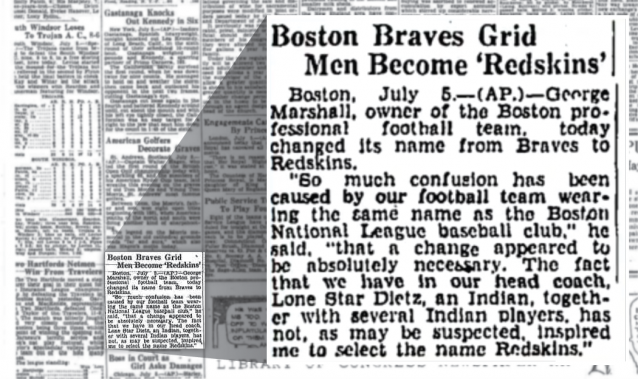

Think Progress think they have a gotcha with “The 81-Year-Old Newspaper Article That Destroys The Redskins’ Justification For Their Name.”
As challenges against the name of the Washington Redskins have persisted for more than four decades, the teams ownership and management has held on to a consistent story: that the team changed its original name — the Boston Braves — to the Boston Redskins in 1933 to honor its coach, William “Lone Star” Dietz, who maintained at the time that he was a member of the Sioux tribe.
But in a 1933 interview with the Associated Press, George Preston Marshall, the team’s owner and original founder, admitted that the story wasn’t true.
“The fact that we have in our head coach, Lone Star Dietz, an Indian, together with several Indian players, has not, as may be suspected, inspired me to select the name Redskins,” Marshall said in the AP report.
[…]
If Marshall didn’t choose the name based on Dietz or the presence of Native Americans, what was his reason? As Olbermann notes in his report, the team chose its original name — the Boston Braves — because it shared a field with Boston’s baseball team by the same name. Marshall explains the AP story that he gave up the name “Braves” because it was too easily confused with the baseball team, and he chose “Redskins” to keep the Native American imagery as the team moved away from the Braves and into Fenway Park, the home of the Boston Red Sox.
Until recently, that story was more commonly told than the one about Dietz. In 1972, freelance writer Joe Marshall wrote a story on team nicknames in a promotional program from a game between Washington and the Atlanta Falcons. Joe Marshall didn’t reference Dietz in his story, instead writing that the team wanted to “change names but keep the Indian motif”
[…]
In that sense, it seems obvious that the name “Redskins” was chosen more as a marketing ploy than anything else, a way to tweak the team’s name without changing the image it had established. Regardless of the original motive, however, this much is clear: the story the team and NFL have used to justify the name’s existence as a “badge of honor” is not true, and the man who founded the team refuted it himself more than 80 years ago.
To my mind, this does more to debunk the notion that the “Redskins” name was intended as a racial slur than to debunk the notion that it was intended to honor American Indians. It’s well documented that George Marshall was a racist, even by the standards of his day. Yet, while it wasn’t the motivation for the “Redskins” name, he did employ four Native American players and a head coach who purported to be, even if he apparently wasn’t, one. Whether they found the “Redskins” moniker offensive isn’t covered in the report but it strikes me as unlikely.
Further, this reminds me that the team previously had a different nickname that referenced the American Indian, one that it shared with the local baseball team. That team moved on to Milwaukee and later Atlanta but retains the “Braves” sobriquet. It’s notable, too, that the football Braves only used that nickname for their inaugural season.
Now, unlike my co-blogger Doug Mataconis, I’ve come to believe not only that the Redskins should choose another name but that it’s only a matter of time until they’ll be forced to do so. It’s really irrelevant whether the intention in 1935 was to honor American Indians, slur them, or if it was just a marketing movement made without a care in the world what they thought. The fact of the matter is that, in 2014, a growing number of people, Native Americans or otherwise, now find the term offensive. Eventually–and I’d guess within a decade–pressure from corporate sponsors or the loss of trademark protection for the brand will mean the Washington Warriors or Washington Federals or some other follow-on franchise will be fighting for old DC. The only real question is whether the new nickname will retain a link to the American Indian branding heritage (I’ve seen mockups of a Warriors helmet based on the 1965 to 1969 Redskins unis) or dispense with it altogether.









