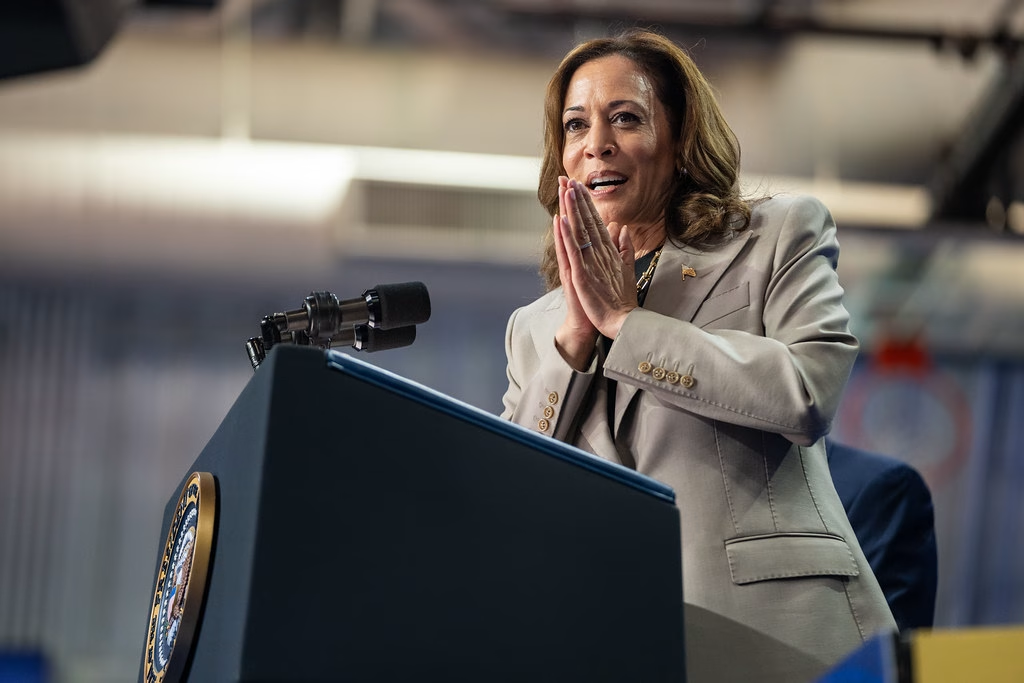
Yesterday, James wrote about the buzz over a possible brokered GOP convention. Not only is this is meme that floats every four years, it is bolstered this year by the fact that the GOP field is especially crowded this year.
However, while it is true that at the moment there appears to be no frontrunner, I really see no realistic way that we will go through the primary/caucus process and end up with no candidate who does not have well over 50% of the delegates pledged to support him at the convention.
Here’s the deal, and it is one that hardcore political junkies to accept sometimes: despite the seemingly eternal campaign, we are still in the preseason here. Until the voters start voting, and the candidates start to feel the effects of support (or the lack thereof) will we really be able to say that no frontrunner exists or that none seems imminent. I predict that one or more of the serious candidates (i.e., Romney, McCain, Huckabee, Giuliani, Thompson) will emerge from Iowa/New Hamsphire seriously wounded, and the winnowing will begin. Indeed, I find it rather unlikely that we will make it out of February without knowing who the the nominee is to be.
We go through some version of this speculation practically every four years, as there is some point (prior to votes being cast, usually) wherein it just seems like there is no way that the voters are ready to coalesce around a candidate. Remember back in 2004 where it seemed as if it could be Dean, Kerry,or Edwards? (or even Gephart or Clark?). Yet, after Iowa Gephart was gone and Dean was mortally wounded, and by New Hampshire Dean was toast. Soon, there was only Kerry (who had looked dead a few months earlier).
For a brokered convention scenario to emerge there would have to be solid (if not unshakable) support for a number of candidates along regional lines/specific states in a way that the delegates would balance out and continue to stay balanced, contest after contest. The closet thing to a regional advantage that any candidate has is Huckabee in the South (and that is not a sure thing at this point), and while Romney and Giuliani may have some allegiances in the Northeast, neither has a rock-solid lock. Indeed, and more to the point, no one has a clear lock on much of anything, meaning that the likelihood is that someone will start to quickly lose the soft support that they currently have, making way for consolidation around a candidate over the course of the first several primaries. The fact that there are lot of choices and no clear frontrunner really isn’t the best scenario for a brokered convention, even if that seems to be the caes at first blush. A brokered convention would require two or three candidates with a strong base that would be unlikely to shift until the bitter end. There are no candidates who have supporters of that type. As such, there is plenty of room for defections and changed minds.
Further, and this is key: most of the GOP state-level rules allocate delegates on some version of a winner-take-all basis. This means that even if support for candidates is split, plurality wins will start to lead to accumulation of delegates. Even if different candidates are splitting wins, someone will start winning larger states and accumulating more delegates. It would take a rather odd (and improbable) patchwork of wins to different candidates for the delegate counts to remain roughly equal over the course of several state contests. The majority of the state GOP delegate selection processes award a certain number of delegates to the winner of the most votes at the state level and then allocate the rest to the winners of the most votes per congressional district. And while the by-district model just allow for the splitting of some delegate in a state, the typical trend is for the candidate with the plurality lead statewide to normally also have a plurality in most of the Congressional districts as well.
For example: if I go to a state with a winner-take-all allocation, and I win the state with 27% of the vote, with the remaining vote split amongst numerous candidates, I come away with 100% of the the delegates. Yes, the party is still split on its preference, but I have made a large stride towards my goal of winning the nomination, while my compadres have gained nothing. Even in a case wherein I win the state and split some of the Congressional districts with the others, I am still making greater progress towards my goal of a an absolute majority of delegates. Again, the math tends to catch up with the guys who are coming in second, third and fourth. Money dries up. Voters begin to doubt that their guy can win and shift to their second and third choices.
Put another way: even if the top three, four or five candidates continue to have some significant support with GOP voters, the allocation of delegates will not directly mirror those poll numbers because the delegates are not allocated in any way that is perfectly proportional to support—far from it. Candidates will start to lose, and losing will bolster others, and a clear winner will emerge.
Also remember: not all states have the same number of delegates and so some wins mean less than others in terms of delegate counts.
As such, the odds of a brokered convention are quite low. (And really, at this point arguments in favor of such an outcome are wishful thinking).
This post was adapted from one posted earlier in the week at PoliBlog