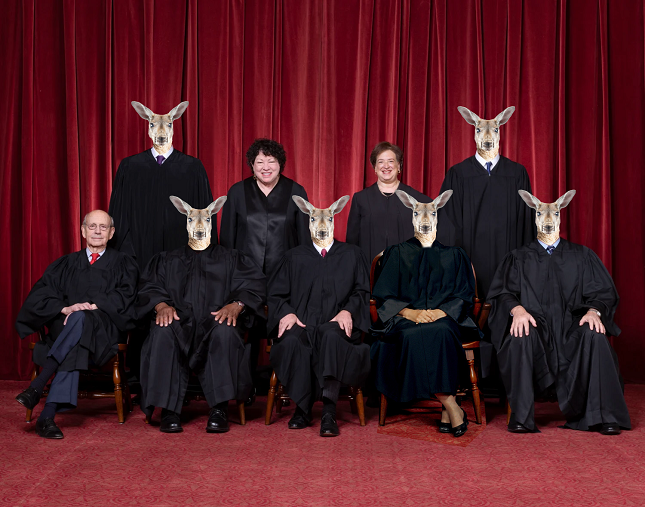

While one can understand the frustration that many have over the confirmation of Amy Coney Barrett to the US Supreme Court, the bottom line had been that the Republican Party currently controls both the nominating mechanism and the confirming mechanism.
Accusations of hypocrisy vis-à-vis the Garland nomination were never going to carry the day, nor were parsings of history.
This was inevitable from the moment Ruth Bader Ginsburg passed.
Via NPR: Amy Coney Barrett Confirmed To Supreme Court, Takes Constitutional Oath
The Senate has voted 52-48 to confirm Judge Amy Coney Barrett to the Supreme Court, just about a week before Election Day and 30 days after she was nominated by President Trump to fill the seat of the late Justice Ruth Bader Ginsburg.
[…]
The only Republicans who voted against the cloture motion on Sunday were Sens. Susan Collins of Maine and Lisa Murkowski of Alaska.
Appeals to norms were never going to stop this, if anything because whether we like it or, the most significant norm in play here was that a party in power is not going to voluntarily surrender its power.
Outrage over this move is, ultimately, born of disappointment and frustration than any realistic expectation that a party in the Republican’s current position would behave any differently.
And yes, Merrick Garland deserved a hearing and a vote. And he almost certainly would have been voted down because, again, the Republicans had the votes then, too.
The issue at hand is not norms. Nor is it the shocking appearance of hypocrisy in politics.
This is ultimately about institutions and we, as a country, need to come to terms with it.
This is the result of bad design of the Supreme Court, which creates a capricious and arbitrary timeline for replacements.
This is the result of a system wherein the nominating power can come into power without even plurality support across the country.
This is the result of a confirming power that imbues power to the party that represents a minority of the citizenry.
And, more broadly, as really needs to be heard far and wide: the Republican Party has won the plurality of the vote (i.e., the most votes nationally) once (2004) in the last three decades and yet it nominated 5 Justices during that period and now has a 6-3 majority on the Court.
There is a massive imbalance here.
Focusing on norms and hypocrisy misses the point. The most dominant norm in politics is power and using it when one has the chance. And maybe the second most dominant norm in politics is hypocrisy.
On that last point, let’s not forget that the country that was founded via a document that stated “all men are created equal” also had chattel slavery until 1865. So, appeals to a romantic past when we adhered to more honorable practices are a bit problematic.
Change is hard, clearly. It starts with understanding and dissemination of that understanding.
Hypocrisy is not the problem.
The problem is that there is a profound disconnect between the governed and government.
The more people who understand this, the better.
(And, of course, all of this is why I am where I am on a list of reforms).
And, for those who think all of this is fair and acceptable because the rules are the rules, I would first ask how they would feel if the shoe was on the other foot? I would then ask: how long can a system that is supposedly predicated on “government of the people, for the people, by the people” persist if the majority increasingly becomes aware that the frustration they are feeling is because of those rules?