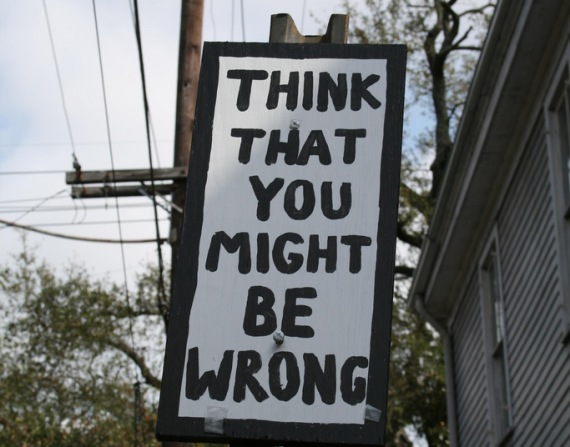

For the record, despite my tenacity at times, I think the above all the time. The sentiment is not aimed at anyone, but all of us. Part of how I think things through is writing. (Photo by SLT taken in NOLA in 2009).
Overview
The ongoing discussion of the applicability of “fascism” to Trumpism spurs a lot of thoughts in my already full head, so here is a somewhat different approach to a post wherein I have specific thoughts that are somewhat discrete, but also related. This is all inspired by various comments made in various threads. Some I will directly note, but not in all cases.
I have an ongoing intellectual struggle over the appropriate way to categorize Trump. I am actually quite open to the notion that fascism is not the right term and even to the idea that even bringing up fascism and Hitler is a problem from a general discourse/political strategy point of view. I absolutely have been, and continue to be, concerned that using the word makes a person sound hysterical. While I would like to think that my overall, long-term tone is enough to inoculate from such accusations, I know that there is a lot of emotion and social significance to these terms.
I have long thought that “fascism” in the general discourse is just a word people use for things they don’t like. But I also think that whether or not Trump is properly defined as a fascist, his actions and rhetoric make it hard not to see the applicability of the concept. I also would have to agree that the term is contested, both in the sense that most terms are, but also because there really isn’t a set academic definition. Despite what some have argued in the comment section, I do not think that there is a common fascist ideology, at least not in the way that communism or even classical liberalism has a core ideology.
I have long thought that fascism is largely defined more by what it opposes than what it prescribes. While one can certainly find a coherent worldview in Nazism, for example, it is harder to do so for fascism, writ large. Hitler, Mussolini, and Franco, to name perhaps the three most prominent examples, had commonalities, but did not share the same kind of fleshed-out theory of politics the way that one could say that, as different as they were, Lenin, Mao, and Castro shared about communism.
My general theory of the case, in broad brushstrokes (I would need a far longer medium to fully flesh out) is the Enlightenment spawned classical liberalism and both communism and fascism emerged as a critique. Marx basically is saying that classical liberalism does not actually fulfill its promises of equality, and is a deeper critique of liberalism for not going far enough. Fascism is a reactive response to both by rejecting notions of equality and the disruptions that such claims create. Fascism promises a return to a more stable past wherein society is properly ordered. Fascists also build their worldviews around a defined “us” and a defined “them.”
It occurs to me as I write this, that that means that fascism is quite likely to evolve over time as the mythic past that a given fascist seeks to return to would have to evolve. Likewise, who plays the role of “us” and “them”?
On to other thoughts.
Consultant or Analyst?
I think there is a difference between what political consultants and campaign advisors do as it pertains to campaign rhetoric and what I do here. I am not attempting to suggest what broad communication and rhetorical strategies that politicians should use. My main goal here has always been to try and provide informed analysis and commentary about daily politics while trying to stay within the boundaries of things that I have legitimate claims to have some level of expertise. This includes things in which I can truly be said to be an expert and many adjacent things where I have substantially more education than the average American.* I try to avoid that which I do not really know what I am talking about.
And, of course, this is an outlet for my ongoing thoughts, even to the point of being, as I like to say, “a rough draft of my thoughts” because blogging is largely reactive and not the result of contemplation. Sure, over the long haul, there is a cumulative effect, but any given post is usually in reaction to something specific. I would say that in many ways, my philosophy of blogging is not that different than what I outlined in the post Blogging 101 from 2011 (and weirdly, also, More on NATOME, which also has a bearing on the general Trump discussion).
Part of why I write so much, and often argue in the comments, about the meaning of terms is because unless we have a shared agreement as to what a word means, we often find ourselves talking about different things, even as we use the same word. Without an agreed shared meaning, conversations are often really operating in parallel instead of intersecting.
On Hitler
I think that Hitler is a near singular character in history, which makes comparison to him to be fraught. He is practically a supervillain in the American mind, in particular, not the least of which is because, in so many movies, he pretty much is portrayed that way. It also suits the American mythos that we defeated the Greatest Villain of the Them All in WWII! That we didn’t do it by ourselves, and that among our little helpers was Josef Stalin, a man who belongs in Hitler’s category of terrible totalitarian tyrants is hand-waved away in our collective minds.
However, given the truly terrible nature of Hitler, I would think it should be noteworthy that the president-elect of the United States frequently uses rhetoric that sounds an awful lot like ol’ Adolf. And that he has said admiring things about him. Pointing this out is not saying that Trump=Hitler. But if Hitler is such a singular example of evil governance (and he is), then it seems reasonable not to like it when anyone, especially powerful people, sounds like him or appears to admire him. It seems to me that people get so worked up about the comparison that this rather obvious dictum gets ignored somehow.
I mean, how far does sounding like Hitler have to go before people pause and wonder if a person using such rhetoric ought to be given power?
I will say this, if the only way for the term “fascism” to be applied is for it to look like, in scale and scope, to Hitler, then yes, the term should be retired.
Differing Definitions of Fascism
In the spirit of both explaining myself and addressing the definitions of others, let me turn to JohnSF and Andy.
So, first, JohnSF offers the following:
I still think “fascism” as per German Nazism is not a useful descriptor of Trump/MAGA politics.
It is not a totalizing state and/or ethnic ideology.
It is not based on a quasi-military mass party organization.
It does not seem to be, at base, “revolutionary”, which both Italian Fascism and German Nazism conceived themselves as being.It seems a lot closer to the quasi-fascist populism of Peronism in Argentina.
Fascism for lazy people?
First, I agree that saying Trump is a Nazi and that he is bringing us Nazi Germany is 1) wrong, 2) never what I have meant, and 3) perhaps why even bringing it up is the problem, because that is what folks tend to focus on.
Second, I agree that Trump’s approach to politics is not totalizing. That may be a dealbreaker for using the term for some, but I also think that if fascism has to mean totalitarian, then the concept has limited usage. I have become convinced fascism does not have to be totalizing,
I do think that Trump’s politics are based on ethnicity. I think that Trump has a clear view of what “American” means and it is predominantly a White nationalist view. That does not mean that there isn’t room for non-whites. I would note that Hitler himself did not represent the Aryan ideal, so some level of inconsistency is not a new idea.
Third, I don’t think fascism as a mode of politics does not require a quasi-military mass party. I think that totalitarianism probably does, but again, I think that those concepts should be delinked.
Fourth, ultimately I think that both Hitler and Mussolini were reactionary, not revolutionary. Hitler wanted to restore a mythic pan-Germanic Reich. Mussolini wanted to recapture the glory of Rome. Trump is inherently backward-looking as well. He wants to Make America Great Again.
The fact that fallback is to “quasi-fascism” suggests that maybe there is room for the concept after all.
Next, Andy provided a longer list that I had managed to overlook until he referenced it again yesterday. The “-” portions are Andy and I answer below each.
– The centrality of the state
I agree that Trump does not talk about the state the way that, say, Mussolini did. But I also think things like his threats in regards to Schedule F and the way he is clearly trying to populate the government with cronies loyal to him. His views on Article II, as now enhanced by SCOTUS, show a man who thinks that the American state belongs to him the same way a company would.
– One party rule with a dictator/autocrat at its head – extreme authoritarianism
I think that “extreme” is doing a lot of work here because I think this approach to fascism assumes that fascism has to equal totalitarianism (which may be the main disagreement between Andy and myself).
– Militarism and the glorification of violence
While Trump has made some gestures in the direction of militarism (such as a desire for military parades), I will grant that they have been anemic. However, I will say that he has repeatedly suggested that the military is there to do what he wants it to do, whether it pertains to dealing with protestors (see my post here), the border, or deportations. That he opined that he wanted generals like Hitler had seems kind of relevant as well.
I think Trump does glorify violence. I have a long list of examples here: Radicalizing Rhetoric. He also frequently states he wants law enforcement to be violent (see, for example, “One Violent Day”).
See also, A Fascistic and Authoritarian Response.
– The use of violence both domestically and internationally (both regimes used chem weapons on their own citizens, as one example)
I would put the child separation policy in the category of using violence domestically. We shall see if there is any violence as it pertains to deportations.
It seems to me that using chemical weapons is quite a high bar (and I don’t know what that has to do with fascism, per se).
But let me note that I do not understand how in these discussions January 6th seems to get memory-holed. He helped create that display of domestic violence, cheered it on, and refused to assert his obvious power to call it off. He has used domestic political violence, aimed at overturning an election.
– Calls to the values and unity of the past
Trump does this all the time. MAGA is about the past, often some idealized version of the 1950s. He has often waxed about the era when GM was king and the US controlled steel, etc.
The whole anti-trans thing is a call for the values of the past. He is also using the rhetoric of putting God and prayer back in schools, also a call to the past.
– Notions of “lebensraum” – not as prevalent in Syria, but core to Baathist Iraq
I would argue that having an irredentist/ethno-territorialist element to politics is not in any way a necessary component for fascism. The question of international boundaries and where certain people groups are located is simply a long-term salient aspect of European and Middle Eastern politics in ways that are simply not relevant for the United States, a continental nation that has no long-term claims on either Canadian or Mexican territory.
I will state, however, that there are (at least in my mind) gross echoes of calls for living space when Trump claims that mass deportations will help ease the housing shortage.
His concerns about borders and “not having a country” seem relevant as well.
– The use of propaganda and control of information as a means of control and influence
Here, again, I think that there is a conflation of totalitarianism with fascism.
But I would also push back and note that Trump clearly pushes untruths and propaganda. As noted in James Joyner’s post, he made the official White House Spokesman go out and blatantly lie about the size of crowds. At roughly the same time, Kelly Conway, in an official capacity, told the press that “alternative facts” is a thing. See, also, Rudy: “Truth isn’t truth”.
“They’re eating the dogs, they’re eating the pets” is propaganda.
I would note, for example, that Trump created his own social media company to specifically appeal to his followers.
I suppose the disagreement is about scale.
– Extreme nationalism, albeit in the larger context of pan-Arab nationalism (Similar to how Putin sees himself and Russia as fighting for slavs).
As noted above, the US does not have long-standing, historical claims on territory that fits that mold. I do not see how that is directly relevant to fascism, per se).
I will note that there is an obsession or immigrants and who can be American. For example, see my post On Birthright Citizenship.
– Racism and ethnic superiority (Fuck the Kurds and the Jews)
My main response would be: Fuck the immigrants. There is both the threat, but also the past: see, separation, family (as part of the zero-tolerance policy).
There is a clear obsession with who is American within Trumpism (that echoes Palin’s “Real America” rhetoric).
In truth, I don’t think Andy and I disagree all that much save in two ways. One (which I think is the main disagreement) is the degree to which fascism has to equal totalitarianism. I would argue that these are discreet concepts that can overlap but do not have to. Second, it is just about the degree of intensity of the issues listed above.
I think the thing that I need to think further about is the degree to which fascism has to be totalizing/the degree to which the term can only be deployed in a totalitarian context.
Likewise, I am now thinking about the differences between fascist movements ad regimes as well as the question of whether fascism can only be applied if a certain threshold is reached.
Also, despite my continued writing on the subject, I am actually open to the idea that even bringing up Hitler and fascism was ill-advised and counter-productive. Of course, at this point the cat is out of the bag, so too late, I guess. There is also the possibility that the concept is either simply an artifact of the past or it is truly reserved for only very extreme and specific cases.
Again, my preferred definitions of fascism can be found in the following post:
And two reminders from people who worked directly with Trump. And remember that members of the US military are trained to be apolitical, so they overcame a lot of professional reticence to make these statements. As, by the way, did I (but different professions and different obstacles).
And with that, we come to the conclusion of this post.
*I could likely go on at length about what all that means, but an examination of what “expert” means and doesn’t mean is a lengthy conversation, as it trying to parse out levels of knowledge and training.