
Matt Bernius’s post “Reviewing 5 Claims About Tim Walz Military Record” touches on several minor controversies about the presumptive Democratic vice presidential nominee, some of which I’d not seen before but the most important of which I had. I fully agree with Matt’s conclusion “I don’t think its stolen valor, but Walz has played it lose when referring to his service,” but have been steeped in the military culture most of my almost six decades and have a different perspective on many of the claims.
Some deck clearing first.
First, while I was only barely aware of him before his name surfaced as a VP candidate, I mostly like what I see. While I disagree with him at the margins on some issues, he seems like a pragmatist rather than an ideologue. While I roll my eyes at the lengths to which he goes to portray himself as an “Everyday Joe,” he seems like a decent guy. He’s qualified to be VP and, should it be necessary, to step up into the big chair. Given the alternatives, I’ll vote for the ticket.
Second, and perhaps more importantly, Walz being on the ticket will have almost nothing to do with my vote or that of any other American. In 2008, I wrote multiple scathing posts about the selection of Sarah Palin as John McCain’s running mate. I thought and continue to think that Joe Biden, the VP alternative on the other ticket, was more prepared to serve. I still voted for McCain. (While I thought about it much less, the same is true in hindsight for Lloyd Bentsen and Dan Quayle in 1988.)
Third, while I opposed him for all manner of reasons (my then-strong allegiance to the Republican Party first and foremost of them), I immediately and vociferously defended John Kerry against the smears of the Swift Boaters. While I thought his record of protests against the Vietnam War, including throwing his war medals over the White House fence and some smears against his fellow veterans before Congress were absolutely fair game, the “stolen valor” claims were outrageous and I said so early and often.
All that said, while I take @wr and others’ point that politicians stretch the truth about their past accomplishments as a matter of course, military service is a different animal. Among veterans and active duty personnel, there is simultaneously a fierce and often petty pecking order about who did what but an honor culture that reacts—even over-reacts—to claims to honors one didn’t earn. And Walz has clearly done the latter—and allowed others to do the latter—repeatedly.
Let me take the claims Matt lists in the order in which he debunks them.
Walz steals valor by wearing a special forces hat.
This is the first I’d seen of the charge and I largely agree with Matt that it’s not a big deal. He has frequently worn a camouflage baseball cap with the De Oppresso Liber crest of the U.S. Army Special Forces, the Green Berets. It was a gift given to him, as a Member of Congress, when he visited the 1st Group. Given that he’s never claimed to be SF, it’s certainly not a “stolen valor” issue.
That said: I wouldn’t wear the hat outside the context in which it was given. When presented with the hat, I’d have put it on and gotten photographed with the presenters. Depending on my reading of the room, I might have left it on. I would subsequently have put it on my mantle or wherever my SWAG was displayed and never worn it again precisely because I’d be embarrassed to give someone the impression that I’d been SF when I hadn’t earned that right.
More than a decade ago, I was part of a delegation from the Atlantic Council that did a distinguished visitor tour of the USS Eisenhower. We were all presented Eisenhower ball caps with scrambled eggs on the visor. I haven’t worn it since we left the carrier. While I suppose I have the “right” to wear the cap, most people seeing me in it would naturally assume that I had served in the Navy and been assigned to the Ike.
Similarly, I’ve been working for the Marine Corps since 2013. It would never occur to me to wear a hat, shirt, lapel pin, or anything else that said “U.S. Marines,” “USMC,” or the like on it because it might give the incorrect impression that I served in the Marines. (I served, but in the Army.) I have plenty of SWAG that says “Marine Corps Command and Staff College” and some that says “Marine Corps University.” Those, I’ve earned the right to wear.
Walz never deployed during the Global War on Terror.
Matt is right here: Walz deployed to his unit to Europe to backfill soldiers who had been deployed to war zones. That’s honorable service and more than most did. (It’s more than I did in terms of the GWOT.)
But, to me, “We can make sure those weapons of war, that I carried in war, are only carried in war” goes well beyond puffery. It’s a goddamn lie. While it doesn’t cross the line into “stolen valor,” it’s awfully goddamn close. It’s, frankly, shameful.
And, frankly, in the broader context of GWOT, I would hesistate to describe going to Germany to relieve actual soldiers to go to actual combat as being “deployed.” It’s technically correct but gives a misleading impression that I think intentional.
Walz retired to avoid deployment to Iraq and, in doing so, abandoned his unit.
This is two claims, which I’ll dissect in order. Because it’s the most damning and prominent of the claims, I’ll devote the most time to it.
Matt presents the timeline that Walz’ defenders have put out and, to the best of my knowledge, it’s accurate. Unlike the previous case, Walz actually deserves some credit here: His press release announcing his candidacy for Congress acknowledged that he was aware that portions of his battalion would be deployed. But he’s shading the truth here, too.
First off, if a significant portion of the battalion is deployed, it’s a sure bet that the commander, command sergeant major (CSM), and primary staff will go with them. Walz was the CSM. So, it’s not like it was a random lottery he was avoiding.
Second, I’m reliably informed that the practice in those days for Guard units was to issue early warnings to the command team about probable deployments precisely so that people who didn’t want to serve—or were unfit to serve—could muster out before the orders came down. Unlike the Reserve, the Guard has a very long history of cronyism. For much of its history, it was a way to pretend to serve in the military without much chance of having to actually go to war. Additionally, during that period, there were severe manpower shortages, so Guard units allowed people who were medically and otherwise unfit to serve to stay on the rolls collecting (meager) paychecks and earning (rather significant) retirement pensions. (It should be noted, this would very soon change. The Guard would become an active reserve, expected to routinely deploy to combat. Walz retired at the tail end of the former era.)
Third and relatedly, the rules for dropping retirement paperwork Matt cites are correct now. They weren’t then. It was pretty easy for Guardsmen to get out of their contracts and, certainly, to retire.
Does all of this constitute “abandoning his unit”? I’m of mixed minds.
Walz had decided to run for Congress. While I’m sure his motives were mixed—he clearly has a lot more ambition that his “aw shucks” persona lets on—that’s a form of national service that’s arguably more important than serving as CSM of an artillery battalion. And, while he never went to combat, 24 years of service is, again, way more than most gave.
At the same time, I can understand why some in his unit—his commander and some of his subordinates—might feel bitter about their CSM dropping his papers in the run-up to a combat tour. The unit would lose men in the war and get many more wounded. If they felt abandoned, I wouldn’t blame them.
It’s worth noting that, unlike the Swift Boat smears, these charges seem to have been organic and to have emerged well before Walz’ selection for the VP bid. Again, I don’t think they’ll amount to much. But they’re not manufactured outrage, either.
Walz has misrepresented his rank, claiming to be a rank higher (Command Sergeant Major – E9) than his retirement rank (Master Sergeant – E8)
Here again, Walz is simply lying his ass off. He’s repeatedly claimed, in official publications, to have retired as a CSM. Kamala Harris’ introduction of him played up this rank.
In fact, as Matt notes, while he was promoted in-house to CSM (something that doesn’t happen in the real Army), he was in fact a Master Sergeant, the next lower* rank. He would have actually promoted to CSM had he completed (apparently, by correspondence) the Sergeants Major Academy. He did not do so before putting in his retirement papers.
It would be somewhat weasely but, in my judgment, acceptable, to say that he’d served as his battalion’s CSM. But to say that he’d achieved the rank of CSM, much less that he’d retired at that rank, is a goddamn lie.
In the real Army, by the way, selection for Sergeant Major is a very big deal. There are relatively few slots available and selection (as for Sergeant First Class and Master Sergeant) is by a centralized Army-level promotion board. In the Guard of Walz’ day, it was hand-picked by the local commander. So, from my perspective (which is likely not Walz’) it’s doubly dubious to claim the title. (Then again, I have trouble with his claim that he “served 24 years in the Army” when his entire career, save arguably the deployment to non-combat in Europe, was in the Nebraska and Minnesota Guard.)
***
All of that, though, is very Inside Baseball. Will there be some significant number of veterans who have hard feeling over Walz’ claims? Quite possibly. Will it matter in the election? I doubt it.
Relatedly, as Matt’s post notes some “bothsides” discussions on these matters, I want to note this graphic that I saw on the Facebook page of an esteemed former colleague as a way of comparing the military service of the two VP candidates:
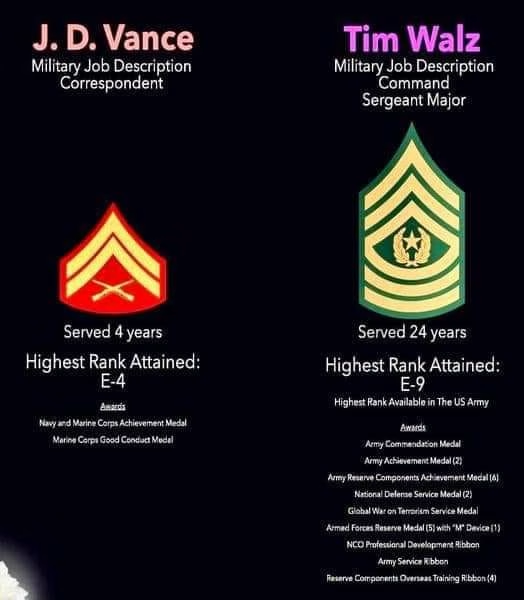
It’s rather amusing at first blush but incredibly deceptive.
First, I’m sorry, 24 years in the National Guard of Walz’ day is not 24 years of real service. There was next to zero chance that we were going to call up a Guard artillery unit for combat. Second, as already discussed, he never attained pay grade E-9. He was an E-8 wearing CSM rank insignia—and assigned to the CSM billet—in a Guard unit. Third, all of the awards listed for Walz save the top two are what we call “I was there” medals and ribbons. They’re all for simply being in the Guard during certain periods of time or completing mandatory training. And, frankly, an Army Commendation Medal is a paltry top award, indeed, for a senior NCO.
Vance’s NAM is, simultaneously not all that impressive and the highest award a corporal is likely to achieve absent combat valor. And he actually received plenty of I Was There awards: “Sea Service Deployment Ribbon, Iraqi Campaign Medal, Global War on Terrorism Service Medal, Letter of Appreciation (5th award), Meritorious Mast Certificate of Appreciation, and various Campaign and Service Medals.” That’s not bad for four years of service and, frankly, much more impressive to anyone in the know that Walz’ rack.
In fairness, some veterans will scoff that he was in public affairs rather than a combat arms billet. But he did at least carry a rifle in a place where he could be potentially called upon to use it. Walz, claims to the contrary, did not.
Army NCO ranks are a bit odd. At pay grade E-8, one can be a Master Sergeant or a First Sergeant. The pay is the same but the latter is more prestigious, as it’s a specific leadership billet: the senior enlisted advisor in a company/battery/troop. At pay grade E-9, one can be a Sergeant Major or a Command Sergeant Major. The former will serve in a staff role of some sort while the latter is the senior enlisted advisor at a battalion or higher formation. Making it more confusing, 1SG and CSM are billet-specific. So, as was the case with my late father, one can serve as a company 1SG and then subsequently be assigned to a staff billet and revert to the default MSG rank. Usually, but not always, one is allowed to retire in the more prestigious rank if they’ve served in it.