
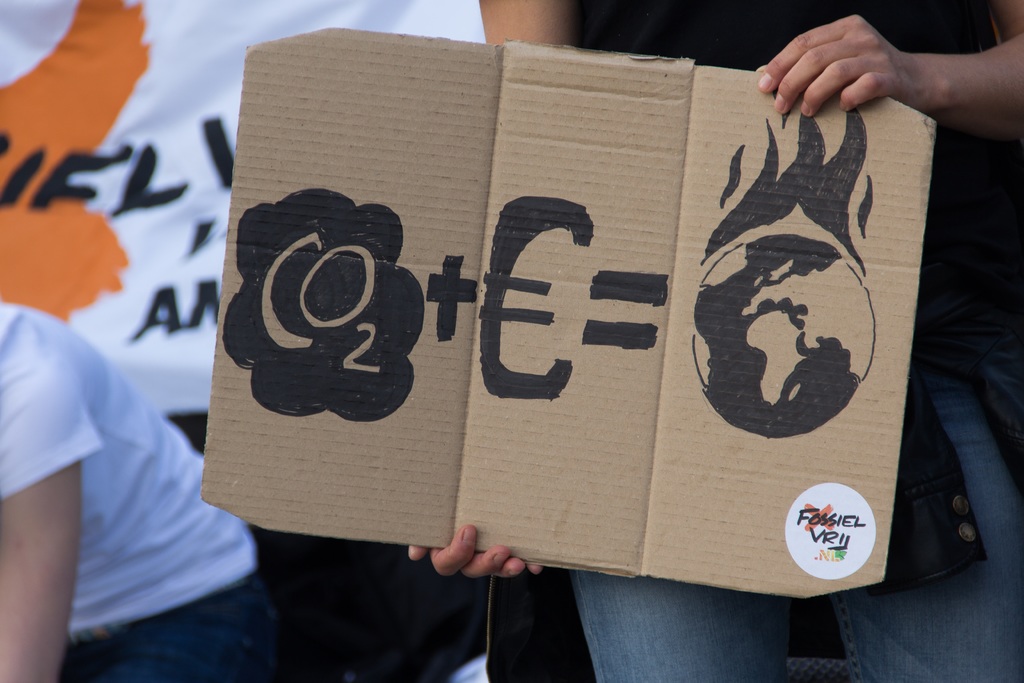
President Trump dismissed climate change as “the greatest con job ever perpetrated on the world” in his address at the United Nations General Assembly today. I would say he has finally said the quiet part out loud, but anyone who has followed Trump’s career knows he was merely repeating himself, though this time he was speaking on one of the biggest stages in the world. No backsies now. And anyone who has been following his administration knows that his environmental policies are essentially predicated on this belief—or, if not this belief, then guided by some concern apart from its reality and importance. Of course, it’s possible he believes that climate change is real but values corporate profit more highly, for example.
Trump also criticized nations for investing in carbon-reduction policies and urged them to turn back from such strategies. He warned, “If you don’t get away from this green scam your country is going to fail.”
Whether you agree with him or not, one is forced to admit that the evidence he brought for his beliefs was scientifically sound. I’m lying, of course. He adopted a posture of derision, mocking past predictions that “were made by stupid people.” The idea of a carbon footprint, he said, was “nonsense”—a “hoax made up by people with evil intentions.”
All of this is regrettable, to say the least. More than ever we need robust and creative conversations to deal with what I believe will be the most significant problem of 2100, if not sooner. One way I’ve found it useful to get my head wrapped around climate change discourse is to break the topic into semi-discrete questions. Here are some questions that can guide our conversation:
- Is the planet warming?
- To what extent is recent warming caused by human activity (anthropogenic greenhouse gases and land-use change)?
- What are the main physical consequences of that warming for Earth systems (temperature, sea level, hydrology, ecosystems, extreme weather)?
- What are the most likely social and economic impacts of those physical changes — both harms and any localized benefits?
- Which countries, regions, or social groups are most vulnerable to those impacts, and why?
- If we weaken current policies or fail to adopt new ones, how serious are the likely consequences for human welfare and global stability?
- Is it still possible to avoid the worst projected outcomes (e.g., very high warming scenarios)?
- How urgent is it that governments and societies act now — i.e., what’s the window for effective intervention?
- What policy measures (e.g., carbon pricing, regulation, R&D, infrastructure, adaptation funding) are likely to be most effective at reducing risks?
- Which of those policies should we actually pursue given trade-offs of effectiveness, cost, feasibility, and equity?
This may seem like a lot of questions, but I’ve actually left out some of the thorniest questions such as those about national responsibility and how the burdens of mitigation should be shared among countries.
From the evidence I’ve seen, the first two, possibly three, questions above are hardly interesting at this point as points of debate. Good-faith disagreement about policy in response to climate change is possible, but good-faith disagreement about climate change’s reality, its principal cause (human activity), and its overall effect on humans (net negative) is dubious. How we answer questions nine and ten does not flow automatically from our answers to the first eight but depends on our particular values. Agreement on the science is insufficient to forge agreement on policy, but policy agreement (or even adopting sensible policy at all) is virtually impossible if the established science itself is rejected.
Here Trump not only gives cover to corporations with perfectly understandable self-interested reasons to minimize the effects of climate change policy, but he—yet again—legitimates doubt among many Americans who already question the authority of experts as biased elites. Whether such skepticism is sometimes warranted (it is, occasionally), there is no doubt that our ongoing well-being as a society is predicated on the existence—and recognized authority—of experts.
But that’s a column for another time.









