
CNN (“Trump said he threatened to bomb Moscow if Putin attacked Ukraine, 2024 fundraiser tapes show“):
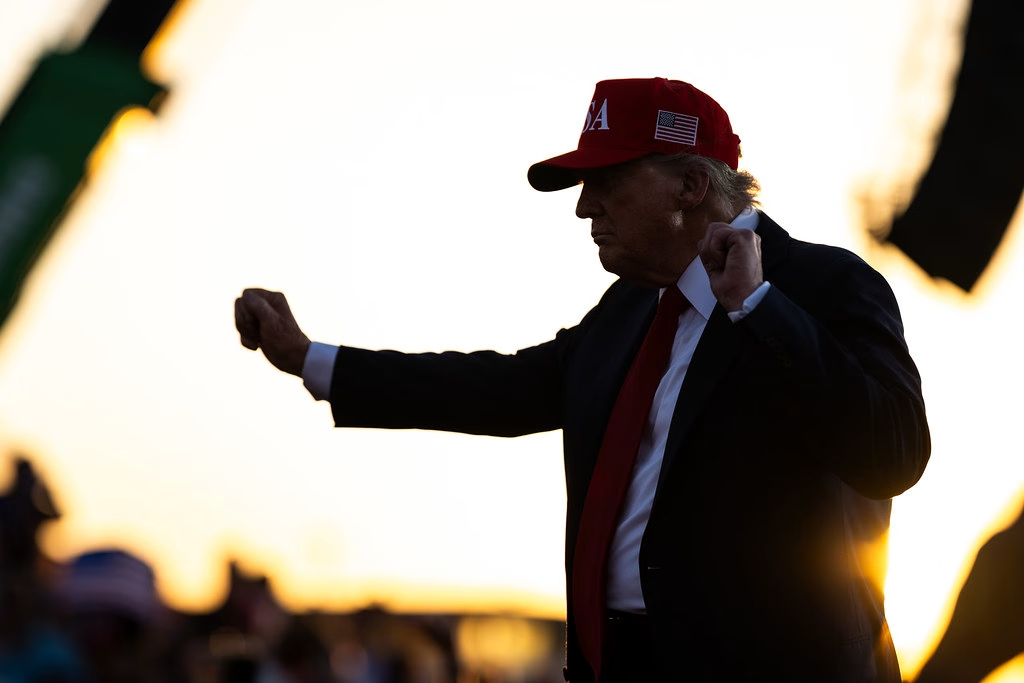
Donald Trump told a private gathering of donors last year that he once sought to deter Russian President Vladimir Putin from attacking Ukraine by threatening to “bomb the sh*t out of Moscow” in retaliation, according to audio provided to CNN.
“With Putin I said, ‘If you go into Ukraine, I’m going to bomb the sh*t out of Moscow. I’m telling you I have no choice,’” Trump said during one 2024 fundraiser, according to the audio. “And then [Putin] goes, like, ‘I don’t believe you.’ But he believed me 10%.”
Trump later claimed he relayed a similar warning to Chinese President Xi Jinping over a potential invasion of Taiwan, telling him that the US would bomb Beijing in response.
“He thought I was crazy,” Trump said of Xi, before noting that “we never had a problem.”
BBC’s Allan Little (“How Trump is using the ‘Madman Theory’ to try to change the world (and it’s working)“) had this to say days before this news broke:
Asked last month whether he was planning to join Israel in attacking Iran, US President Donald Trump said “I may do it. I may not do it. Nobody knows what I’m going to do”.
He let the world believe he had agreed a two-week pause to allow Iran to resume negotiations. And then he bombed anyway.
A pattern is emerging: The most predictable thing about Trump is his unpredictability. He changes his mind. He contradicts himself. He is inconsistent.
“[Trump] has put together a highly centralised policy-making operation, arguably the most centralised, at least in the area of foreign policy, since Richard Nixon,” says Peter Trubowitz, professor of international relations at the London School of Economics.
“And that makes policy decisions more dependent on Trump’s character, his preferences, his temperament.”
Trump has put this to political use; he has made his own unpredictability a key strategic and political asset. He has elevated unpredictability to the status of a doctrine. And now the personality trait he brought to the White House is driving foreign and security policy.
It is changing the shape of the world.
Political scientists call this the Madman Theory, in which a world leader seeks to persuade his adversary that he is temperamentally capable of anything, to extract concessions. Used successfully it can be a form of coercion and Trump believes it is paying dividends, getting the US’s allies where he wants them.
There has been a longstanding debate in the deterrence literature about the desirabilty of ambiguity. Some argue that, for it to be maximally effective, parties need to be transparent about where red lines are to avoid catastrophe. Others counter that some degree of murkiness is preferable, lest the adversary take the red line as license to advance right up to it.
After some discussion of actions taken by Trump and his senior appointees, Little continues,
Julie Norman, professor of politics at University College London, agrees that there is now an Unpredictability Doctrine.
“It’s very hard to know what’s coming from day to day,” she argues. “And that has always been Trump’s approach.”
Trump successfully harnessed his reputation for volatility to change the trans-Atlantic defence relationship. And apparently to keep Trump on side, some European leaders have flattered and fawned.
Last month’s Nato summit in The Hague was an exercise in obsequious courtship. Nato Secretary General Mark Rutte had earlier sent President Trump (or “Dear Donald”) a text message, which Trump leaked.
“Congratulations and thank you for your decisive action in Iran, it was truly extraordinary,” he wrote.
On the forthcoming announcement that all Nato members had agreed to increase defence spending to 5% of GDP, he continued: “You will achieve something NO president in decades could get done.”
Trump supporters rightly point to these concessions as evidence his Tough Guy approach is achieving its desired outcome. (Opponents rightly note the considerable costs in soft power.) But Little is unconvinced that the approach works as well with adversaries:
Ukrainian President Volodymyr Zelensky, an ally who was given a dressing down by Trump and Vance in the Oval Office, later agreed to grant the US lucrative rights to exploit Ukrainian mineral resources.
Vladimir Putin, on the other hand, apparently remains impervious to Trump’s charms and threats alike. On Thursday, following a telephone call, Trump said he was “disappointed” that Putin was not ready to end the war against Ukraine.
And Iran? Trump promised his base that he would end American involvement in Middle Eastern “forever wars”. His decision to strike Iran’s nuclear facilities was perhaps the most unpredictable policy choice of his second term so far. The question is whether it will have the desired effect.
The former British Foreign Secretary, William Hague, has argued that it will do precisely the opposite: it will make Iran more, not less likely, to seek to acquire nuclear weapons.
Prof Desch agrees. “I think it’s now highly likely that Iran will make the decision to pursue a nuclear weapon,” he says. “So I wouldn’t be surprised if they lie low and do everything they can to complete the full fuel cycle and conduct a [nuclear] test.
There’s also the question of sustainability:
Looking ahead, unpredictability may not work on foes, but it is unclear whether the recent shifts it has yielded among allies can be sustained.
Whilst possible, this is a process built largely on impulse. And there may be a worry that the US could be seen as an unreliable broker.
“People won’t want to do business with the US if they don’t trust the US in negotiations, if they’re not sure the US will stand by them in defence and security issues,” argues Prof Norman. “So the isolation that many in the MAGA world seek is, I think, going to backfire.”
German Chancellor Friedrich Merz for one has said Europe now needs to become operationally independent of the US.
“The importance of the chancellor’s comment is that it’s a recognition that US strategic priorities are changing,” says Prof Trubowitz. “They’re not going to snap back to the way they were before Trump took office.
“So yes, Europe is going to have to get more operationally independent.”
Which, in the short term, is very much what Trump has signaled he wants. A more robust European defense capability has been a longstanding, bipartisan US foreign policy goal. It’s even more desirable as our focus shifts to the Indo-Pacific. But I fear Trump’s approach will come at the cost of alliance cohesion.
Further, it’s not at all clear to me why a mercurial approach to foreign and defense policy will deter adversaries. Certainly, Putin has seemed completely undaunted by these threats, as he continues to escalate his illegal war in Ukraine.









