
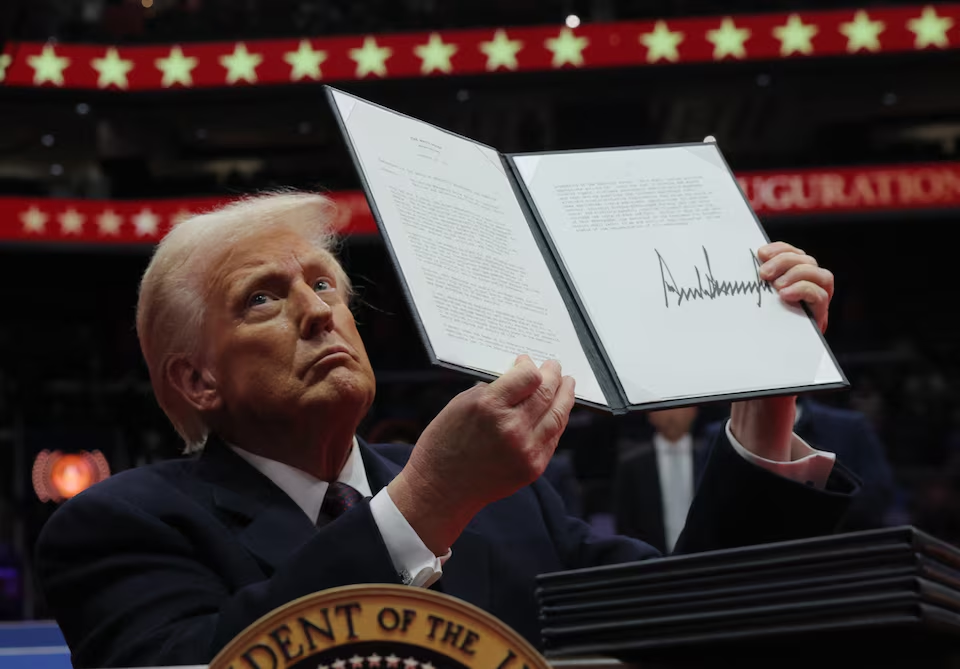
As promised, President Trump signed several Executive Orders on his first day in office aimed at, depending on who you believe, eroding the power of The Deep State, making government employment sufficiently miserable that hordes quit, or some combination of those things. Most notable among these are orders seeking to curtail Civil Service protections for those deemed to be in “policy-connected” positions; ending telework; and a hiring freeze.
WaPo (“Trump reinstates plan to strip protections from federal workers“):
President Donald Trump on Monday reinstated a policy to strip employment protections from tens of thousands of federal workers, potentially allowing his administration to reshape agencies by stocking them with political loyalists.
The executive order was one of multiple first-day Trump directives aimed at overhauling the federal workforce of 2.3 million — including a hiring freeze, a strict return-to-office mandate, an update of hiring rules and changes designed to bring more accountability to career senior executives, in part by making them easier to dismiss.
The White House described the order stripping employment protections from agency employees as necessary to rein in what Trump and his allies have called a “deep state” of bureaucrats who resisted his plans during his first term.
“There have been numerous and well-documented cases of career Federal employees resisting and undermining the policies and directives of their executive leadership,” reads the order, signed by Trump around 9 p.m. on Monday. “Principles of good administration, therefore, necessitate action to restore accountability to the career civil service.”
Critics, though, have said the policy will upend the foundation of the modern civil service, where staffers are supposed to be hired based on merit and cannot be arbitrarily fired. Those in the new job category will have limited due process rights to appeal dismissals by the Trump administration.
“President Trump’s order is a blatant attempt to corrupt the federal government by eliminating employees’ due process rights so they can be fired for political reasons,” Everett Kelley, national president of the American Federation of Government Employees, which represents 750,000 civil servants, said in a statement. “This unprecedented assertion of executive power will create an army of sycophants beholden only to Donald Trump, not the Constitution or the American people.”
Which, of course, is a feature, not a bug, from Trump’s standpoint.
NPR (“Trump seeks to end telework for federal workers“):
President Trump has signed an executive action directing federal agencies to order their workers back to the office full time.
“Heads of all departments and agencies in the executive branch of Government shall, as soon as practicable, take all necessary steps to terminate remote work arrangements and require employees to return to work in-person at their respective duty stations on a full-time basis, provided that the department and agency heads shall make exemptions they deem necessary,” the executive memo states.
Having more federal employees work from the office has long been a focus of Republicans.
“Service backlogs and delays, unanswered phone calls and emails, and no-show appointments are harming the health, lives, and aspirations of Americans,” Iowa Senator Joni Ernst wrote in a report released late last year.
[…]
Many flexible work arrangements predate the pandemic, though the federal government, like many offices, greatly expanded telework during COVID.
A number of agencies, including the Environmental Protection Agency and the Social Security Administration, agreed to long-term telework arrangements in their collective bargaining agreements.
The American Federation of Government Employees, which represents 800,000 federal and D.C. government employees, says it expects those agreements to be honored, given the Trump memo states that the directive “shall be implemented consistent with applicable law.”
Still, in a statement, AFGE president Everett Kelley called the directive a “backward action” and asked the Trump administration to rethink its approach.
“Providing eligible employees with the opportunity to work hybrid schedules is a key tool for recruiting and retaining workers in both the public and private sectors. Restricting the use of hybrid work arrangements will make it harder for federal agencies to compete for top talent,” he wrote in a statement.
He also warned that given the success federal agencies have had consolidating unused office space and selling off properties that were costly to maintain, there may no longer be enough office space to accommodate an influx of on-site workers.
In an opinion piece in the Wall Street Journal last fall, Elon Musk and Vivek Ramaswamy, whom Trump appointed to lead his Department of Government Efficiency, or DOGE, suggested that requiring federal employees to return to the office five days a week “would result in a wave of voluntary terminations that we welcome.”
“If federal employees don’t want to show up, American taxpayers shouldn’t pay them for the Covid-era privilege of staying home,” they wrote.
Government Executive (“Trump will require agency plans to slash workforce as he lays out hiring freeze details“):
Federal agencies must develop plans to reduce the size of their workforces through efficiencies and attrition, President Trump announced on Monday, spelling out in a memorandum that they must roll out those proposals before lifting the hiring freeze he has put into place.
Trump froze federal hiring on Monday in a presidential memorandum, following the practice he established when he took office in 2017. The federal workforce reduction plans also mirror those he required in order to lift the hiring moratorium he instituted in his first term. Most agencies in that instance never wound up producing definitive plans to slash their workforces and the White House later denied it ever asked for the blueprints for cuts.
Trump’s latest hiring freeze is set to last 90 days, with the exception of the Internal Revenue Service where it will remain in effect until the Treasury Department and other officials agree it is “in the national interest” to lift it. Trump made clear that contracting out to circumvent the freeze was prohibited.
“In carrying out this memorandum, the heads of executive departments and agencies shall seek efficient use of existing personnel and funds to improve public services and the delivery of these services,” Trump wrote.
As expected, the freeze will not apply to the military or positions related to immigration enforcement, national security or public safety. The freeze will otherwise take effect regardless of the source of an agency’s funding stream. Political appointments under Schedule C the non-career Senior Executive Service will continue. The Office of Personnel Management on Monday issued new guidance allowing for an unlimited number of appointees that Trump can temporarily deploy into agencies as his administration gets up and running, overriding more limited guidance the Biden administration had put forward.
These orders were all foreshadowed in the campaign and will doubtless make a lot of people happy. Government employees are widely perceived to be lazy and overpaid.
There is already a suit filed to stop Schedule F and I expect others to follow. But, even if they’re rolled back substantially by the courts, they’ll achieve some of their desired effects. First and foremost, Trump gets the performance impact of having carried out his promises here. Second, they will almost certainly cause some of the most marketable career employees to leave government service for a more hospitable environment. The telework prohibition alone will be devastating, as many people took their jobs precisely because it offered that flexibility, which enables juggling two-earner households with children whose school schedules don’t align with a standard workday. Third, and perhaps most problematic of all, those who stay will be fearful of getting crossways with the new administration.
University of Michigan professor of public policy Don Moynihan observes,
This was better organized than before. Trump had his orders ready. Acting officials (usually career employees) were in key positions, and some of those officials had pre-drafted memos on hand. The reflects the fingerprints of the secret 180 Day Playbook aspect of Project 2025, led by Russ Vought.
Which is odd, in that we were constantly told that Trump had no connection to Project 2025 and, indeed, had never heard of it.
As to the hiring freeze, it’s worse than the media reports. Moynihan:
A new OPM memo also requires the creation of lists of federal employees still on their probationary period (usually 1 year) to be reported to OPM by January 24. This is because those officials do not have full civil service protections. The implication is that agencies will have to justify retaining those employees, or they will be fired. This is bad HR policy. The federal government has a bigger hiring than firing problem, and targeting the newest and youngest hires in an aging workforce is a terrible idea, unless the goal is simply to cut people. Which it is.
The hiring freeze may indicate a policy of cost-cutting for civil servants, but in other ways efficiency is clearly not a concern. The same OPM memo encourages agencies to use paid leave to remove employees they want to get out of the way or fire in the future.
There’s also this:
For political appointees, there is no limit on hiring. Another new OPM memo removes the traditional cap on Schedule C appointees for 240 days. As a reminder, the US government has about 4,000 political appointee positions, about 1,300 of whom are Senate-confirmed. This change could see the number of non-Senate confirmed appointees increase significantly. It fits with the broader pattern of politicization.
The same memo also created a back-door path for Senate-confirmed appointees to join the agency in an “advisory or consultative capacity.”
[…]
This effectively diminishes advise and consent power of the Senate. It puts nominees in de facto acting capacity from Day 1 of the administration, even if they cannot formally occupy the position they are nominated for. It is also a response to the Senate doing a woeful job in confirming less visible appointees in a timely fashion, or simply putting holds on appointees for reasons completely unrelated to the candidate. While this is an executive branch aggrandizement, the Senate asked for it by its incompetence and pettiness when it comes to the conformation process.
As to the telework order:
As I’ve noted before, I think this is a dumb, politics-of-resentment type of policy that Musk and Ramaswamy implied was there mainly to encourage people to quit. The federal government does not use telework at a different rate from the private sector, but it is now being told to give up on a tool that can help it hire and retain employees.
The process does allow for exemptions, and contracts with employees may make it difficult to extend this immediately or quickly, but the intent is clear. Trump also seeks to undermine collective bargaining rights, in a sprawling executive order that undid many Biden initiatives, including on DEI.
Moynihan has quite a bit more, including an analysis of the backdoor method by which Trump has created “DOGE” by placing it inside the little-known US Digital Service.









