

AP (“Trump notches a commanding win in the Iowa caucuses as DeSantis edges Haley for second place“):
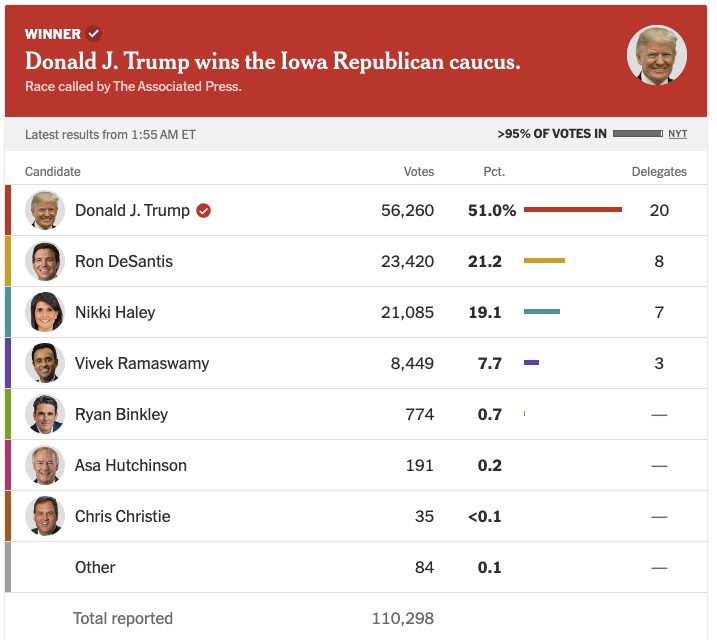
Former President Donald Trump scored a record-setting win in the Iowa caucuses on Monday with his rivals languishing far behind, a victory that affirmed his grip on the 2024 Republican presidential nomination.
In what was the lowest-turnout caucus in a quarter-century, participants endured life-threatening cold and dangerous driving conditions to meet in hundreds of schools, churches and community centers across the state. But those who ventured out delivered a roughly 30-point win for Trump that smashed the record for a contested Iowa Republican caucus with a margin of victory exceeding Bob Dole’s nearly 13-percentage-point victory in 1988.
Florida Gov. Ron DeSantis finished a distant second, just ahead of former U.N. Ambassador Nikki Haley.
The results left Trump with a tighter grip on the GOP nomination, though it could take several more months for anyone to formally become the party’s standard bearer. The magnitude of Trump’s victory, however, posed significant questions for both DeSantis and Haley. Neither candidate appeared poised to exit the race, though they leave Iowa struggling to claim making much progress in trying to become Trump’s strongest challenger.
Having repeatedly vowed vengeance against his political opponents in recent months, Trump offered a message of unity in his victory speech.
“We want to come together, whether it’s Republican or Democrat or liberal or conservative,” he said. “We’re going to come together. It’s going to happen soon.”
The GOP contest moves swiftly to New Hampshire, which will hold the first-in-the-nation primary on Jan. 23. A shrinking field will compete there after conservative entrepreneur Vivek Ramaswamy suspended his campaign after a disappointing fourth place finish and endorsed Trump.
AP (“Most Trump supporters in Iowa caucuses say they knew they’d support him all along, AP VoteCast shows“):
In some ways, Iowa’s Republican caucuses were practically over before they began, with Donald Trump cultivating a deep network of support over three presidential runs.
About 7 in 10 Iowans who caucused for Trump on Monday night said they have known all along that they would support a man who has remade the Republican Party through his “Make America Great Again” political movement. Trump was carried to victory by the majority of caucusgoers who say they back it, a sign of his growing influence in a state that denied him a victory eight years ago.
His chief challengers — Florida Gov. Ron DeSantis, former South Carolina Gov. Nikki Haley and biotech entrepreneur Vivek Ramaswamy — tried to carve out their own coalitions. But none could match the demographic edges enjoyed by Trump in this year’s first presidential contest, according to the findings from AP VoteCast. Ramaswamy said he is suspending his campaign after a disappointing finish in the caucuses.
Trump performed strongly in small town and rural communities, where about 6 in 10 caucusgoers said they live. He won with white evangelical Christians, who are nearly half of the caucusgoers. He excelled among those without a college degree.
CNN (“Iowa entrance poll: Most GOP caucusgoers don’t accept Biden’s 2020 win, say a conviction wouldn’t make Trump unfit for office“):
Most Iowa GOP caucusgoers refuse to accept President Joe Biden’s 2020 election victory and say they would view former President Donald Trump, whom CNN projected will win the caucuses Monday night, as fit for office even if convicted of a crime, according to CNN’s entrance poll for the Iowa Republican presidential caucuses.
Trump’s victory highlights his strength among key groups that form the bulk of the GOP electorate, according to the entrance poll. Roughly half of Iowa caucusgoers described themselves as “very conservative,” and nearly half identified as part of the MAGA movement, referring to the “Make America Great Again” slogan popularized by Trump in 2016. Broad majorities in both of those groups broke for Trump, as did the lion’s share of White evangelicals and those age 65 and older.
The results also highlight the stark educational divide that has become a defining feature of the GOP electorate. While Trump held a commanding lead among Iowa caucusgoers without college degrees, college graduates were more closely divided among Trump, former South Carolina Gov. Nikki Haley and Florida Gov. Ron DeSantis.
Entrance polls are a valuable tool to help understand caucusgoers’ demographic profile and political views. Like all surveys, however, entrance polls are estimates, not precise measurements of the electorate. That’s particularly true for the preliminary set of entrance poll numbers, which haven’t yet been weighted to match the final results of the caucus. But the results provide a glimpse of the type of voters turning out to participate in the first contest of the 2024 campaign.
The results of the entrance poll mark a shift in the Republican electoral landscape from the 2016 Iowa caucuses, when White evangelicals and very conservative votes broke in favor of Texas Sen. Ted Cruz over Trump. (Cruz went on to win the state that year but lost the nomination to Trump.)
Trump’s strength with the Iowa electorate is also evident in caucusgoers’ response to his previous election loss and the criminal charges he faces. About two-thirds said they do not believe that Biden’s victory over Trump more than three years ago was legitimate. There is no evidence of widespread voter fraud in the 2020 election. More than 6 in 10 said that they would consider Trump fit for the presidency if he were to be convicted of a crime, with only about one-third saying they wouldn’t see him as fit in that circumstance.
Among the minority of caucusgoers who said Trump would be unfit for the presidency if convicted, about half backed Haley on Monday, with about one-third supporting DeSantis.
Trump’s support in Iowa has been locked in for some time, the entrance poll suggests, while his rivals have seen more recent gains. About 80% of Trump’s supporters said they made their decision to back him prior to this month. By contrast, a majority of Haley’s supporters said they made their decision sometime in January, as did roughly half of DeSantis’ backers.
Asked which of four personal qualities mattered most to them in a candidate, about 4 in 10 caucusgoers said they wanted to see a candidate who shared their values and about 3 in 10 that they wanted someone would fight for people like them, with fewer looking for a candidate who had the right temperament or could defeat Biden. While voters’ decision-making processes are too complicated to be described by a single question, the divide in responses highlights the very different appeals that Trump, DeSantis and Haley offer to their respective supporters.
Roughly half of Trump supporters said they were looking for a candidate who would fight for people like them, with about one-third prioritizing a candidate who shared their values, and few attributing their decision to Trump’s temperament or perceived electability. A wide majority of DeSantis supporters, by contrast, said they most wanted to see a candidate who shared their values. And Haley supporters were more divided: about 37% said they prioritized temperament, 27% a candidate who shared their values, and 24% someone who could defeat Biden, with few looking for a fighter on their behalf.
Pretty much, if not every, Iowa Caucus iteration since 2004 has produced at least one OTB post about how stupid caucusing and, in particular, starting the official campaign season with a caucus in lily-white Iowa is as a way of gauging national popular support. Steven Taylor’s “The Absurdity of Iowa” filled that duty for this cycle.
The absurdity is further magnified by having a quasi-incumbent in the race, particularly one who’s dominated the polls from the outset. Record-setting cold further exacerbates the situation in that, if you know your favorite candidate will, at best, finish a distant second it’s going to be really hard to get motivated to risk your life to participate.
That’s a long way of saying that I don’t think these results tell us anything we didn’t already know about the viability of Nikki Haley vis-a-vis Ron DeSantis. But they certainly re-emphasize that Trump’s taking the Republican nomination for a third straight cycle is all but inevitable.
Indeed, despite a relative dearth of polling, the night wound up damn close to the RealClearPolitics projection:









