As the Saudi war on Yemen, with it’s countless human rights abuses that have led to famine, the death of innocent families and children, and the transformation of Yemen into what is likely to become the next breeding ground for terrorists, President Trump has not unexpectedly vetoed a Congressional effort to limit American involvement in and aid to a war that is most assuredly not in our interest:
WASHINGTON — President Trump vetoed a bipartisan resolution on Tuesday that would have forced an end to American military involvement in Saudi Arabia’s civil war in Yemen, rejecting an appeal by lawmakers to his own deeply rooted instincts to withdraw the United States from bloody foreign conflicts.
The veto, only the second time Mr. Trump has used his power to block legislation passed by both houses of Congress, strikes down a resolution that invoked the War Powers Act to distance the United States from a four-year conflict that has killed thousands of civilians and resulted in a widespread famine.
The measure was a rebuke of Mr. Trump’s support for Saudi Arabia even after the killing of the dissident journalist Jamal Khashoggi. It was opposed by several of the president’s top advisers, including Secretary of State Mike Pompeo and the national security adviser, John R. Bolton, according to people who spoke with White House officials.
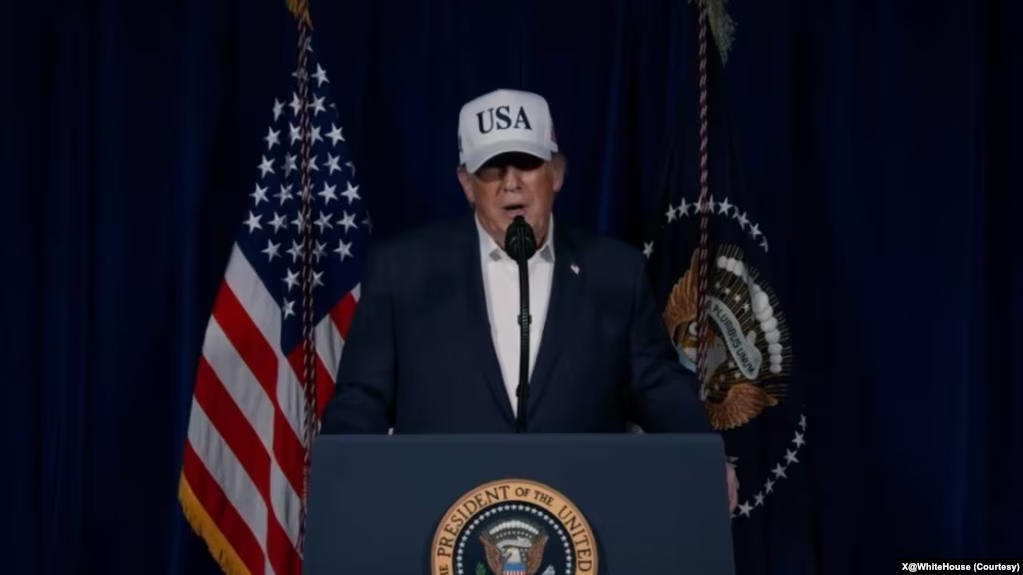
“This resolution is an unnecessary, dangerous attempt to weaken my constitutional authorities, endangering the lives of American citizens and brave service members, both today and in the future,” Mr. Trump said in his veto message.
The veto came only a month after Mr. Trump similarly rejected a bipartisan measure that would have overturned his declaration of a national emergency at the southwestern border. Congress failed to override that veto and appears similarly unlikely to muster the votes to override the Yemen veto.
Supporters of this resolution had higher hopes that Mr. Trump might sign it. Although it went against a key ally, Saudi Arabia, it played to his longstanding opposition to American involvement in foreign wars. This was the first time War Powers legislation passed Congress with bipartisan support and reached a president’s desk.
But the rebuke of Saudi Arabia and the perceived threat to Mr. Trump’s executive powers played a bigger role in his decision.“This is deeply disappointing,” said Representative Ro Khanna, Democrat of California, who was one of the original sponsors of the measure in the House and had sought a meeting with Mr. Trump to try to persuade him to sign it.
“The president had the opportunity to sign a historic War Powers Resolution and stand with a bipartisan coalition, including his allies Rand Paul, Mark Meadows and Matt Gaetz, to stop endless wars,” Mr. Khanna said. “He failed to uphold the principles of the Constitution that give Congress power over matters of war and peace.”
Mr. Khanna was referring to the Republican senator from Kentucky, Mr. Paul, and two Republican representatives, from North Carolina and Florida, Mr. Meadows and Mr. Gaetz, who are closely aligned with Mr. Trump, but split with fellow Republicans to vote with Democrats in favor of the resolution. Members of the group had asked to meet with Mr. Trump to make their case against a veto, but the White House brushed them off.
Mr. Trump has spoken out for years against American military entanglements, whether in Iraq, Afghanistan or Syria. He has clashed with his generals over the timetable for withdrawing troops from Afghanistan and Syria.
In his veto message, Mr. Trump said he agreed with Congress that “great nations do not fight endless wars.” He noted that the United States was negotiating to end its involvement in Afghanistan and drawing down troops in Syria, after what he said was the conquest of 100 percent of the territory once held by the Islamic State.
Yemen, however, is a different situation, he declared. The United States provides logistical support to the Saudi-led coalition against the Houthi rebels. It stopped its most direct military involvement: in-flight refueling of Saudi planes. And Saudi Arabia remains a staunch ally of the United States, the linchpin of its campaign to isolate Iran, which supports the Houthis in their uprising against the Yemeni government.
“We cannot end the conflict in Yemen through political documents,” Mr. Trump said. “Peace in Yemen requires a negotiated settlement.”
(…)
Senator Tim Kaine, Democrat of Virginia and an advocate for congressional prerogative on matters of war, said the veto was “part of an alarming pattern of Trump turning a blind eye to Saudi Arabia’s actions that fly in the face of American values, like the murder of journalist and Virginia resident Jamal Khashoggi and the jailing of women’s right activists.”
Mr. Trump spoke by phone last week with Saudi Arabia’s crown prince, Mohammed bin Salman, whom intelligence officials believe ordered the killing of Mr. Khashoggi in October in the Saudi Consulate in Istanbul. Mr. Trump has not accepted that assessment, saying the prince’s role in the killing was not clear.
As James Joyner noted earlier this month when Congress passed the resolution that the President has vetoed, this is part of a debate between the Executive and Legislative Branches that goes back decades if not longer.
As I have noted several times in the past, the history of the United States, especially since the end of World War Two, has seen Congress gradually cede more and more authority in this area to Presidents who have proven to be more than willing to take that authority and run with it, thus expanding the power and scope of Presidential authority far beyond where Article II of the Constitution intended it to lie. Even on occasions where Congress has sought to rein in that power, such as with the passage over President Nixon’s veto of the War Powers Act in 1973, the move has proven to be entirely ineffective largely because no President has considered themselves bound by that law and the Courts have proven unwilling to step in and intervene in cases where the President clearly seems to be acting in violation of the law. Finally, Congress has generally until now been unwilling to exercise its authority as appropriator of funds to limit Presidential authority in cases of overseas military deployments, typically because most Congressman and Senators are loathed to be seen as taking money away from the troops that have been committed by the President even in situations where that deployment is clearly outside Presidential authority. Hopefully, this moves marks the beginning of a new trend in which there will be more oversight of Presidential action when it comes to foreign and military policy. So, while the President’s veto is inexcusable and unfortunate it may ultimately serve the purpose of making Congress reassert some of its authority in an area it has neglected for far too long.
As Daniel Larison notes, the President’s purported defense of his veto is particularly weak:
As long as the U.S. is providing logistical and intelligence support to the Saudi coalition, deploying troops to the Saudi border with Yemen, and assisting in the enforcement of the naval blockade, it is a party to the conflict and engaged in hostilities.When the president and other officials claim otherwise, they are not telling the truth. The administration very much wants to have things both ways. On the one hand, they will say that the U.S. isn’t a party to the conflict and therefore the resolution isn’t needed, but then they’ll insist that U.S. involvement in the conflict must continue for the sake of the Saudi relationship, weapons sales, and so on. Supporters of the war are desperate to claim at the same time that U.S. involvement is so meager that it doesn’t amount to hostilities but also so vitally important that it must not be ended. Of course, if the U.S. role were really as small as they sometimes claim, there would be no danger in ending it, and if it is as significant as they say at other times it is absolutely appropriate for Congress to shut it down because Congress never authorized it.
As Larison goes on to note, one of the more prominent arguments that Administration officials have made for continuing to support what amounts to Saudi genocide is the idea that it is intended to counter Iran, which has backed a rival faction in the ongoing Yemeni civil war. In reality, continuing to back the Saudis is only helping to strengthen Iran:
To the extent that Iran is involved at all, it is the continuation of the war that gives Iran this opportunity to cause trouble. The longer that the U.S. supports the Saudi coalition and keeps the war going, the better things are for Iran. Iran’s involvement in Yemen has always been very limited, but it has increased because of the war and the best way to make sure that it doesn’t continue to increase is to pressure the Saudis and Emiratis to bring the war to an end. Otherwise, the Saudis and the UAE will remain bogged down in a quagmire of their own choosing, and the U.S. will continue to be implicated in their many crimes because of the support Trump refuses to end.
American support for the Yemeni war is, as Larison has said elsewhere, a prime example of everything wrong with American foreign policy. In the beginning, it was motivated by both blind allegiances to the idea that we ought to back so-called allies even when we don’t have an obligation to do so and by the idea that the Saudi war on Yemen was in some sense a proxy war against Iran. In the first case, it has resulted in the refusal of both the Obama and Trump Administrations to hold our supposed friends in Saudi Arabia accountable for the numerous human rights violations they and their allies were committing in the name of that war from the beginning. At the same time, the war was and is seen by many inside both Administrations, and many outside analysts as a way of engaging against Iran given the fact that the Houthi rebels that are the primary target of the war are loosely allied with Iran. While the United States is not directly involved in the conflict, our support for the Saudis and their allies from the United Arab Emirates is as close to involvement as one can get without actually putting American boots on the ground. From the beginning it was a war of choice started by the Saudis and our involvement, albeit on the sidelines, has also been a conscious choice notwithstanding the fact that there are no American interests implicated in the conflict and that, arguably, American interests are being harmed the longer the war is allowed to continue and the deeper Yemen is plunged into the kind of chaos that will inevitably turn it into the same kind of breeding ground for terrorists that we saw in pre-9/11 Afghanistan and more recently in Syria and Libya.
At some point down the line, I’m afraid, we are going to pay a price for turning a blind eye to the war crimes and human rights violations that the Saudis and Emiratis are committing with our full support in their war on Yemen. What that price will be is unclear at this point, but it could include everything from the establishment of an Iranian-backed beachfront on the Arabian Peninsula to a breeding ground for a whole new generation of terrorists that will direct their aim at the United States and other Western targets. At that point, we’ll wonder why they’re so mad at us, and most people won’t even realize that it was our own support for this genocidal war that created a new generation of enemies. For that reason alone, Trump’s veto of this resolution, while understandable from the point of view of the seemingly never-ending push and pull between Congress and the Executive Branch over war powers and foreign policy, is inexcusable.