AP (“US strikes Venezuela and says its leader has been captured and flown out of the country“):
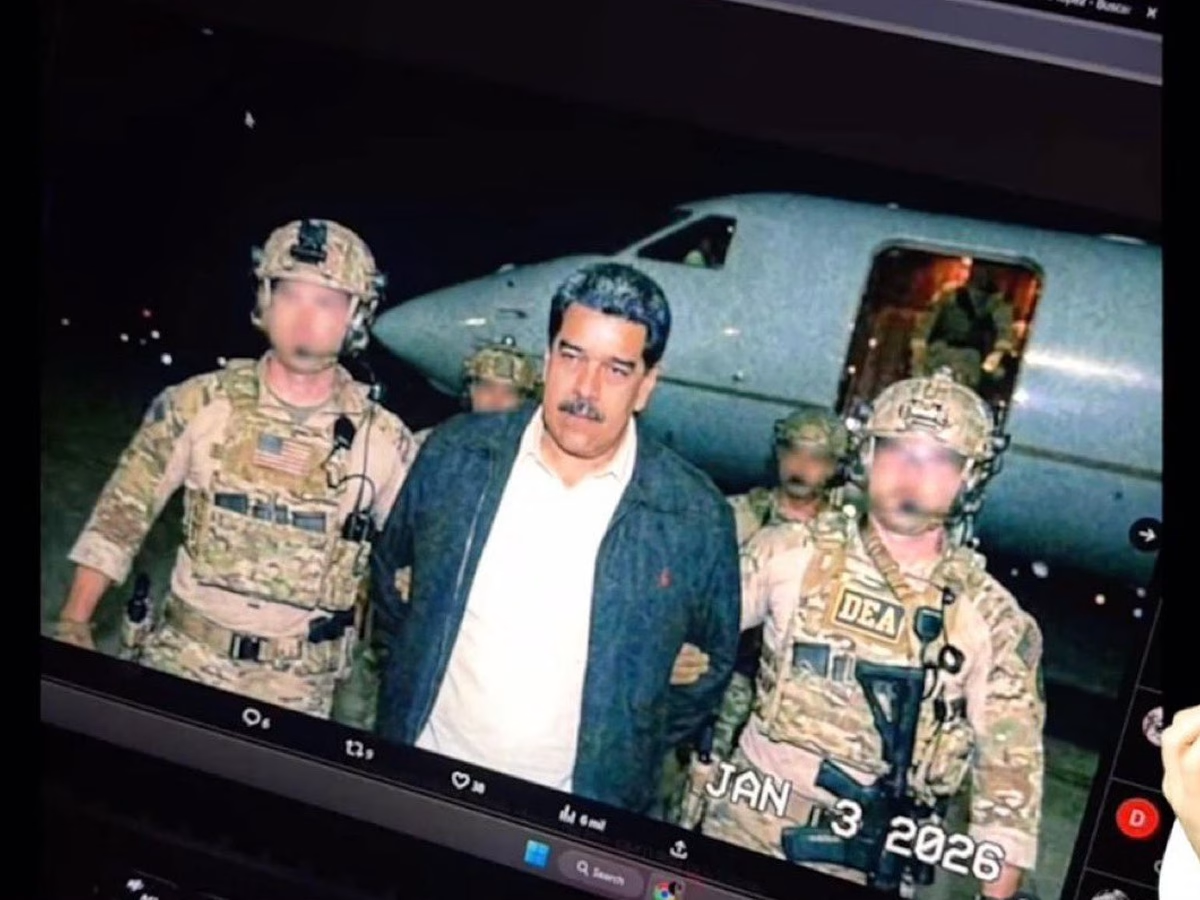
The United States hit Venezuela with a “large-scale strike” early Saturday and said its president had been captured and flown out of the country after months of intense pressure on Nicolás Maduro’s government — an extraordinary nighttime operation announced by President Donald Trump on social media hours after the attack.
The legal authority for the strike — and whether Trump consulted Congress beforehand — was not immediately clear. The stunning American military action, which plucked a nation’s sitting leader from office, echoed the U.S. invasion of Panama that led to the surrender and seizure of its leader, Manuel Antonio Noriega, in 1990 — exactly 36 years ago Saturday.
U.S. Attorney General Pam Bondi said Maduro and his wife, Cilia Flores, would face charges after an indictment in New York. Bondi vowed in a social media post that the couple would “soon face the full wrath of American justice on American soil in American courts.”
Maduro and other Venezuelan officials were indicted in 2020 on “narco-terrorism” conspiracy charges, but it was not previously known that his wife had been and it wasn’t clear if Bondi was referring to a new indictment. The details of the allegations against Flores were not immediately known.
Early Saturday, multiple explosions rang out and low-flying aircraft swept through the Venezuelan capital, as Maduro’s government accused the United States of attacking civilian and military installations, calling it an “imperialist attack” and urging citizens to take to the streets.
With Maduro’s whereabouts not known, the vice president, Delcy Rodríguez, would take power under Venezuelan law. There was no confirmation that had happened, though she did issue a statement after the strike.
“We do not know the whereabouts of President Nicolás Maduro and First Lady Cilia Flores,” Rodríguez said. “We demand proof of life.”
[…]
The attack itself lasted less than 30 minutes and the explosions — at least seven blasts — sent people rushing into the streets, while others took to social media to report what they’d seen and heard. Some Venezuelan civilians and members of the military were killed, according to Rodríguez, the vice president, without giving a number.
It was not known if there more actions lay ahead, though Trump said in his post that the strikes were carried out “successfully.”
Sen. Mike Lee, R-Utah, posted on X that Secretary of State Marco Rubio had briefed him on the strike and said that Maduro “has been arrested by U.S. personnel to stand trial on criminal charges in the United States.”
NYT (“Live Updates: U.S. Captures Venezuelan Leader, Trump Says“) adds:
A U.S. official said there had been no American casualties in the operation but would not comment on Venezuelan casualties.
In a brief phone interview with The New York Times after the announcement, Mr. Trump celebrated the success of the mission to capture the Venezuelan president. “A lot of good planning and lot of great, great troops and great people,” he said. “It was a brilliant operation, actually.”
When asked if he had sought congressional authority for the operation or what is next for Venezuela, Mr. Trump said he would address those matters during a news conference at 11 a.m. at Mar-a-Lago, his private club and residence in Palm Beach, Fla.
[…]
Since late August, the Pentagon has amassed troops, aircraft and warships in the Caribbean. The U.S. military has attacked many small vessels that U.S. officials maintained were smuggling drugs, killing at least 115 people. And the C.I.A. conducted a drone strike on a port facility in Venezuela last month, according to people briefed on the operation.
A broad range of experts on the use of lethal force have said that the strikes on small vessels amount to illegal extrajudicial killings, but the Trump administration has asserted they are consistent with the laws of war because the United States is engaged in an armed conflict with drug cartels.
Axios (“Trump faces quick criticism from Democrats over Maduro capture“):
President Trump is already being blasted by congressional Democrats for ordering strikes on military targets in Caracas, as part of an overnight operation that resulted in the capture of Venezuelan President Nicholas Maduro.
[…]
The lawmakers say the president blatantly overstepped his authority by not seeking congressional authorization for the operation beforehand.
[…]
Republicans have praised and defended the move, with Sen. Mike Lee (R-Utah) saying Trump “likely” acted under his authority in Article II of the U.S. Constitution to defend American troops overseas.
“This strike doesn’t represent strength. It’s not sound foreign policy,” said Sen. Andy Kim (D-N.J.) in a post on X, who pointed to polling that shows broad voter disapproval towards armed conflict in Venezuela. The operation, Kim said, “sends a horrible and disturbing signal to other powerful leaders across the globe that targeting a head of state is an acceptable policy for the U.S. government.”
Rep. Darren Soto (D-Fla.), while praising Maduro’s capture as a “major step” towards a free Venezuela, added on X that “Trump’s failure to seek Congressional approval for these strikes raises serious questions about the legality of the mission.”
“Congress did not authorize this war. Venezuela posed no imminent threat to the United States,” said Rep. Seth Moulton (D-Mass.).
Both Soto and Kim noted that top Trump officials previously testified to Congress that the U.S. was not seeking to oust Maduro, and would seek congressional authorization for any ground operations in Venezuela. “Congress must now conduct extensive hearings on the attack and all efforts to restore democracy in Venezuela,” said Soto.
“Nicolas Maduro wasn’t just an illegitimate dictator; he also ran a vast drug-trafficking operation,” Senate Intelligence Committee Chairman Tom Cotton (R-Ark.), a member of GOP leadership, said in a post on X. “That’s why he was indicted in U.S. court nearly six years ago for drug trafficking and narco-terrorism,” Cotton continued, adding that Muduro would now “face justice for his crimes against our citizens.” “The interim government in Venezuela must now decide whether to continue the drug trafficking and colluding with adversaries like Iran and Cuba or whether to act like a normal nation and return to the civilized world. I urge them to choose wisely,” he said.
The NYT Editorial Board (“Trump’s Attack on Venezuela Is Illegal and Unwise“) sides with the Democrats:
Few people will feel any sympathy for Mr. Maduro. He is undemocratic and repressive, and has destabilized the Western Hemisphere in recent years. The United Nations recently issued a report detailing more than a decade of killings, torture, sexual violence and arbitrary detention by henchmen against his political opponents. He stole Venezuela’s presidential election in 2024. He has fueled economic and political disruption throughout the region by instigating an exodus of nearly eight million migrants.
If there is an overriding lesson of American foreign affairs in the past century, however, it is that attempting to oust even the most deplorable regime can make matters worse. The United States spent 20 years failing to create a stable government in Afghanistan and it replaced a dictatorship in Libya with a fractured state. The tragic consequences of the 2003 war in Iraq continue to beset America and the Middle East. Perhaps most relevant, the United States has sporadically destabilized Latin American countries, including Chile, Cuba, Guatemala and Nicaragua, by trying to oust a government through force.
Mr. Trump has not yet offered a coherent explanation for his actions in Venezuela. He is pushing our country toward an international crisis without valid reasons. If Mr. Trump wants to argue otherwise, the Constitution spells out what he must do: Go to Congress. Without congressional approval, his actions violate United States law.
While I am not a lawyer, I study U.S. defense policy and adjacent areas for a living. I can think of no justification for this action under U.S. or international law.
That said, this is hardly without precedent. When I first saw the headline in the middle of the night, my initial reaction was that we had not openly invaded a Latin American country to enact regime change since the Bay of Pigs fiasco. But then I remembered the operation to seize the Panamanian leader, Manuel Noriega, which was somewhat ironically dubbed JUST CAUSE. (Some wags referred to it as JUST ‘CUZ.) That today marks the 36th anniversary of his surrender to U.S. forces compounds the irony.
Like Noriega, Maduro had been indicted by U.S. courts for drug trafficking. Like Noriega, he retained power after a stolen election. Then, as now, Congress had not been consulted, much less declared war. (They had, however, issued several proclamations calling on Noriega to step down.)
The similarities mostly end there. The United States had a substantial military presence in Panama ahead of the invasion. Noriega had declared a state of war against the United States, and an American Marine, Lieutenant Robert Paz, had been killed by the Panamanian Defense Forces. President George H.W. Bush used that as a proximate cause, arguing that 35,000 American lives were in danger.
Beyond that, whatever the wisdom of invading a country and toppling its leader, Maduro and Noriega are hardly the only cases where the United States has done that. Indeed, we did it somewhat routinely during the Cold War, albeit almost always in clandestine operations with at least some plausible deniability. Since then, we’ve toppled the governments of Afghanistan, Iraq, and Libya and intervened in support of favored leaders in Iraqi Kurdistan, Somalia, Haiti, Bosnia, Kosovo, and elsewhere. In only a handful of those instances did Congress authorize use of military force; in a few cases, Presidents acted against the express wishes of Congress.
Regardless of the plain meaning of Article I, Section 8, Presidents have long since taken upon themselves the de facto power to commit troops under their Article II role as Commander-in-Chief of the armed forces. For reasons political and practical, Congress has seldom taken action to claw that power back.
Indeed, the most recent serious effort to do so—the 1973 War Powers Resolution, which passed over President Richard Nixon’s veto—was a de facto admission of their own institutional weakness. With a large standing military at their disposal, Presidents have the first-mover advantage. Further, Congress largely recognizes the utility of allowing Presidents considerable leeway to act in fast-moving situations.
In this particular instance, based on what I know from open sources, it is not at all obvious why immediate action was necessary. The appropriate Congressional committees could have been consulted and asked for authorization. Whether the administration saw some exigency that I’m missing, believed Congress would not in fact give authorization, or simply thought they had the requisite authority to act, time will tell.