
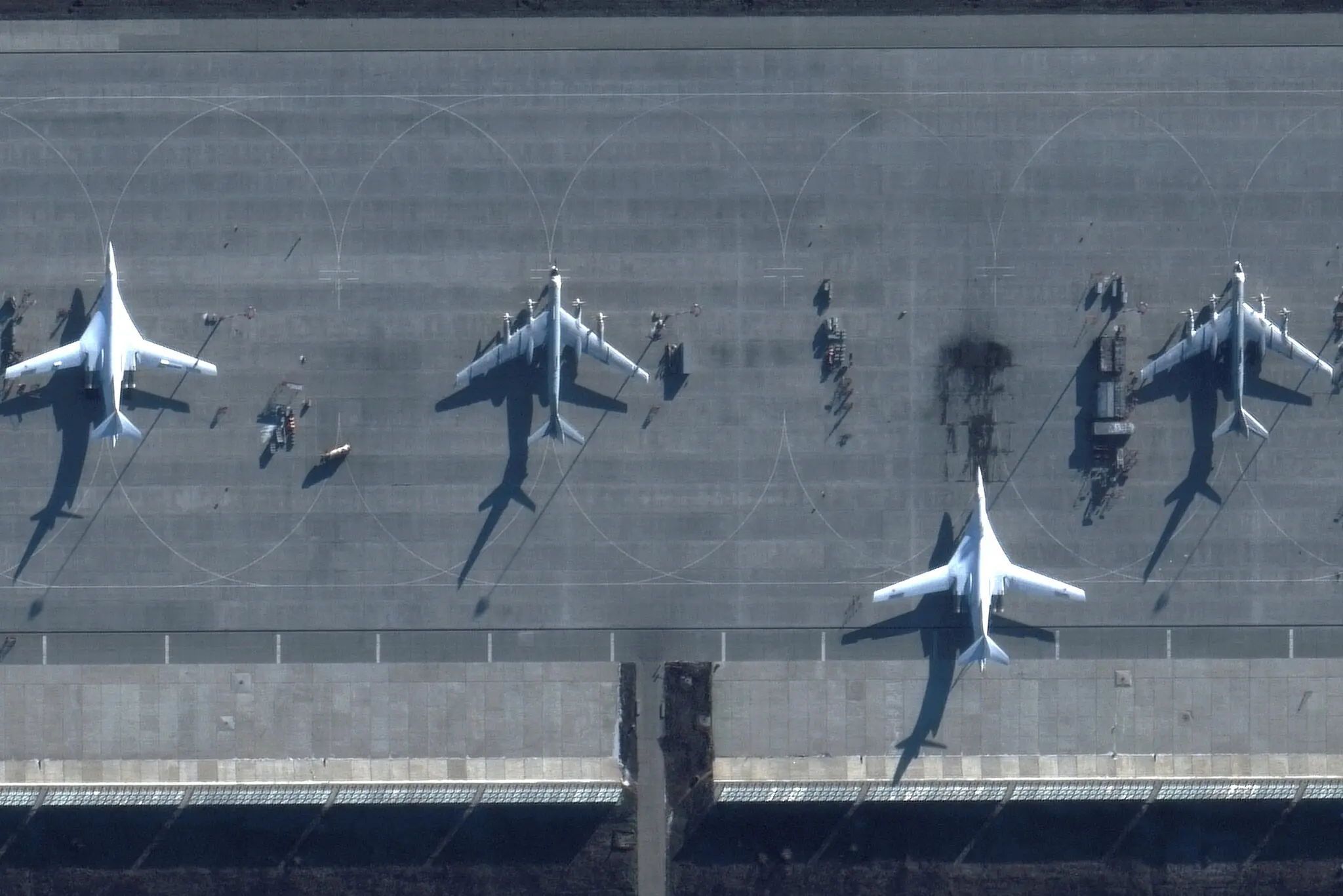

For months, Ukrainian leaders have asked for longer-range missiles, which US leaders have not provided, fearing escalation of the war with Russia. Yesterday, we learned that we’ve gone so far as to secretly modify HIMARS rocket launchers so they couldn’t fire at full range. It turns out, Ukrainian forces can strike Russian targets without those tools.
NYT (“Ukraine Targets Bases Deep in Russia, Showing Expanded Reach“):
Ukraine executed its most brazen attack into Russian territory in the nine-month-old war on Monday, targeting two military bases hundreds of miles inside the country using drones, according to the Russian defense ministry and a senior Ukrainian official.
The drones were launched from Ukrainian territory, and at least one of the strikes was made with the help of special forces close to the base who helped guide the drones to the target, said the official, speaking on condition of anonymity to convey sensitive information.
The strikes signaled a new willingness by Kyiv to take the fight to bases in the heart of Russia, raising the stakes in the war, and demonstrated an improved ability to attack at a distance. Shortly after the attacks on the bases, Russia sent a barrage of missiles streaking toward Ukrainian cities.
The Kremlin said that the weapons launched by Ukraine were Soviet-era jet drones and were aimed at bases in Ryazan and Engels, about 300 miles from the Ukrainian border. It said that its forces had intercepted the drones, and that “the fall and explosion of the wreckage” had “slightly damaged” two planes, killing three servicemen and wounding four others.
The Engels airfield, on the Volga River in southern Russia, is a base for some of Russia’s long-range, nuclear-capable bombers, including the Tupolev-160 and Tupolev-95. Ukrainian officials say it is also a staging ground for Russia’s unrelenting campaign of missile attacks on infrastructure, which have left millions of Ukrainians with intermittent light, heat or water — or none at all — at the onset of winter. Security footage from an apartment complex near the base showed a fireball lighting up the sky.
The other explosion occurred at the Dyagilevo military base in the central city of Ryazan, about 100 miles from Moscow, according to Russia’s defense ministry. It was there that the fatalities and injuries occurred, the Russian state news agency RIA Novosti reported.
Ukraine’s government declined to publicly acknowledge the strikes, in keeping with its practice of intentional ambiguity on attacks in Russia and Russian-occupied Crimea. But officials have established a pattern of comments suggestive of Ukraine’s involvement.
[…]
Ukraine’s state-owned weapons maker, Ukroboronprom, said in October that it was “finalizing the development” of a drone with a 165-pound warhead and a range of more than 600 miles, and said on Sunday that it had completed tests of the weapon.
“We hope to be able to test it in combat use,” Natalia Sad, a spokeswoman for the arms maker, said on national television Sunday night.
It was not clear how Ukrainian special forces were able to infiltrate Russia, or how close to either base they got. But the car bomb assassination in August of the ultranationalist commentator Daria Dugina, believed to have been carried out by Ukrainians, showed similar capabilities.
“Ukraine’s ability to strike deep into Russian territory is not just militarily significant,” said Max Bergmann, a former American diplomat and expert on European and Russian security at the Center for Strategic and International Studies in Washington.
“It also sends a message to Russia that continuing the war is not cost-free, that it is not just Ukraine which is vulnerable to long range drone and missile strikes; so is Russia,” Mr. Bergmann said. “This is useful for Kyiv, since when or if the two countries ever sit down, a commitment to stop attacks on Russian territory is now a valuable chip Ukraine has to offer.”
This is a positive development, indeed. So long as Ukraine makes a good faith effort to limit its strikes to legitimate military targets—military bases, weapons production facilities, command and control headquarters, and the like—they press their advantage and put more pressure on Putin’s regime to end their illegal war. The contrast with Russian forces constantly committing war crimes, striking civilian infrastructure in a terror campaign against the population, will be stark.









