
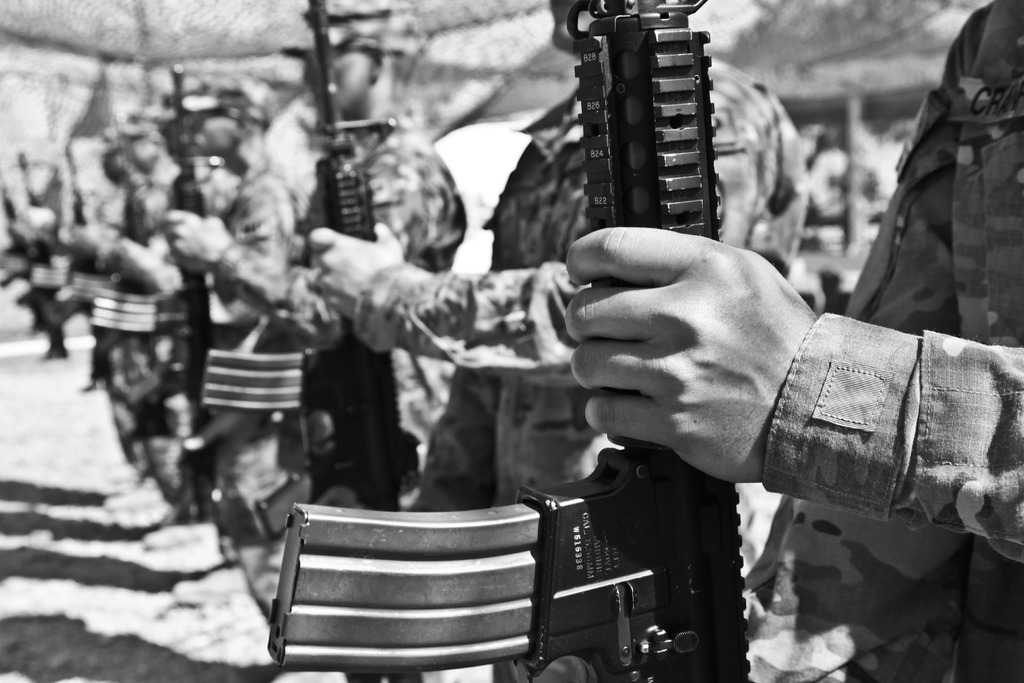

The United States has had fighting forces in Afghanistan for over eighteen years.* That may be about to end. Then again, we’ve thought that before.
ABC News previewed the deal yesterday afternoon:
After a week-long deal to reduce violence across Afghanistan, the U.S. and the Taliban are set to sign a historic agreement Saturday that would see U.S. troops start to withdraw, according to a statement issued Friday afternoon by President Donald Trump.
“Soon, at my direction, Secretary of State Mike Pompeo will witness the signing of an agreement with representatives of the Taliban, while Secretary of Defense Mark Esper will issue a joint declaration with the government of Afghanistan. If the Taliban and the government of Afghanistan live up to these commitments, we will have a powerful path forward to end the war in Afghanistan and bring our troops home,” Trump said.
WaPo has just reported that the deal is done:
The United States and the Taliban signed a peace deal Saturday that calls for the full withdrawal of American troops from Afghanistan within 14 months — a turning point in an 18-year war that has cost tens of thousands of lives.
The complete withdrawal of U.S. and coalition troops is contingent on a guarantee from the Taliban that Afghan soil will not be used by terrorists with aims to attack the United States or its allies, according to a copy of the agreement released by the State Department as the signing was underway.
But the Taliban does not have full control over all areas outside government hands. Other factions, including breakaway Taliban groups and others claiming allegiance to the Islamic State, have footholds around the country and potentially could grow stronger without U.S.-led forces to keep them in check.
Other major challenges lie ahead: Afghanistan’s deepening political crisis, a controversial prisoner swap and complex intra-Afghan talks that could drag on for months or longer.
Even the relative calm in Afghanistan over the past week — a precondition for the peace deal signing — was thrown into question.
The spokesman for the Taliban’s Qatar office, Suhail Shaheen, told The Washington Post that the Taliban hoped for a “permanent solution” to violence levels. But the pledge for a week-long period of reduced violence has “ended,” he said.[…]
The deal signing came after a seven-day “reduction in violence” in which U.S., Afghan and Taliban forces pledged not to carry out offensive operations. The agreement does not specify whether that commitment would continue. Instead, it notes that a cease-fire would need to be agreed upon in intra-Afghan talks that are expected to start in 10 days.
The withdrawal will begin with a drawdown to 8,600 troops within 135 days, according to the document. During that time, U.S. allies and coalition members will also proportionally draw down their forces.
NYT adds:
The war in Afghanistan in some ways echoes the American experience in Vietnam. In both, a superpower bet heavily on brute strength and the lives of its young, then walked away with seemingly little to show.
American efforts to instill a democratic system in the country, and to improve opportunities for women and minorities, are at risk if the Taliban, which banned girls from schools and women from public life, become dominant again. Corruption is still rampant, the country’s institutions are feeble, and the economy is heavily dependent on American and other international aid.
The signing of the agreement in Doha, Qatar, which followed more than a year of stop-and-start negotiations and conspicuously excluded the American-backed Afghanistan government, is not a final peace deal and could still unravel.
But it is seen as a step toward negotiating a more sweeping agreement that some hope could eventually end the insurgency of the Taliban, the militant movement that once ruled Afghanistan under a severe Islamic code.
The war cost $2 trillion and took the lives of more than 3,500 American and coalition troops and tens of thousands of Afghans since the U.S. invasion in aftermath of the Sept. 11 attacks, which were plotted by Al Qaeda leaders under the protection of the Taliban.
The withdrawal of American troops — about 12,000 are still in Afghanistan — is dependent on the Taliban’s fulfillment of major commitments that have been obstacles for years, including its severance of ties with international terrorist groups such as Al Qaeda.
Spencer Ackerman is bleaker still. His headline says it all: “The Taliban Peace Deal Might Have Been Had Many Years and Thousands of Lives Ago.”
No one will ever know what would have happened if Rumsfeld and the George W. Bush administration had permitted Karzai and Omar to work out a deal—whether it would have held, whether the Taliban would have truly broken with al Qaeda, whether Afghanistan would have known peace. But there is brutal certainty about what happened instead: 2,298 dead U.S. servicemembers and at least 43,000 dead Afghans in a war the U.S. fought for a generation rather than admit it could not win.
Ackerman hands out unexpected praise:
Whatever emerges, Trump—to his credit and to the shame of those Trump critics who consider themselves more responsible stewards of U.S. foreign policy—has shattered the generation-long American political cowardice that inhibited negotiating an end to the war.
At least three times over the past 19 years that the U.S. could have had such a deal, on terms at least as favorable to Washington as the one reached now, and likely better.
The first was the 2001 surrender offer. Another opportunity arose in 2003. The third came amid Obama’s 2010-11 troop surge.
In the early days, the U.S. and its Afghan clients were so triumphant about their apparent victory, and the wounds of 9/11 and the Afghan civil war so fresh, that they sneered at negotiations. Later, when the Taliban insurgency showed the folly of that decision, the U.S. preferred to fight on in the similarly elusive hope that more violence would mean more leverage. Instead, over the course of 19 years, the Taliban simply strengthened their own.
“The outcomes we could have gotten a decade earlier, two decades earlier, would have been far stronger,” lamented retired Army Col. Chris Kolenda, who was part of the failed 2011-12 peace effort and has ever since urged the U.S. to negotiate with the Taliban. “It’s a missed opportunity,” assessed Ali Jalali, the former Afghan interior minister whom the Taliban contacted in 2003 to explore a deal.
Ackerman may well be right. But we’ll never know.
The thing about wars and the killing and destruction they sow is that they make accepting outcomes that would otherwise have been unacceptable possible. Yes, it was American hubris to think we could fully defeat an indigenous force in a war they were prepared to fight forever and we were not. It’s not the first time we’ve made that mistake. But the Taliban, too, were unlikely to go from governing Afghanistan to a bit player. It’s more thinkable after nearly two decades of fighting.
Still, it’s not obvious that we achieved much of consequence for our investment of blood and treasure. Going after al Qaeda in Afghanistan and punishing the Taliban government that sheltered them were politically necessary decisions in the wake of the 9/11 attacks. And endless and failed nation-building effort was not.
_____________________
*So long that the Army has changed its camouflage pattern multiple times during the fight. The Army Combat Uniform pictured in the graphic atop the post was the second of these. It has long since been retired.









