
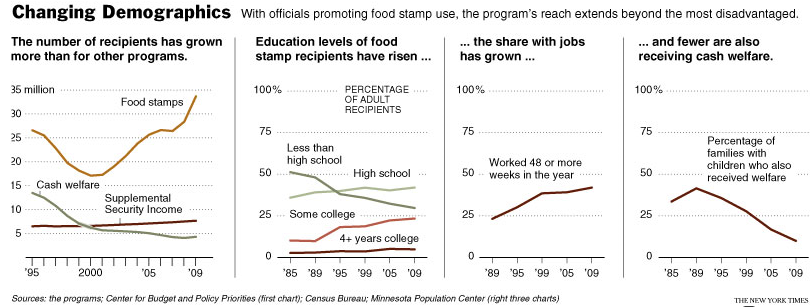
Like Ezra Klein, I was surprised to read that “one in eight Americans” are now getting food stamps.

But, reading Jason Deparle and Robert Gebeldoff‘s feature, it’s not hard to see why: We’re actively recruiting people to sign up!
A decade ago, New York City officials were so reluctant to give out food stamps, they made people register one day and return the next just to get an application. The welfare commissioner said the program caused dependency and the poor were “better off” without it.
Now the city urges the needy to seek aid (in languages from Albanian to Yiddish). Neighborhood groups recruit clients at churches and grocery stores, with materials that all but proclaim a civic duty to apply — to “help New York farmers, grocers, and businesses.” There is even a program on Rikers Island to enroll inmates leaving the jail.
“Applying for food stamps is easier than ever,” city posters say.
[…]
But support also turned on chance developments, including natural disasters (which showed the program’s value in emergencies) and the rise of plastic benefit cards (which eased stigma and fraud). The program has commercial allies, in farmers and grocery stores, and it got an unexpected boost from President George W. Bush, whose food stamp administrator, Eric Bost, proved an ardent supporter.
[…]
States eased limits on people with cars and required fewer office visits from people with jobs. The federal government now gives bonuses to states that enroll the most eligible people.
A self-reinforcing cycle kicked in: outreach attracted more workers, and workers built support for outreach. In a given month, nearly 90 percent of food stamp recipients still have incomes below the federal poverty line, according to the Department of Agriculture. But among families with children, the share working rose to 47 percent in 2008, from 26 percent in the mid-1990s, and the share getting cash welfare fell by two-thirds.
I’m of mixed minds on all this. We should help the working poor — and their children — get enough to eat. Ditto those too disabled to work and provide for themselves. De-stigmatizing aid to such people — and even reaching out to make sure they know help’s available — makes sense.
But, rather clearly, we’ve taken this to absurd levels, creating a self-licking ice cream cone in which the program’s main focus is on expanding the program. Do we really need to be providing food stamps to able-bodied college graduates who are Americorps volunteers? Or, indeed, if we think Americorps is so valuable, why not provide a stipend so its “volunteers” can afford to feed themselves rather than treating them as indigents?
This is a classic case where good intentions and rent seeking collide. We want to help the poor. And we’re doing it through a mechanism that’s good for local farmers, local grocery stores, and the local economy. And paying for it with federal money!
UPDATE: Frequent commenter UlyssesUnbound, himself a former Americorps volunteer, offers a detailed response, including this justification:
Americorps VISTA (the only program I have experience with) is a program designed to reduce poverty. The idea is that to reduce poverty, you have to understand poverty. To understand poverty, you have to live it. That includes doing things like living in low-income housing, or using food stamps. You find out what its like to rely on assistance for sustenance, the stigma that is associated with it, and you learn firsthand why it is important to ensure that people lift themselves out if it.
I’m not sure I buy the soundness of this reasoning but it’s interesting.









