New York Times, “Walter Koenig, Chekov From ‘Star Trek,’ Has Died“
Walter Koenig, a mainstay of the “Star Trek” franchise as Pavel Chekov, the Russian navigator aboard the U.S.S. Enterprise, died on Sunday at his home in the North Hollywood neighborhood of Los Angeles. He was 90.
[….]
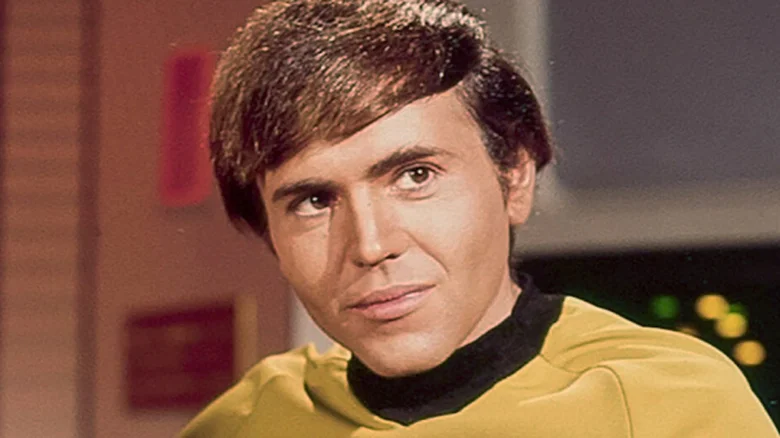
Ensign Pavel Chekov — who arrived at the beginning of the show’s second season, in the fall of 1967 — was conceived as a solution to a demographic problem. Gene Roddenberry, the creator of “Star Trek,” had been told that young viewers considered the show’s leads, William Shatner (Captain Kirk) and Leonard Nimoy (Mr. Spock), who were both 35 when the series began, practically middle-aged.
So Chekov was positioned as a younger type — Mr. Koenig was 30 when he was cast — complete with a mop-top haircut that the producers hoped would remind adolescent girls of Davy Jones of the Monkees, the popular TV-generated rock band.
His character also represented a future beyond the Cold War’s balance of atomic terror, one in which a Russian officer could be serving under a captain from Iowa as a unified humanity explores the stars.
Mr. Koenig (pronounced KAY-nig), whose parents were Russian Jewish immigrants from Lithuania, was born in Chicago; his onscreen accent was theatrical. Over the show’s remaining two seasons on network television, before “Star Trek” ascended into a multimedia pop-culture phenomenon, Chekov appeared in 36 episodes, most often just doing his job and making practical pronouncements like “Warp speed 2, Captain.”
His favorite episode, Mr. Koenig said, was “Spectre of the Gun” (1968), in which the Enterprise crewmen were forced by aliens to participate in a Wild West gunfight. In that episode, Chekov took a bullet to the chest from Wyatt Earp (as it turned out, it was all an illusion) and enjoyed lavish physical affection from a saloon hostess.
Mr. Koenig was irreverently honest about the technological shortcomings of “Star Trek.” Before being cast, he said, he had never watched a full episode because, while channel surfing, he had noticed that in an outdoor scene the rocks looked like Styrofoam. Asked by one interviewer about the show’s special effects, he shook his head and said, “The triggers didn’t even pop.”
Of the “Star Trek” movies in which he appeared, released between 1979 and 1994, he considered “Star Trek IV: The Voyage Home” (1986) “the best film we did,” he told Yahoo Entertainment in 2016. A time-travel story centered on recovering whales from the 20th century to save Earth from certain doom some 300 years later, it represented, Mr. Koenig said, Mr. Roddenberry’s vision of telling “sociopolitical stories that spoke to what was happening in the world at the time.”
[…]
When the “Star Trek” years were over, science fiction called again. In 12 episodes of “Babylon 5” in the 1990s, Mr. Koenig played Alfred Bester, a manipulative, telepathic 23rd-century cop. In 2020, he appeared in “Unbelievable!!!!!,” a “Star Trek” parody starring Snoop Dogg and featuring many other actors from the various series.
[…]
Mr. Koenig said that in the early 1970s he “hit rock bottom” financially after the original “Star Trek” series went off the air. In response to his money troubles, he began writing scripts to help pay the bills, and sold several pilots, he recalled in a 1994 interview with a documentary filmmaker. He wrote an episode of “Star Trek: The Animated Series,” and had several other credits in the ’70s and ’80s.
He was modest about the relative importance of his most famous character and generous in his evaluation of the fans, who came to be known as Trekkies. They were not just computer people or college students, he pointed out in the Archive of American Television interview.
“It was people who had a sense of humanity and a sense of justice and a sort of political bent,” Mr. Koenig said. “People who had imagination — and people who loved monsters.”
Variety, “Walter Koenig, Chekov on Original ‘Star Trek,’ Dies at 90“
Walter Koenig, who memorably played Chekov in the original “Star Trek” series and seven “Star Trek” feature films, died Sunday in Los Angeles, Variety has confirmed. He was 90.
[…]
Koenig’s Chekov, an arrogant young navigation officer in the original series, was introduced to the series to appeal to teenage viewers — his hairstyle recalled that of the Monkees’ Davy Jones.
The Russian-born Chekov was also used to poke fun at the Soviet way of falsely taking credit for every important human invention.
[…]
During the 1980s, when he was busy with the “Star Trek” movies, he appeared as Pompey in a 1984 TV adaptation of “Antony & Cleopatra” that also featured Nichelle Nichols and future “Star Trek: Enterprise” actor James Avery.
The actor appeared in a string of low-budget science fiction movies over the years, including “Moontrap,” in which he starred, and “Deadly Weapon,” both in 1989; as well as Cynthia Rothrock martial arts vehicle “Sworn to Justice” in 1996 and independent horror film “Mad Cowgirl” in 2006.
A one-character film that Koenig wrote and performed, “You’re Never Alone When You’re a Schizophrenic,” was screened at the 1996 New York Film Festival.
He voiced Chekov in a variety of “Star Trek” video games, including 1998’s “Starfleet Academy: Chekov’s Lost Missions.”
The actor guested on an episode of the CBS sitcom “Almost Perfect” titled “Where No Woman Has Gone Before” in 1997 and voiced himself on a 2002 episode of “Futurama” titled “Where No Fan Has Gone Before,” which also featured the voices of William Shatner and Leonard Nimoy, among other “Star Trek” regulars. He also guested on “Diagnosis Murder” (in an episode that featured several other “Star Trek” actors) and “Son of the Beach.”
He penned the 2008 sci-fi legal thriller “InAlienable,” in which he also appeared (the tagline was “From the mind of Walter Koenig”).
Koenig also had a stage career that spanned three decades.Rolling Stone, “Walter Koenig, Original ‘Star Trek’ Star Who Played Pavel Chekov, Dead at 90“
Walter Koenig, the actor and writer best known for his portrayal of Pavel Chekov in the original Star Trek TV series and numerous films, died Sunday, Variety reports. He was 90.
[…]
Koenig had been working steadily as an actor for about a decade before he was cast as Ensign Pavel Chekov, a navigator on the USS Enterprise. Chekov was something of an outlier among the Enterprise crew, both because he was Russian at the height of the Cold War, and because he was young. And while the character was alwasy going to be Russian, according to Koenig, Chekov’s original last name was Jones — a likely nod to the Monkees’ Davy Jones, and the show’s desire to add a character that would appeal to a younger audience.
“And indeed, my [fan] mail was from people who were eight to 14 years old,” Koenig told the Television Academy in 2013. “‘I think you’re groovy,’ ‘I love your hair’ — which was a wig by the way. I got hundreds and hundreds of letters! At one point, I was getting the third most mail after Bill [Shatner] and Leonard [Nimoy].”
[…]
Koenig started securing his first TV roles in the early Sixties, including the pilot episode of the hit soap General Hospital, as well as shows like Mr. Novak, The Alfred Hitchcock Hour, and I Spy. He was cast as Chekov ahead of Star Trek’s second season, and remained a series regular through its third and final season.
In the coming decades, Koenig would regularly reprise the role of Chekov. He appeared in 1979’s Star Trek: The Motion Picture, and the next seven films in the franchise, concluding with 1994’s Star Trek Generations. He also voiced Chekov in numerous Stark Trek video games, and made cameos in episodes of shows like Deep Space Nine and New Voyages.
His last appearance in a Star Trek property came in 2023, when he lent his voice to the series, Star Trek: Picard. Notably, Koenig did not portray Pavel, but rather the character’s son, Anton, who was at that point serving as President of the United Federation of Planets.
[…]
Along with Star Trek, Koenig had a memorable recurring role on another hit sci-fi franchise, Babylon 5, during the Nineties. He also appeared in a variety of independent genre films, and worked extensively as a writer, penning several books, as well as scripts for TV shows like Land of the Lost and The Incredible Hulk. He recently appeared in the short film, Mr. Fleischmann, winning an award for his performance at the 2026 Independent Shorts Awards.
Dying “of old age” at 90 is about all you can ask for, I guess.
He was a working actor his entire adult life and had success as a writer as well. But he’ll always be known for a cheesy role on a short-lived, low-budget television show that was canceled almost six decades ago. It turned out that the show’s fanbase, while initially not big enough to keep it on the air, was insanely loyal, allowing iterations of it to continue to this day.
So many actors who are forever associated with a particular role seem to resent it. Thankfully, Koenig had good humor about it.
That the only other role of his that I could have named was his turn on another television sci-fi series, Babylon 5, is rather amusing.