Who Could Have Predicted It?

I can’t help myself…

19

Comments

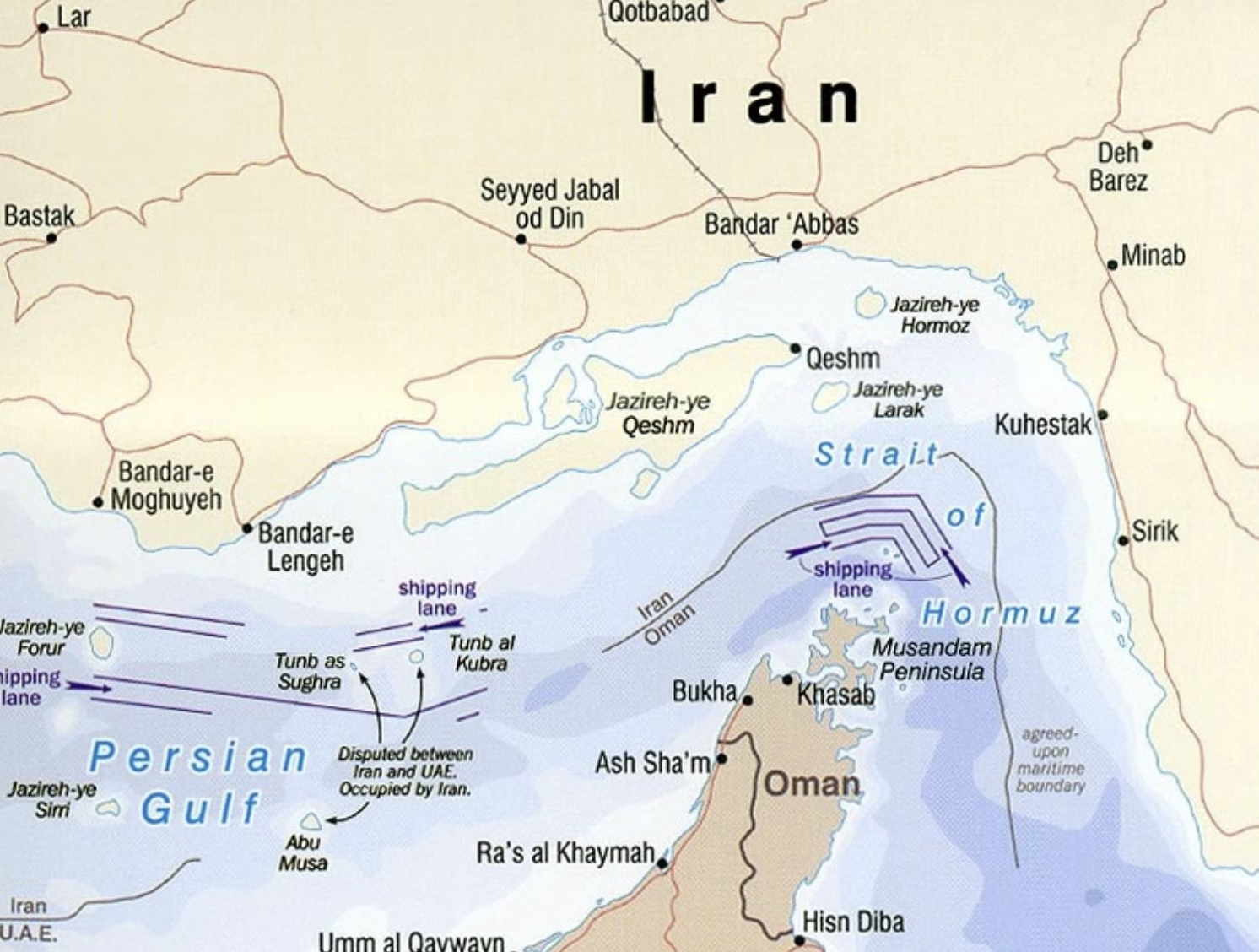
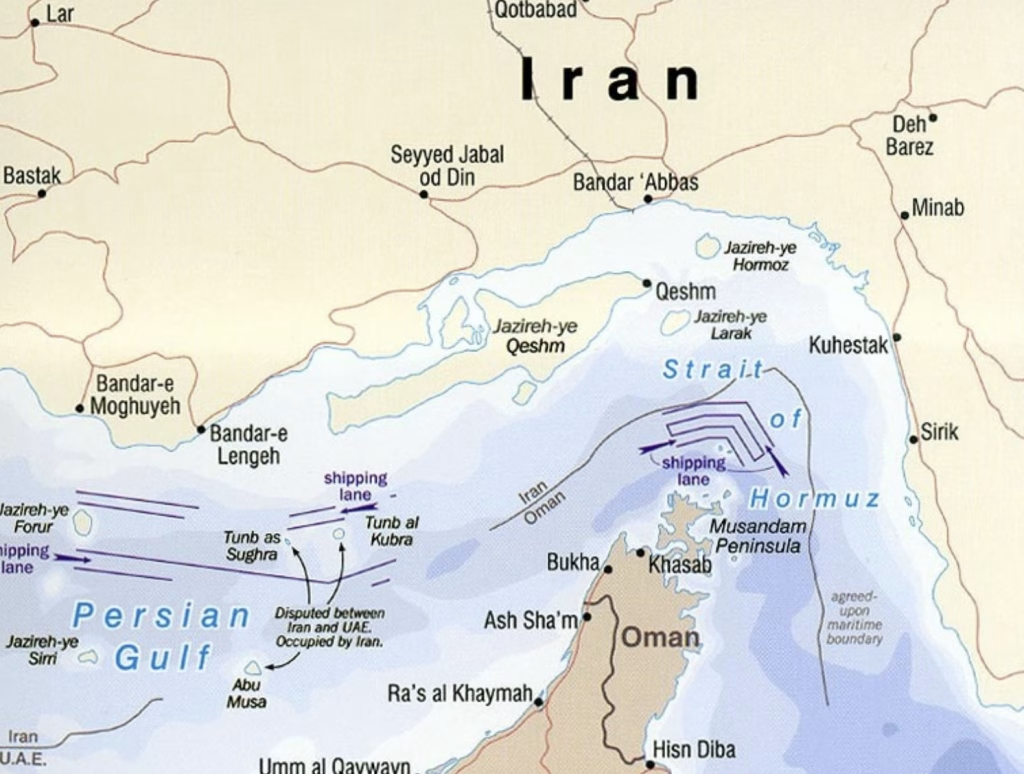
Via Axios: Iran says it is closing Strait of Hormuz over Israeli attacks on Lebanon.

The Iranian armed forces announced Saturday they will close the Strait of Hormuz — just three days after it reopened — alleging America’s failure to rein in Israeli attacks on Lebanon violates the new ceasefire deal.

Who could have seen that coming?

19 responses to “Who Could Have Predicted It?”

  1. Who could have seen that coming?

    Anyone who gave it the tiniest bit of thought.

    Give immediate concessions to Iran up front that relieve economic and other pressures on Iran, thus strengthening Iran’s bargaining position, while concessions by Iran are vaguely defined and put off to the future. What else could possibly happen?

    Unlike Trump and dopes like Hegseth, Iran’s leaders are not stupid.

    6
  2. @charontwo:

    Anyone who gave it the tiniest bit of thought

    To be clear: that’s my point.

    2
  3. The dumb fucks came up with an agreement that binds Israel without including Israel in the agreement.
    And everyone knows that Bibi is Fatso’s daddy.

    6
  4. @Daryl: I don’t think he is. I do, however, think there’s a non-zero chance of America invading Israel before this is over. I’m honestly not sure if it’s more or less likely than America invading Iran.

  5. @Kevin:

    Using what staging area? With what plans that Israel is not privy to in advance?

  6. @Kevin:
    If by non-zero you mean less than zero…yeah

    1
  7. @Kevin: Invading? No. But, a missile strike or something else as a warning? It sounds nuts, but it also doesn’t sound impossible with this president.

    2
  8. I agree, the US attacking Israel is completely insane. But if Trump ever comes to believe that Netanyahu/Israel is the reason Trump can’t stop the war he started, which is actually, though partially, true, I don’t really know what he’d do at that point. What if Iran insists that Netanyahu be removed from power?

    This is what happens when you elect someone who’s never had to deal with any real consequences to power. I’m not sure he’s capable of understanding what’s going on. He certainly doesn’t seem to understand that Iran has agency. Nor Israel.

    2
  9. Iran may have closed the Strait of Hormuz, but that won’t stop the outbound shipment of oil from the Gulf states… at least not from Iran. Not only can Iran move its oil through the strait, but the absence of a blockade or sanctions on its oil is allowing Iran to ship it from ports outside the Strait. Bloomberg reported that seven supertankers with a capacity of about 14 million barrels were detected leaving the Iranian port of Chabahar on the Gulf of Oman on Friday.

    I wonder if Vance was including Iranian oil in the 16 million barrels he said “we” got out of the Strait yesterday, which he also said is a record going back to before the conflict started. (It’s not a record, and not even as much as the pre-conflict daily average.)

    1
  10. This looks like a good spot to post some relevant background.

    Wajeeh Lion

    The most acute threat to the MoU’s implementation is United States federal law, specifically the Iran Nuclear Agreement Review Act of 2015 (INARA). INARA guarantees congressional oversight of any international agreement regarding Iran’s nuclear program. It requires the executive branch to submit the agreement text to Congress, initiating a mandatory 30-day legislative review period during which the President is legally prohibited from waiving or reducing sanctions.

    The commitments made by the Trump administration in Versailles directly contradict this statute. The MoU text promises immediate economic relief and the immediate issuance of Treasury Department licenses for financial transactions upon the June 17 signing. However, the legal timeline makes this impossible. Following the June 17 signing, the five-day INARA transmittal window runs through June 19, during which the President is legally barred from issuing waivers. Once transmitted, the mandatory Congressional review period extends from June 20 to July 19, maintaining the statutory prohibition on sanctions relief. Should Congress pass a joint resolution of disapproval, a potential veto and override period extends the legal freeze from July 20 to August 10. Consequently, the executive branch is completely paralyzed from delivering the promised immediate relief for nearly the entirety of the MoU’s active 60-day negotiation window, which expires on August 16.

    The most unstable provision is Paragraph 6: the $300 billion multi-national reconstruction fund. Structured as a private investment vehicle financed by Gulf Cooperation Council (GCC) states, the fund is effectively a reparations substitute. Iran initially demanded $400 billion in direct compensation from the US and Gulf states, blaming nations like Saudi Arabia, the UAE, and Qatar for allowing allied forces to use their airspace during Operation Epic Fury. Qatari mediators rebranded this demand as a “prosperity fund.”

    However, Gulf leaders view financing the reconstruction of a hostile adversary as strategically suicidal. To paralyze the fund without officially breaking the MoU, Saudi Foreign Minister Prince Faisal bin Farhan utilized a speech at the European Council on Foreign Relations in Vienna on June 18, 2026. He established a “trust condition,” declaring that economic cooperation requires a rebuilding of trust damaged by Iranian attacks. Because trust is unquantifiable and has no deadline, Saudi Arabia successfully converted a structural weakness into a position of indefinite restraint, rendering the $300 billion fund practically non-existent.

    This domestic pressure provided the political justification for a massive escalation. On June 20, 2026, Iran’s Khatam al-Anbiya Central Headquarters officially announced the immediate closure of the Strait of Hormuz to all maritime traffic. The military command cited blatant US non-compliance regarding sanctions relief and the continuous violation of the ceasefire by Israel in Lebanon as the catalyst, warning this was merely the “first step.”

    Iran had many available pretexts to close the Strait, it didn’t need Israel staying in Lebanon, the failure of sanctions relief is just one (there are others in the full text at the link).

    The 60-day window established in Versailles has ceased to function as a pathway to a permanent treaty. The semantic ambiguity over Lebanon guarantees continuous localized combat. The mandatory PGSA insurance regime and overlapping Western sanctions ensure energy trade remains choked. The Saudi trust condition ensures the reconstruction fund will never materialize, likely prompting Iran to resume nuclear enrichment citing allied bad faith. Meanwhile, the IRGC’s shadow crypto economy continues to accelerate. As of late June 2026, all primary actors are utilizing the diplomatic pause to realign domestic capital and rearm. The closure of the Strait of Hormuz on June 20 signals the definitive transition away from the Islamabad framework and back toward regional kinetic warfare.

    2
  11. @Eusebio:

    But how long can 14MMBPD of Iranian oil can be shipped when Iran’s oil fields have much lower daily production?

    Other stuff that comes from the GCC is still blocked, urea, sulfur, aluminum etc.

    1
  12. You may get a Toddler in Chief follow up out of this!

    3
  13. @Steven L. Taylor: I could easily see a scenario where Trump unilaterally cuts aid to Israel to try to get them on board.

    Given the number of white supremacists, neonazis and other filth in the Republican base, it’s plausible that the Republican-Israel relationship will swing hard and fast into antisemitism if that happens. They’ve been itching to add Jews to the list of undesirables.

    3
  14. @charontwo: The only effective way to enforce the Iran Nuclear Agreement Review Act would be to impeach a president who ignored it. And that ain’t gonna happen in this instance.

    It was darkly humourous that when a reporter asked Trump if his MOU was going to be sent to Congress, he replied he hadn’t even thought about it. But now the question had been asked, it seemed like a good idea. So he sent Congress a copy, after he’d signed it. Not with a request they approve it or anything, just with a FYI. Possibly he thanked them for their attention to the matter.

    2
  15. Trump said a couple of times recently that Netanyahu would do what he’s told. Further evidence, if any were needed, of his rapidly advancing senile megalomania. Witness also his observations about being the most powerful man in the history of the world; one whose only guardrail was his own morality.

    Now he’s sent Witkoff back for “technical negotiations”, the man who screwed up the “peace talks” in February. But since then he’s visited Los Alamos, presumably for a crash course in nuclear science, and probably assured Trump he knows almost as much about it now as the president himself, who knows more than anyone thanks to his uncle who was the most brilliant professor ever to serve at MIT.

    5
  16. dazedandconfused Avatar
    dazedandconfused

    @Gustopher:

    He might try, but the Christian right would nip it in the bud. To them Israel is everything. Here’s Mike Huckabee saying that without Israel, the US would not exist. That man thinks he’s Israel’s ambassador to the US, not the US’s ambassador to Israel. He really does.

    The Christian Right will not idly stand by and let Trump do whatever he wants with Israel, they will fight like hell for Israel. It’s a part of the GOP Trump can’t do without too.

    3
  17. @Ken_L:

    Trump said a couple of times recently that Netanyahu would do what he’s told.

    It is basic psychology that when you challenge someone that way, you get the opposite response. That just guaranteed Netanyahu defiance. Plus, it is politically essential for Netanyahu to show he is not Trump’s puppet.

    It was darkly humourous that when a reporter asked Trump if his MOU was going to be sent to Congress, he replied he hadn’t even thought about it.

    If he had competent negotiators instead of Kushner/Witkoff/Vance they would find out all the relevant legislation and procedures. There are reasons it took two years of negotiations to get to the JCPOA, with several other countries involved.

    This whole administration is a Dunning-Kruger demonstation.

    5
  18. @Ken_L:

    The only effective way to enforce the Iran Nuclear Agreement Review Act would be to impeach a president who ignored it. And that ain’t gonna happen in this instance.

    Can Trump just simply choose to not enforce sanctions that legally have not actually been lifted? I don’t know, but Iran is complaining about not getting the sanctions relief they expected.

    1






