


In writing about the various abuses of the Christian religion by the sitting President, the Veep, and the Secretary of Defense, I started thinking more about an interchange within my post about the attack on the Pope and the Trump-as-Jesus meme. The question was asked as to when mainline Christians would be more actively opposed to Trump, given the amount of Evangelical and conservative Catholic support he has been getting. A back-and-forth ensued.
Ultimately, I think that the critique was unfair because there are plenty of self-identified Christians who are in opposition to this administration and its abuses. I will say, however, that I understand the feeling that there isn’t enough opposition as a general matter, as we discussed about the general efficacy of No Kings. But the reality is that dramatic and obvious opposition is hard to sustain, and it is easy to say that enough isn’t being done. I am of the view that truly visible opposition, to include civil disobedience, requires a specific target of protest, such as the ICE actions in Minneapolis (more on that below).
It is also true that there is simply so much going on right now that focus is difficult in a country of our size. Should the focus be on the war? On ICE? On the economy? On the midterms?
Should activists take to the streets? Should they focus on lawsuits? On GOTV activity? On fundraising?
All of the above, I suspect, but a lot is going on, to be sure (and it is hard for us to even keep track of it all).
Back to the debate that inspired this post, commenter Michael Reynolds asked,
If mainstream Christians wanted to be heard nationally, they would be heard nationally. Do they not have Twitter? Do they not have their own publications?
Setting aside the question of whether or not Twitter accounts and other publications should be the main venue for mainstream Christians as some bloc of society (the clergy? parisioners? who?), the reality is, yes, yes they do.
This question was in the back of my mind when I wrote my post about Hegseth because I cited the Substack, A Public Witness, and it was a reminder that here we have self-identified Christians out there trying to counter the Trump administration and their allies via their own publications. Note the inclusion of the following endorsement on their “About” page:
“A bad actor.” —Jenna Ellis, a Trump attorney who sought to overturn the 2020 presidential election.
This struck me, given a recent comment-thread interaction on the subject, which focused on the question of where all the non-MAGA Christians are out there in cyberspace.
Well, for what it is worth, Public Witness is run by a Baptist minister and one of the other contributors also identifies as a clergymember, and all four as Christians.
It seems worth noting that in the post that started the debate, I cited the Baptist News, which was criticizing Trump.
I can think of other folks who are using their platforms from an overly Christian point of view. John Pavlovitz comes to mind.
Another recommendation would be the podcast Straight White American Jesus. Its hosts are religious studies scholars, albeit ex-Christians, but they frequently feature clergy who are in the business of combating the rise of Christian Nationalism.
It seems kind of noteworthy to observe that our previous president was overtly Christian, as opposed to the current one in office. The funny thing that seems to happen in these kinds of discourses is that Christian individuals who oppose the current administration (or who aren’t conservative evangelicals) are often treated as not really Christians, the same way people like JD Vance dismissed the Pope.
I would recommend not playing that game, as it is falling into the hands of Christian Nationalists who very much want to draw the lines of who the “real” Christians are versus the “fake” ones.
I am further reminded that Senator Raphael Warnock (D-GA) is a Baptist Minister and head pastor at Ebenezer Baptist Church in Atlanta. Senate hopeful James Talarico of Texas has been overt in his Christianity in his campaign and attended seminary.
As I noted in the comment thread in question, there was a substantial presence of clergy in Minneapolis during the ICE crackdown: 99 cited in clergy-led anti-ICE protest at MSP Airport that ended with mass arrests.
And there is this image of the Reverend David Black that will be in the history books.
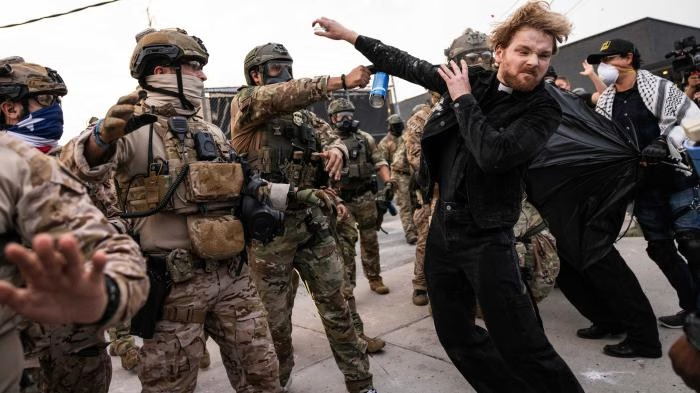
Via the Presbyterian News Service: The Rev. David Black of First Presbyterian Church of Chicago recounts his pepper ball shooting at an ICE detention center.
Please note that I am making empirical observations; I do not see a need to defend Christians for some self-serving reason. While I have frequently noted Biblical passages on the site as a means of critiquing the actions of this administration, I do so as someone who should be described as an exvangelical. On the one hand, I was steeped in conservative evangelical theology, and I speak fluent Evangelical, but I moved on from those waters some years ago. I do avoid going much deeper than that on the subject, if anything, because I find my views to be vague and ill-defined, and because that is not the topic of this blog.
I will say this: I understand the frustration aimed at evangelical voters who embraced, and continue to embrace, a man who does not, in any way, reflect the alleged values of those voters (not if one takes those values seriously). They deserve the opprobrium they receive. Still, as a political scientist, I do understand their obsession with abortion is important, and how the overturning of Roe v. Wade is a major triumph in their eyes (from a purely political/policy point of view, that actually makes sense). I understand, further, that their concerns over sexual mores are real, although I would argue that they are unhealthy and vested more in notions of social power (i.e., a preference for a male-dominated nuclear family) than anything else. And I understand the way that conservative Christianity has become fused with Republican politics in the identities of many, many voters.
But, of course, such power structures are at the heart of all of this, I think. The confluence of various social variables: race, gender, socio-economic status, and regional identity, to name but four, has converged to create a powerful identification between white evangelicals, in particular, with the Republican Party.
I will admit that one of the biggest mistakes I have made in trying to analyze American politics on the fly on this blog was assuming that Trump could not win the GOP nomination in 2016 because the socially conservative evangelical voters in the Republican primary electorate would not support an adulterous, thrice-divorced, casino-owning, libertine New Yorker.
To use a term of art: oops!
It was in 2016 that it became clear that the supposed values that motivate a good chunk of evangelical voters were less about Christian virtue than they purported.
Let me note that I am especially talking here about primary voters. In the 2016 primary season (general elections change the calculation from intraparty to interparty), the Republican electorate had a lot of choices. Strategically, there may well have been too many, but have I ever noted that we have weak parties that don’t control things like who gets involved in primary contests?
As a reminder, the following candidates participated in the 2016 primary contest: Ted Cruz, Marco Rubio, John Kasich, Ben Carson, Jeb Bush, Rand Paul, Mike Huckabee, Carly Fiorina, Christ Christie, Jim Gilmore, and Rick Santorum.
Additionally, the following tried to complete, but withdrew before the primaries: George Pataki, Lindsey Graham, Bobby Jindal, Scott Walker, and Rick Perry.
All of the above have one thing in common: any one of them would have been a better president than Donald J. Trump.
I would hasten to add that Trump did not win a majority of the GOP primary vote (Wikipedia puts it at 44.9%). I note this note to absolve Republicans, but to hammer a point that I keep making, and perhaps a phrase I need engraved on my tombstone (except that I plan to be cremated, so perhaps for my urn): “Institutions Matter.”
Trump translated plurality support in the 2016 primaries to then go on to lose the popular vote, and yet still became POTUS because, well, institutions matter.
I would underscore, to pick up a point I left dangling above: my ire for Republican voters is actually lessened for the 2016 general election than it was for the primaries because, given the clear logic of a rigid two-party system, it stands to reason that a lot of evangelicals and other conservative would vote for whomever it was that had the R after their name.
Yes, some Republicans chose to forgo the R that year, but mass politics are mass politics, and therefore a lot of people didn’t.
Have I ever mentioned he lost the popular vote by almost three million?
The primaries laundered Trump from being a celebrity outsider to being The Republican. And in our presidentialized system, he was able to take over the party.
All of this is to say that, yes, there are Christians who are part of the Trump coalition, but there are also plenty who aren’t.
So, two thoughts in conclusion.
First, there are plenty of Christian voices out there in opposition to Trump. They may not be as loud as one wants, but that may well be true for any number of other voices. We are all trying to work through this political moment.
Second, don’t fall into the trap of classifying non-conservative Christians as not really Christians. That is falling into the trap of the Christian Nationalists who want to control that narrative.
Empirically speaking, there are a lot of self-identified Christians who support both parties, and so simplistic claims about millions of people should, perhaps, be reconsidered in that light.
For funsies, here are some numbers for review:
- Via Religion in Public: The 2020 Vote for President by Religious Groups – Christians
- From Gallup: Religious Group Voting and the 2020 Election
- From Pew Research on 2024: White Protestants and Catholics support Trump, but voters in other U.S. religious groups prefer Harris.
- Some other charts of interest from Pew: Party identification among religious groups and religiously unaffiliated voters.
It ends up, and I guess this is my main point, that broad assertions about vast groups in a country of over 300 million are almost certainly inaccurate and perhaps unwise to make. It is why I try, personally, not to make broad claims about The Right or The Left or all Republicans or all Democrats (although I am sure that in my haste and in my need to post, I fail in that goal).









