
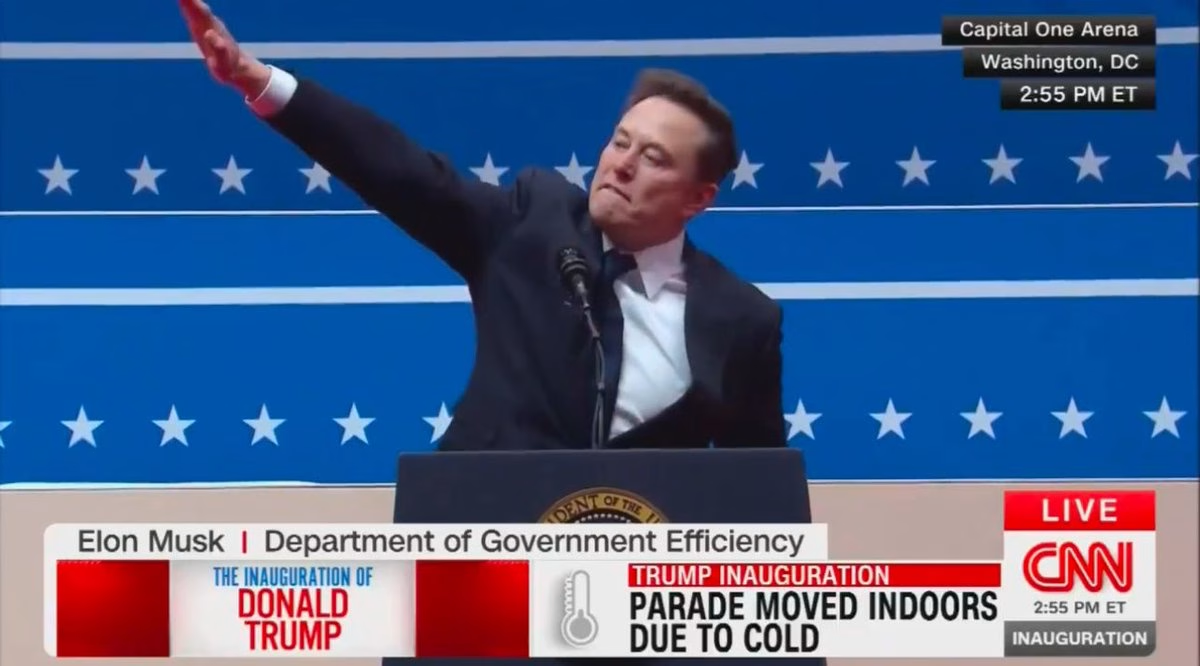

James and Steven have already covered many of the facts about Elon Musk’s unprecedented role in the rushed remaking of the federal government under the Trump administration. I want to fill in some details on the edges to advance the argument about how many of these actions fly in the face of espoused “conservative values.”
As James covered this morning, Musk has essentially shutdown USAID. Given many conservative’s (paleocons at the very least) distrust of foreign interventions, I can see how some might think this is a good move. That said, from a Christian perspective, the idea of suspending low cost, life saving aid to our less fortunate neighbors seems to clash with concepts from the Gospels (though I’m not high IQ, so I could have that wrong). That’s before we get to stabilizing impact of trying to advance global health initiatives–but then again, it’s not like the world got shut down by a pandemic during our life time, let alone the last time that Trump was president.
That said, I’m prepared to squint and accept the argument that those funds could be better spent caring for our neighbors within this country. Actually, I’m definitely sympathetic to the argument that charity begins close to home (I just don’t think that should negate charity abroad).
But then we get to the “Lutheran Services” thing from this weekend:
https://x.com/elonmusk/shttps://x.com/elonmusk/status/1885964969335808217
Steven, at the time, wrote this:
Look, I don’t know what Lutheran Family Services does, but just because there is a word in the title of the entity that Mike Flynn (known QAnon devotee) and Elon Musk don’t like doesn’t mean it is corrupt.
It’s understandable that Steven, and most readers, don’t know what Lutheran Family Services (or Catholic Family Services) are. In fact, the system is in part designed to work that way (but not in a nefarious sense). They are state-selected organizations that receive Federal Block Grants to deliver social services. From the Block Grant Wikipedia page:
Social Services Block Grant (SSBG) funds are to enable each state in the United States to furnish social services best suited to meet the needs of the individuals residing within the state. Such services may be, but are not limited to: daycare for children or adults, protective services for children or adults, special services to persons with disabilities, adoption, case management, health-related services, transportation, foster care for children or adults, substance abuse, housing, home-delivered meals, independent/transitional living, employment services or any other social services found necessary by the state for its population.
[…]
Under Title XX,[1][2] each eligible jurisdiction determines the services that will be provided and the individuals that will be eligible to receive services. Federal block grant funds may be used to provide services directed toward one of the following five goals specified in the law: (1) To prevent, reduce, or eliminate dependency; (2) to achieve or maintain self-sufficiency; (3) to prevent neglect, abuse, or exploitation of children and adults; (4) to prevent or reduce inappropriate institutional care; and (5) to secure admission or referral for institutional care when other forms of care are not appropriate.
These are organizations that, among other things, are there to try to stabilize people who have fallen on hard times and ultimately help them get to a place where the no longer have to rely on social services.
To be clear, they are doing the local charity investment that conservatives claim they want to see happening inside the US (versus outside of it).
So that’s the first contradiction. Second contradiction with proclaimed conservative thought is that while the funding is coming from the Federal Level (in fact, is the return of tax dollars to the community), the specific way it is spend and the organizations that its distributed to are determined by the States! This is literally the Federalism/State’s Rights that we are told that conservatives care about.
That’s before we get to the significant amount of time that religious conservatives have spent defending these organizations from “federal overreach” when it came to things like requiring adoptions to same-sex couples or necessitating insurance coverage of contraceptives. Much of the defense of these organizations was the critical work they were doing–but that too has been apparently memory holed.
Finally, there’s the fact that the reason that these organizations and block grants exist was to keep government staff small. All of these services could have been directly delivered by government. But instead, following small government conservative ideals, the decision was made to contract out these services (and in many cases the oversight of these services) to keep the size of government down.
Here’s the thing: I point out these things NOT to accuse past conservatives of hypocrisy. Accusations of hypocrisy are at the best of times self indulgent (because we are all always already hypocites about something). At the worst of times, which we are fast approaching, playing the hypocrisy game is nihilistic–it only serves those in power by preventing coalition building and finding common ground.
So I point out all of the above because I think Block Grants and DOGE’s actions against them are a place where liberals and conservatives can find critical common ground to support change. We don’t have to agree on everything, I truly believe that most conservatives of good faith, once they understand what is happening, will see the profound issues with it.
All it takes is to start by saying “Yes, I agree this is bad” and then resist the temptation to add the “but…” that you’ll want to add to feel less discomfort.
To my more progressive fellow commenters, you also need to embrace some discomfort too. Our quest to point out hypocrisy or that “we were right” is equally nihilistic in these times. All it does is reinforce existing wedges and stop positive collaborations from happening. At some point, is you believe that the Trump administration and it’s unelected autocrats are as bad as you repeatedly say they are, then we need to find those ways of building real bridges on some tangible issues.









