Several months ago there was a bit of a flap between Greg Mankiw, Arnold Kling, Paul Krugman and Brad DeLong about how robust the recovery was going to be. Mankiw and Kling were pointing out that it is entirely possible the recovery might not be that robust. Mankiw cited the “unit root hypothesis” in economics and Kling explained how such a hypothesis could be seen as basically an over-investment in housing and that as a result resources needed to shift sectors which would take longer than has been typical in recessions in the past. Krugman called this view point evil. DeLong pointed to some data which someone noted relied on the economic growth after the Reagan tax cuts.
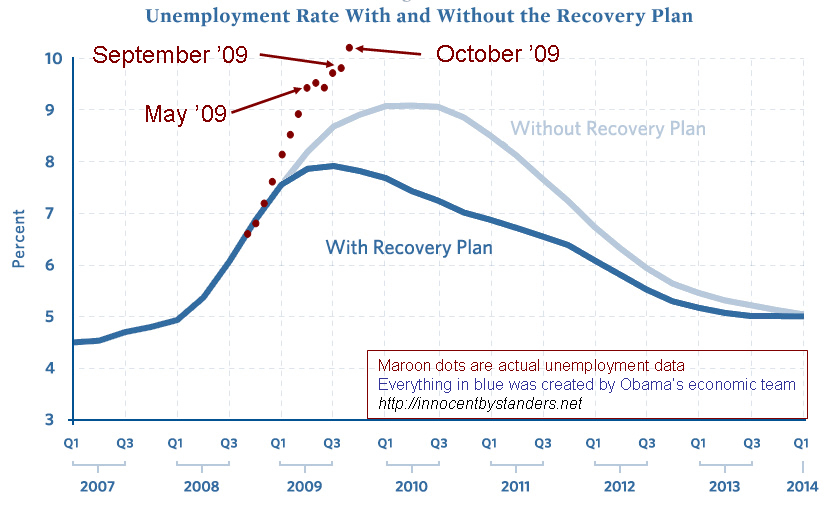
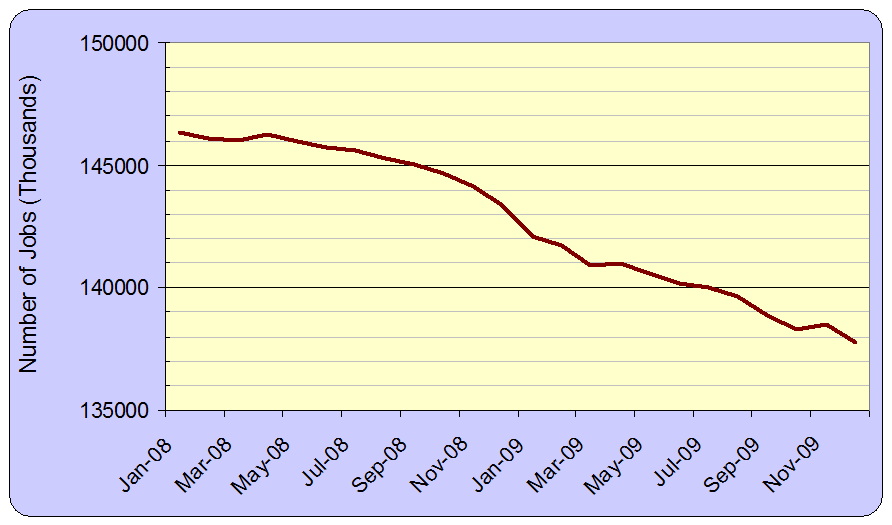
Well here we are and many economists are saying the recession is effectively over. But has the recovery been robust? I think you’d be hard pressed to find many who would make such a claim. Unemployment, while not rising is remaining stubbornly at 10%. While there was one good quarter of growth, the overall feeling is that was somewhat anomalous due to things like Cash for Clunkers (now defunct) and other policies. Also, when looking at things like business investment we see that things don’t look so good.
Now we have this article that indicates what frequent comments Drew has been seeing in his real life profession: small businesses are just not interested in expanding, hiring new workers, or doing much of anything.
A potential wave of new regulation and higher taxes may be scaring many businesses from hiring, prolonging any rebound in employment, say business groups and economists.
The prospect of increased federal and state regulation and taxes has been particularly disruptive to the hiring plans of small- and medium-sized businesses, which have historically generated about two-thirds of the nation’s jobs.
“I don’t really see the private sector hiring much in the next few months,” says Brian Bethune, an economist at Global Insight. “For the small-business sector there is just too much uncertainty about what happens beyond 2010.”
Not only is the Obama administration seeking to push through major overhauls of energy and health care policy, it is also expected to impose dozens of new workplace rules and raise income taxes.
[…]
In reporting that its small business optimism index fell for the second straight month in December, the National Federation of Independent Business Tuesday said members’ No. 2 reason for not expanding payrolls was the prospect of government policy initiatives.
Twelve percent said it was not a good time to expand because of the political environment. Over the next three months, 15 percent said they plan to reduce employment, while eight percent plan to create new jobs.
“We’re hearing it more and more from our membership,” says Bill Rys, the NFIB’s tax counsel. “At the federal level, there’s uncertainty about tax rates, health care costs, energy costs. You also have what’s going on at the state and local levels, with new fees and taxes. They’re reluctant to jump back in.”
Rys says the effect has been more pronounced in the past few months, perhaps mirroring the legislative progress of the massive health care reform bill, the highly-publicized Copenhagen climate change conference and new EPA rules on carbon emissions, as well as the approach of 2010, when the near decade-long Bush administration tax cuts are expected to expire.
[…]
According to the Bureau of Labor Statistics, companies with 1-4 employees lost 140,000 jobs in that period; firms with 10-19 employees shed 220,000 jobs. (That’s the most recent period covered by the data.)
Some of those jobs as well as new ones would normally be created in the coming year.
Coming out of the previous two recessions, companies in the two groups were responsible for net job gains relatively soon after the downturn had ended and picked up momentum as the recovery was established.
Note to the Obama Administration: You are doing it wrong. Creating more uncertainty, raising taxes, imposing more regulations and costs on employers is merely going to make them turtle up, not get moving. That last three paragraphs in particular point out that this is so and that predictions about a robust recovery were foolish. Further, the last two recoveries had significantly longer lags between the end of the recession and the recovery in employment.
I realize that as politicians a crisis is a great time to implement the changes you’ve always wanted to implement but didn’t have the support to do it, but it appears that it is hindering the economic recovery. It is prolonging the dismal outlook in the job market.