
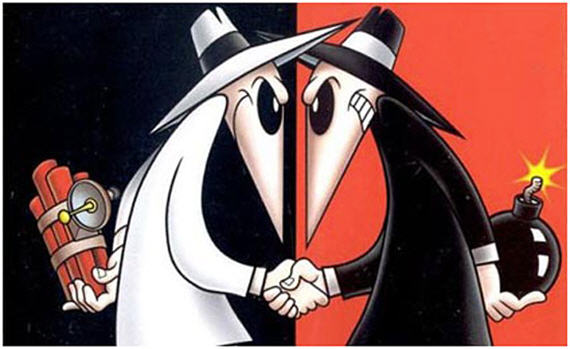
 The whole Fast and Furious confrontation between Representative Issa (and, by extension, the House of Representatives) and Attorney General Holder (and, by extension, the executive branch) makes me think of the following passage by James Madison from Federalist 51:
But the great security against a gradual concentration of the several powers in the same department, consists in giving to those who administer each department the necessary constitutional means and personal motives to resist encroachments of the others. The provision for defense must in this, as in all other cases, be made commensurate to the danger of attack. Ambition must be made to counteract ambition. The interest of the man must be connected with the constitutional rights of the place. It may be a reflection on human nature, that such devices should be necessary to control the abuses of government. But what is government itself, but the greatest of all reflections on human nature? If men were angels, no government would be necessary.
Emphasis mine.
Madison is here describing the nature of separation of powers and checks and balances. “Department” in context means the executive, legislative, and judicial branches (although the discussion in question is focused on executive-legislative relations). The notion here is the linkage of the personal political ambition of politicians to the collective ambitions of said departments.
There is little doubt that at least one of Issa’s main motivations is partisan politics. Likewise, there can be little doubt that that Obama administration is motivated by protecting the president’s re-election prospects. Those political ambitions and interests are manifesting as an inter-branch conflict over power, with the House putting pressure on the executive, and the executive seeking to defend itself.
At the end of the day, there is little doubt that this is all political, but then again isn’t, by definition, everything that takes place in government political?
On the one hand, I must confess to a negative reaction to congressional fishing expeditions that appear born from not from concern over policy, per se, but rather partisan animosity. However, on the other, shouldn’t the congress be holding the presidency’s collective feet to the fire over matters of policy? Regardless of anything else, Fast and Furious was a poorly conceived and even more poorly executed policy. Stepping back from initial reaction, I have to wonder if the public interest isn’t ultimately better served by more fishing expeditions, rather than by less. Fishing frequently produces garbage, to be sure, but sometimes it results in a great catch.
Since the focus here is a a policy, I can see little wrong about the congress wanting more information, even if Issa’s motives are not wholly founded in concern over policy only.
Regardless of anything else, there is plenty of ambition on display here.
I will say this: in terms of electoral politics, I have my doubts that the Fast and Furious situation will have much impact on the election. I think that it will continue to rile consumers of certain media outlets, where I suspect that F&F (along with other things) will be touted as impeachment-worthy activities (indeed, have been for a while now, I think). As a practical political matter, said consumers will hardly be voting for Obama in November.
Quite honestly, apart from the policy aspects of the discussion, the thing I find most problematic about Fast and Furious is that it is a piece in the game of narrative construction on places like Fox News where the goal to cast everything into not only the worst possible light, but to do so in a way that makes everything sound scary and nefarious. It would be nice (he noted wistfully) if policy could be criticized and analyzed in a reasonable way, even in he partisan media.
The real lesson of Fast and Furious should include better public understanding about the the harsh realities of the violence in Mexico, the real problem of gun smuggling into Mexico from the US, and (most importantly) the ongoing failure of the drug war as policy. Instead, we are going to get Democrats defending executive privilege, and Republicans hating on it (despite the fact that the roles were exactly reverse when Bush was president—because in this case, both sides do, indeed, do it). Meanwhile Sean Hannity, Rush Limbaugh, and friends are going to make the whole thing sound worse than Watergate.









