
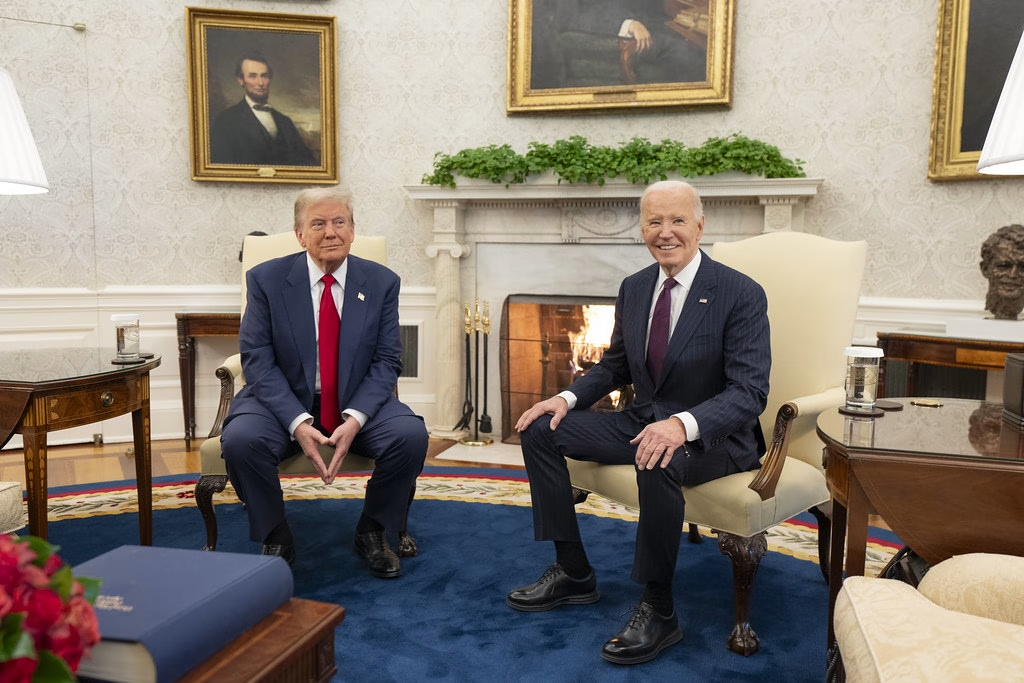
As regulars are well aware, I did not vote for Donald Trump to be President. Indeed, I’m 0 for three on that score, having voted for his Democratic opponent in 2016, 2020, and 2024 despite having voted Republican in all eight previous presidential elections for which I was eligible. Nonetheless, I have expressed my frustration multiple times since the election that President Biden, whose administration was soundly defeated* in the election, has used the lame duck period to “Trump proof” the government, rushing to carry out policies that the voters just rejected** and endeavoring to make it harder for the victor to carry out the policies he was elected to enact.
This, however, goes both ways. We only have one President at a time and Trump is currently interfering with the affairs of state in ways I find quite problematic. While I find it unseemly, I don’t much mind that foreign heads of state are flocking to Mar a Lago to kiss the ring; the leader of the free world needs to be able to hit the ground running and establishing relationships and setting expectations during the transition enables all concerned to plan for the future. But, to take the latest example, intervening at the 11th hour to scuttle a budget deal that would have kept the government running during the holidays is not something a President-Elect should be doing.
Ultimately, while I believe both Biden and Trump are violating longstanding norms, the problem is the absurdly long transition period between administrations. Trump was elected on November 5—over six weeks ago. He won’t be sworn into office until a month from tomorrow—a day short of 11 weeks after the election. (And, yes, I’m fully aware that the inauguration was in March until the passage of the 20th Amendment in 1933.)
By comparison, our cousins across the Pond manage to get a new PM clapped into 10 Downing in as little as two days after an election. France, which also has a presidential system (although a very different one) executes the transition in less than a week.
Certainly, it would take some planning to make our transitions faster. It would, for example, require candidates to announce their intended nominees for major cabinet posts ahead of time so that they could be vetted and confirmed quickly. But the current system is not only wildly undemocratic but creates truly perverse incentives.
*I’m aware that, as laggard states slowly counted their votes, the margins shrank considerably from what they appeared to be on Election Night. Trump appears to have won slightly less than a majority of the vote. Nonetheless, he swept all seven of the “swing states” that both candidates spent most of their resources on and made gains over his 2020 totals in virtually every county in the country.
**Parsing voter intentions when there is a binary choice is, to be sure, complicated. I voted for the Democratic nominee in the last three elections despite having significant policy disagreements with each of them; presumably, a lot of folks who voted for Trump disagreed with him on some issues. Regardless, he made his stance on immigration, Ukraine, and several other issues rather clear for a very long time.









