One of the more interesting items to come out of the new NBC/Wall Street Journal poll is the finding that a near-majority of Americans want the United States to take a less active role in the world:
Americans in large numbers want the U.S. to reduce its role in world affairs even as a showdown with Russia over Ukraine preoccupies Washington, a Wall Street Journal/NBC News poll finds.
In a marked change from past decades, nearly half of those surveyed want the U.S. to be less active on the global stage, with fewer than one-fifth calling for more active engagement—an anti-interventionist current that sweeps across party lines.
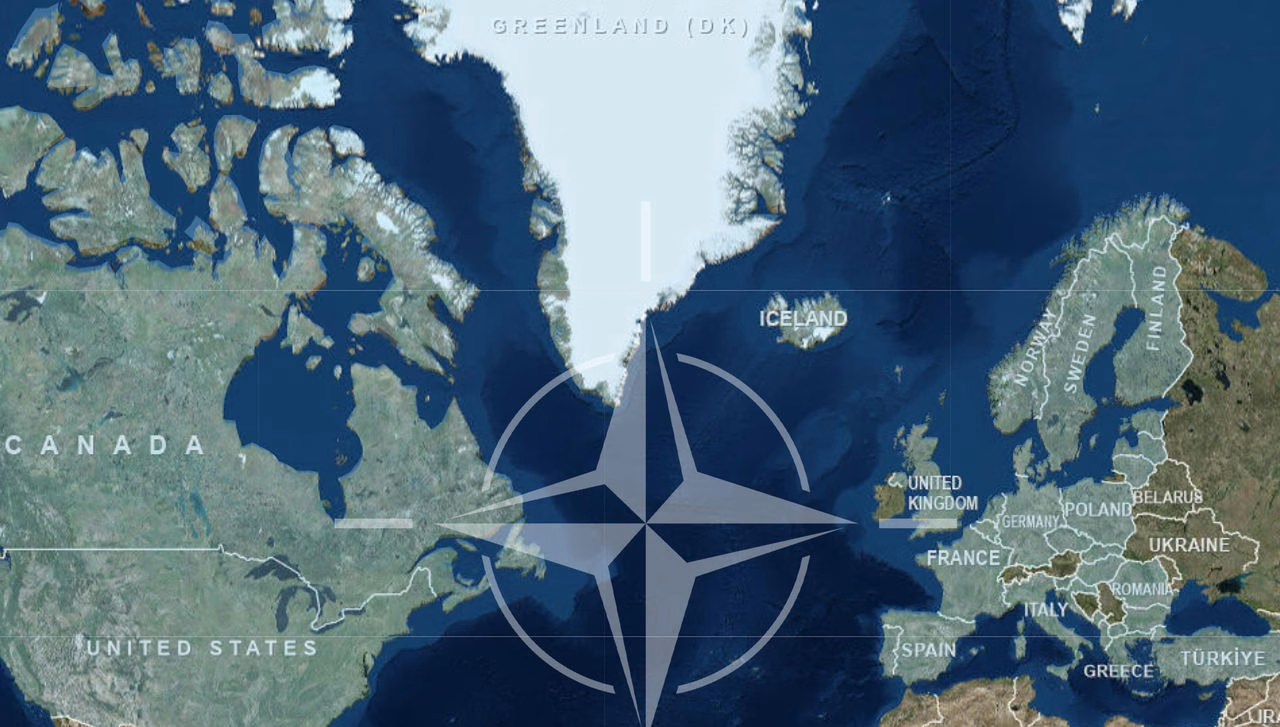
The findings come as the Obamaadministration said Tuesday that Russia continues to meddle in Ukraine in defiance of U.S. and European sanctions. Pro-Russian militants took over more government buildings in eastern Ukraine, while officials at the North Atlantic Treaty Organization said satellite imagery showed no sign that Russia had withdrawn tens of thousands of troops massed near the border.
The poll showed that approval of President Barack Obama’s handling of foreign policy sank to the lowest level of his presidency, with 38% approving, at a time when his overall job performance drew better marks than in recent months.
(…)
The poll findings, combined with the results of prior Journal/NBC surveys this year, portray a public weary of foreign entanglements and disenchanted with a U.S. economic system that many believe is stacked against them. The 47% of respondents who called for a less-active role in world affairs marked a larger share than in similar polling in 2001, 1997 and 1995. (See poll results over time about America’s role in the world.)
Similarly, the Pew Research Center last year found a record 53% saying that the U.S. “should mind its own business internationally” and let other countries get along as best they can, compared with 41% who said so in 1995 and 20% in 1964.
“The juxtaposition of an America that wants to turn inward and away from world affairs, and a strong feeling of powerlessness domestically, is a powerful current that so far has eluded the grasp of Democrats and Republicans,” said Democratic pollster Fred Yang, who conducts the survey with Republican pollster Bill McInturff. “The message from the American public to their leaders in this poll seems to be: You need to take care of business here at home.”
The poll results have broad implications for U.S. politics, helping to explain, among other developments, Mr. Obama’s hesitance to have the U.S. take the lead in using military force in Libya, the reluctance of Congress to authorize force against Syria and the ascent as a national figure of Sen. Rand Paul (R., Ky.), a potential 2016 presidential candidate who has called for a restrained foreign policy.
Suadpport for Mr. Obama’s handling of Russian intervention in Ukraine slipped to 37% in the new poll from 43% in March. But at the same time, a plurality agreed with the statement that Mr. Obama takes “a balanced approach” to foreign policy “depending on the situation,” with smaller shares rating him as too cautious or too bold.
These numbers aren’t entirely surprising, of course. Since the beginning of the Obama Administration, or perhaps even since the latter years of the Bush Administration, the American public has shown a large distaste for foreign intervention of any kind, In no small part, of course, this is due to the disaster that the Iraq War and, eventually, the Afghanistan War, became over time. But I think that’s only part of the explanation. Historically, there has always been a reluctance among the American public to get involved in international affairs. This is something that exhibited itself from the earliest days of the Republic, when the factions that would eventually become the Federalists and the Democratic-Republicans argued, sometimes quite vehemently and violently, about whether or not the new nation should support the revolution in France. For the next 100 years or so, the United States did its best to stay away from involvement in affairs beyond America’s shores. The obvious exception to this, of course, relates to Mexico, Central America, and South America, but of course those areas were exceptions to the general rule carved out by President Monroe in an effort to prevent European intervention in nations close to the United States.
The 20th Century brought somewhat of a change to American’s attitude’s toward foreign policy. Thanks in no small part to a tremendously successful propaganda campaign by the Wilson Administration, the American people rallied around the idea of sending American boys off to die in what, in reality, was nothing more than just another European tribal war. And, while there was a brief period between the two World Wars in which Americans “turned inward,” that quickly changed once the Japanese attacked Pearl Harbor. After World War II ended, of course, the United States inevitably became the leader of the free world and everything changed. Domestically, the Cold War had a significant impact on political opinion on foreign policy pretty much until it ended in the late 1980’s, although the Vietnam War era and the anti-nuclear movements during the Reagan era were certainly a reflection of prominent, although in some cases minority, opinions in that area.
Once the Cold War ended, public attitudes about foreign policy seemed to return to the pre-World War One historic norm. It took a lot of good public relations work for the George H.W. Bush Administration to make the case for the Persian Gulf War, for example, and there was little public support for the adventures that the Bush 41 and Clinton Administrations in places such as Somalia and the Balkans. That all ended, of course, with the September 11th attacks, for rather obvious reasons. Not only was the initial mission in Afghanistan entirely justified given the attacks, but it’s undeniable that the credibility that those attacks gave to a case for war in Iraq that was, in retrospect. rather weak is undeniable.
In any event, in those intervening years, and thanks in no small part to bitter experience, the American people have, quite understandably, become quite reticent when it comes to interfering in the affairs of other nations. Perhaps it’s time that our leaders listened to the people.