
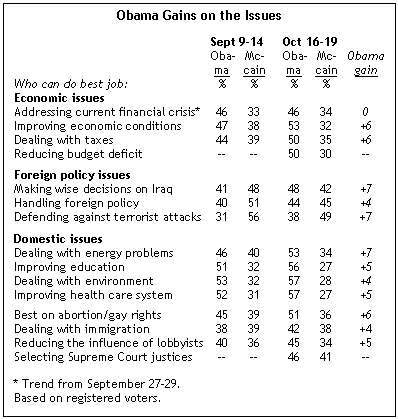
 Matt Yglesias offers these Pew poll results as a rejoinder to those of us who think a win for Obama isn’t a mandate for his policies.
Says Matt, “The voters felt they had a choice between a liberal and a conservative, and felt they preferred the liberal and his policy agenda.”
Well . . . no.
For one thing, most of the choices are generic “addressing,” “improving,” “dealing with,” “wise decisions,” “handling,” and so on and so forth. For another, many of these are generic party choice responses. That is, it’s rare indeed for a Democrat not to be rated “better” on education, economic issues, and the like or the Republicans not to be rated “better” on national security policy.
Beyond that, as elections tighten, people give their guy higher marks on the issues. The swing between the September and October surveys shown in the chart demonstrate this in action. As the race broke open for Obama, mostly in response to the financial markets crisis, he suddenly became better able to handle a variety of issues.
George W. Bush won several states in 2004 that Obama is projected to carry today. Do we really believe that the voters in Ohio, Florida, New Mexico, Colorado, and Virginia are markedly more progressive than they were four years ago? That they’ve swung radically from anti-abortion to pro-abortion? Have decided they want their taxes raised?
Beyond that, what precisely are the policy differences between McCain and Obama on terrorism, energy, education, gay rights, immigration, and lobbying reform that are driving this election? I believe I’ve followed this race a bit more closely than the average swing voter and I couldn’t tell you.
No, as with most elections, people are voting both retrospectively — they’re unhappy with the incumbent president and are ready to switch directions — and prospectively — assessing the personalities and skills of the candidates. If, as expected, Obama wins it’ll be because people wanted change and trusted him moreso than his opponent to deliver it.
None of this is to say that a President Obama wouldn’t have every right to try and enact his policy preferences in what look to be a much stronger Democratic majority House and Senate. Of course he does. But it won’t mean that every vote he got was a vote for each and every one of those priorities.









