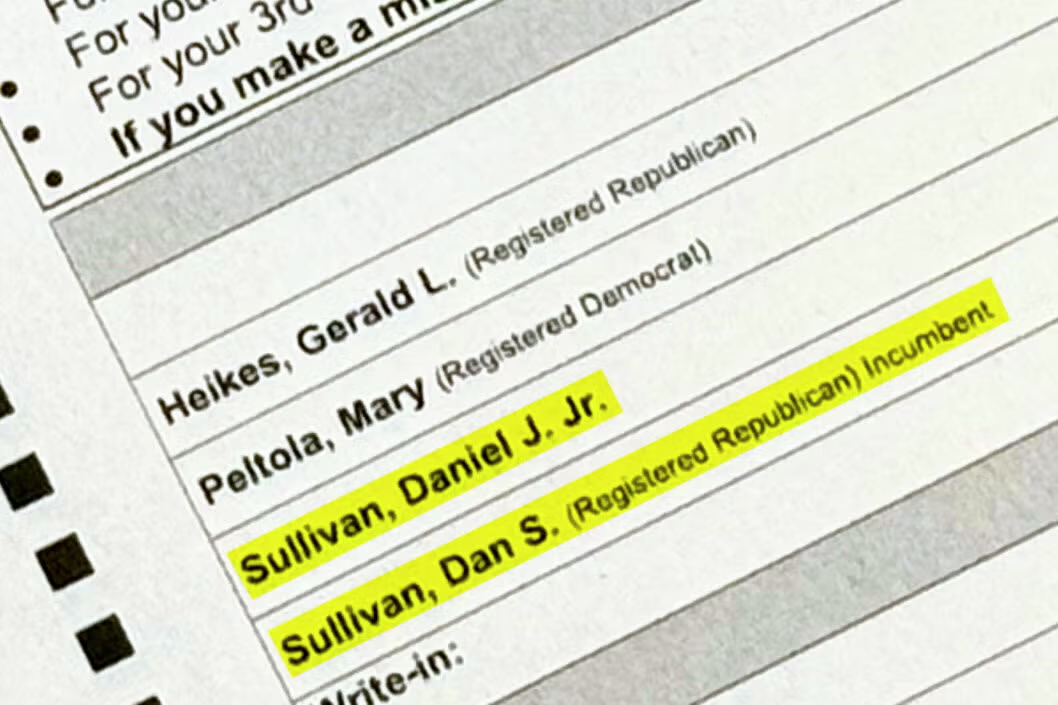
In my June post “Weak Parties and Dirty Tricks,” I linked and excerpted an AP report on the Alaska Senate race in which incumbent Senator Dan Sullivan and other Republican officials claimed that the presence of a second Republican candidate named Dan Sullivan on the ranked-choice ballot was a dirty trick designed “to rig the election” for former Democratic Representative Mary Peltola. I observed,
I don’t know enough about Alaskan politics or the non-incumbent Dan Sullivan to have a definitive opinion, but this certainly looks like dirty pool on the part of the Peltola campaign. Sowing confusion in voters is a time-honored tactic of both parties, alas, however despicable it may be.
before transitioning to my titular point: this couldn’t have happened in a system where political parties had control over who could run under their banner.
This seemingly obvious conclusion drew extreme pushback in the comment section. Why, how dare I attribute the entry into the race for United States Senator of a rando who had never previously run for political office and who just happened to have the name of the incumbent Republican Senator to the opposition party? Surely, it was just a coincidence!
This morning’s episode of The Daily, “A Plan for Two Dans: How Democrats Manipulated Alaska’s Ballot,” featuring NYT political reporter Kellen Browning, presents rather definitive evidence that the second Sullivan was indeed recruited by the Peltola campaign and that, indeed, there’s good reason to think that the other “Republican” who has survived into the top four, Gerald Heikes, was as well.
It’s based on Browning’s report “Inside Democrats’ Secret Effort to Stack Alaska’s Ballot,” which appears on the front page of today’s print edition (although, oddly, is nowhere to be seen on the main page of their website).
In the summer of 2025, a staffer for Mary Peltola, the Alaska Democrat who was eyeing a run for Senate, received unusual instructions from top campaign aides: Find as many people named Dan Sullivan in Alaska as you can.
The staffer complied, combing through voter records to produce a list of Dan Sullivans from across the state.
This was no random request. Dan S. Sullivan is the name of the state’s Republican senator. And if the Peltola campaign or its allies could track down and persuade another Dan Sullivan to run for Senate, the confusion could cost the senator crucial votes on the state’s unusual, four-person ballot.
The plan worked. This spring, a retired teacher from a tiny fishing village along the Alaska Panhandle, reachable only by air and sea, announced his candidacy for Senate. His name was Dan J. Sullivan.
The Peltola campaign has repeatedly denied any involvement in his candidacy. But The Times has found, based on interviews and text messages, along with documents prepared for a potential lawsuit against the campaign, that not only did Ms. Peltola’s team work with people trying to recruit Mr. Sullivan to run for Senate, but the effort was much broader. The group worked to coax other would-be spoilers into the race, to dilute the incumbent’s support and help catapult the Democrat to victory.
The endeavor, which was internally called the ballot composition project, involved secret trips to far-flung Alaskan communities and the appearance of a mysterious Midwestern operative, who traversed the state using a fake name and made his pitch to would-be candidates over beers at brew pubs.
It also involved the Peltola campaign’s lawyers, as well as senior aides at the Democratic Senatorial Campaign Committee, which directs the party’s campaign strategy in Senate races across the country. From Washington to Anchorage, those advisers participated in regular conversations about the effort and even considered forming a new political party to draw conservatives onto the ballot.
I doubt the revelations will matter much in how people vote. But the whole thing is despicable.