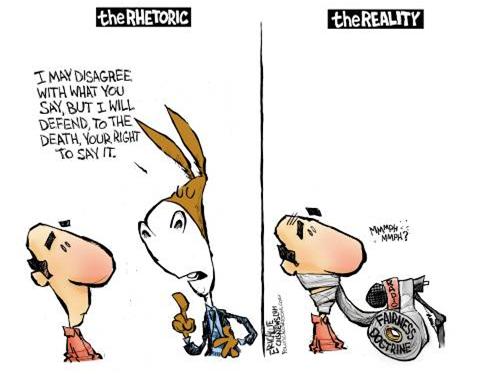
A plurality of Americans want “government [to] require all radio and television stations to offer equal amounts of conservative and liberal political commentary” and nearly a third believe even privately owned blogs should have that requirement, Rasmussen reports.

Nearly half of Americans (47%) believe the government should require all radio and television stations to offer equal amounts of conservative and liberal political commentary, but they draw the line at imposing that same requirement on the Internet. Thirty-nine percent (39%) say leave radio and TV alone, too.
At the same time, 71% say it is already possible for just about any political view to be heard in today’s media, according to a new Rasmussen Reports national telephone survey. Twenty percent (20%) do not agree.
Fifty-seven percent (57%) say the government should not require websites and blog sites that offer political commentary to present opposing viewpoints. But 31% believe the Internet sites should be forced to balance their commentary.
This is a shocking finding in a society founded on a disdain for government control and a demand for free speech. And he pro-censorship numbers are likely understated slightly, since this is a poll of likely voters, which skew wealthier and more educated than the public at large.
The Fairness Doctrine made made some sense when it started in 1947. After all, broadcast was new and people had very limited choice in radio and, later, television stations. There was a real danger that the political conversation could be stifled, or bent to the whims of one or two wealthy individuals, for any given local audience in that environment. Given that “the public owned the airwaves” and station licenses were a public trust, requiring something like “equal time” for opposition viewpoints was a reasonable safeguard.
Fast forward a few decades. Most people have access to dozens, if not hundreds, of television channels, few of which are under the control of local ownership. Radio is mostly an entertainment medium, with political talk relegated to NPR and the AM dial — unless you’re a subscriber to satellite, in which case the choices are legion. Talk radio, in particular, is dominated by nationally syndicated programs. There’s an endless supply of political sites on the Internet, political commentary magazines, and other venues for mass political expression.
What’s the justification, now, for government’s controlling speech?
Beyond that, surely “liberal” and “conservative” inadequately represent the spectrum of opinion. Indeed, for true believers, Barack Obama isn’t liberal enough and John McCain isn’t a conservative at all. Do we have to give equal time to the fringe?