
As promised, Trump is attempting to substantially change how citizenship works in the United States and is doing so expansively, almost entirely shifting us from a legal order that focuses on place of birth to one focused on one based on blood.
Here is a key passage from the Executive Order that was issued.
Sec. 2. Policy. (a) It is the policy of the United States that no department or agency of the United States government shall issue documents recognizing United States citizenship, or accept documents issued by State, local, or other governments or authorities purporting to recognize United States citizenship, to persons: (1) when that person’s mother was unlawfully present in the United States and the person’s father was not a United States citizen or lawful permanent resident at the time of said person’s birth, or (2) when that person’s mother’s presence in the United States was lawful but temporary, and the person’s father was not a United States citizen or lawful permanent resident at the time of said person’s birth.
(b) Subsection (a) of this section shall apply only to persons who are born within the United States after 30 days from the date of this order.
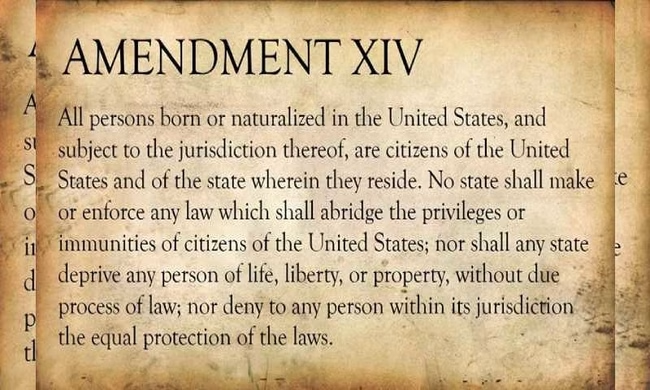
Now, I will remind everyone what the 14th Amendment says: “All persons born or naturalized in the United States, and subject to the jurisdiction thereof, are citizens of the United States and of the State wherein they reside.”
The text is plain and the issue of jurisdiction is dealing with things like the children of ambassadors, a group of people who are literally not “subject to the jurisdiction” of the US. Moreover, the practice of birthright citizenship was in place before the amendment was passed, so it is an affirmation of pre-existing reality and was explicitly stated to clarify the status of ex-slaves.
The EO asserts that the kinds of people listed in the excerpt above fall into the category of not subject to the jurisdiction of the United States. Exactly how this should work is baffling, as it suggests that the undocumented have the equivalence of diplomatic immunity (so, let The Purge: Immigrant Style commence!). And it strains logic and legality to suggest that, say, a person with an H1B visa is not subject to the jurisdiction of the United States? Moreover, how is an H1B different than a green card in terms of legal jurisdiction?
The reality is that the words are clear and their legal understanding and application have been in concert with those words for most of American history. The Supreme Court has acknowledged the plain and obvious meaning of the phrase, and did so in 1898! I detail all of this in a previous post: The Birthright Citizenship Debate.
The president cannot change the meaning of the US Constitution by fiat (on the day he swore to uphold it, I would note).
Of course, the reality is this: the EO will end up in court and it will almost certainly be ruled on by SCOTUS. In any other era of US politics I would assume that the Court would do the obvious: uphold the plain text as reinforced by a century and a half of practice that reinforced said text. However, I am not at all certain how the now ideolog-populated Supreme Court will behave.
I thought that Trump might try to simply equate illegal immigration with an “invasion” and try and treat such persons as part of an invading army, which the 14th Amendment is seen not to apply to. I find such an interpretation incorrect and strains the meaning of words. But, given the nature of the Court, it seems a more fruitful line of attack (even if still one that contradicts 150+ years of understanding).
To try and require parents to have not just legal status, but very specific legal status (see the bolded portion above) is to try and almost entirely upend jus soli and shift it to jus sanguinis.
I will also note what I have noted before: Trump is wrong to assert that the US is alone in granting birthright citizenship.
I have written on this topic, and why I think birthright citizenship is good for the United States here:









