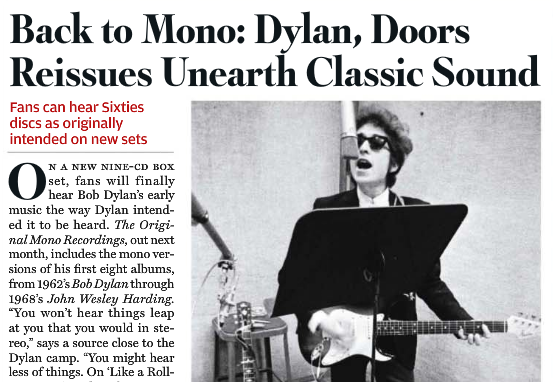

Whilst waiting for a dental appointment this afternoon, I picked up a copy of Rolling Stone for the first time in I don’t know how long and stumbled on an article titled “Back to Mono: Dylan, Doors Reissues Unearth Classic Sound.” I’ve been unable to locate it on the magazine’s website but someone has uploaded the entire issue on scribd.com. It’s on page 22.
The format doesn’t allow copying but the gist of the piece is that, with these new releases, “fans will finally hear Bob Dylan’s early music the way Dylan intended it to be heard.”
Now, we had essentially this same debate a couple decades back when Ted Turner started “colorizing” old black and white movies for his various cable channels. His theory was that the only reason those movies were in B&W was because color was either unavailable or too expensive and that fans much preferred to see movies in color since, well, the world is in color. (The opposite theory was proposed in an old “Calvin and Hobbes” strip, wherein the dad explained that the world was in black and white until the late 1930s.) Movie critics and artistes were incensed, arguing that directors made decisions based on the format and that colorizing them post-hoc cheapened the art. I tended to side with Turner in that one.
Upon reading the opening paragraphs of this piece, I had a similar reaction, rolling my eyes at the notion that Dylan and company wanted people to hear their music using crappy reproduction techniques. But, upon further reading, I started to be persuaded to this view. Apparently, mono recordings produced a quite different sound and one which, while not allowing for all the subtleties of later formats, gave a “full bore” treatment to the vocal performances.
Long after stereo was available for recording albums, producers kept making monorail recordings because that’s the format that AM radio — which is to say, radio — was in and therefore the sound that audiences would be introduced to song in. And few teenagers had stereo record players, anyhow. And, thus, as engineer Allan Rouse contends, “At the beginning, mono was all [Beatles producer] George Martin was thinking about.” Further, while stereo versions were made, the producers often used substantially different arrangements. For example, “The mono mix of Sgt. Pepper has different song endings (more guitar toward the end of the title track) and varied tempos (a slightly faster “She’s Leaving Home”).
Additionally, some purists contend that mono is actually a truer sound. Bob Irwin, owner of something called Sundazed, points out, “When you hear a band playing live, the vocals don’t come out of a left speaker and the instruments out of the right. If you want to hear a band playing together, that’s mono.”
I’m not fully sure I buy it. I’d have to listen to several recordings back-to-back to compare the versions. But it’s certainly a plausible theory.