
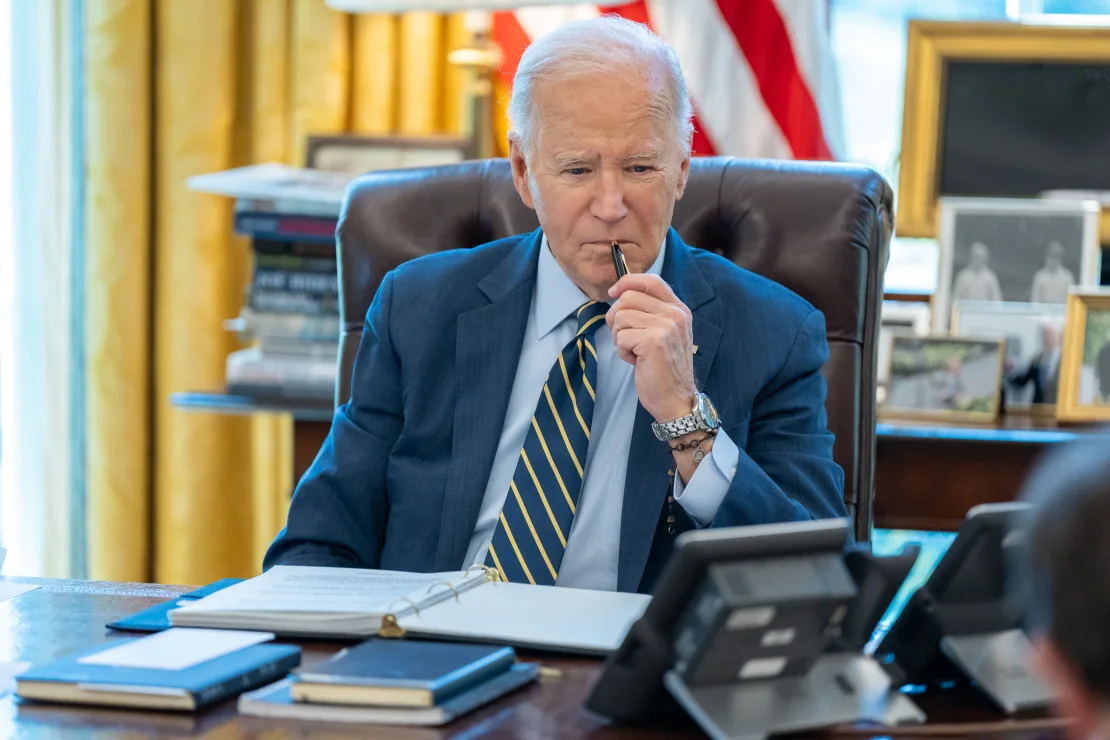

CNN (“Biden says he will stop sending bombs and artillery shells to Israel if it launches major invasion of Rafah“):
President Joe Biden said for the first time Wednesday he would halt some shipments of American weapons to Israel – which he acknowledged have been used to kill civilians in Gaza – if Prime Minister Benjamin Netanyahu orders a major invasion of the city of Rafah.
“Civilians have been killed in Gaza as a consequence of those bombs and other ways in which they go after population centers,” Biden told CNN’s Erin Burnett in an exclusive interview on “Erin Burnett OutFront,” referring to 2,000-pound bombs that Biden paused shipments of last week.
“I made it clear that if they go into Rafah – they haven’t gone in Rafah yet – if they go into Rafah, I’m not supplying the weapons that have been used historically to deal with Rafah, to deal with the cities – that deal with that problem,” Biden said.
The president’s announcement that he was prepared to condition American weaponry on Israel’s actions amounts to a turning point in the seven-month conflict between Israel and Hamas. And his acknowledgement that American bombs had been used to kill civilians in Gaza was a stark recognition of the United States’ role in the war.
The president has come under extraordinary pressure, including from members of his own party, to limit shipments of arms amid a humanitarian crisis in Gaza.
Until now, the president had resisted those calls and strongly supported Israel’s efforts to go after Hamas. Yet a looming invasion of Rafah, the city in southern Gaza where more than a million Palestinian civilians have been sheltering, appears to have shifted the president’s calculus.
“We’re not walking away from Israel’s security. We’re walking away from Israel’s ability to wage war in those areas,” Biden said.
Biden said while the US would continue to provide defensive weapons to Israel, including for its Iron Dome air defense system, other shipments would end should a major ground invasion of Rafah begin.
“We’re going to continue to make sure Israel is secure in terms of Iron Dome and their ability to respond to attacks that came out of the Middle East recently,” he said. “But it’s, it’s just wrong. We’re not going to – we’re not going to supply the weapons and artillery shells.”
Already, the US has paused a shipment of “high-payload munitions” due to Israel’s possible operations in Rafah without a plan for the civilians there, according to the Pentagon, though it said a final decision on that shipment hadn’t been made. The administration has said it is reviewing the potential sale or transfer of other munitions.
Israeli officials privately expressed to US officials “deep frustration” on the pause in shipments as well as the US media briefings on the decision, according to a source briefed on the matter.
Biden’s public linking of American weapons shipments to Israel’s conduct could widen a rift between himself and Netanyahu, with whom he spoke by phone on Monday. That conversation came as Israel ordered the evacuation of tens of thousands of civilians from Rafah and launched strikes near border areas of the city.
Biden said Israel’s actions in Rafah had not yet crossed a red line of entering heavily populated zones, even if their actions had caused tensions in the region.
“They haven’t gone into the population centers. What they did is right on the border. And it’s causing problems with, right now, in terms of – with Egypt, which I’ve worked very hard to make sure we have a relationship and help,” he said.
He said he had conveyed to Netanyahu and other Israeli leaders that American support for operations in population centers was limited.
“I’ve made it clear to Bibi and the war cabinet: They’re not going to get our support, if in fact they go on these population centers,” he said.
Later, Biden described warning Netanyahu about the risks of becoming bogged down in Gaza, drawing parallels to the American experience in Afghanistan and Iraq.
“I said to Bibi, ‘Don’t make the same mistake we made in America. We wanted to get bin Laden. We’ll help you get Sinwar,’” he said, referring to the Hamas leader in Gaza. “It made sense to get bin Laden; it made no sense to try and unify Afghanistan. It made no sense in my view to engage in thinking that in Iraq they had a nuclear weapon.”
WaPo (“Biden says he will cut off offensive weapons if Israel invades Rafah“) adds:
Since the outset of the war in October, Netanyahu has repeatedly defied U.S. demands on major issues, rejecting Biden’s requests that he do more to protect civilians and that he accept the notion of a future Palestinian state. But the president has been loath to impose direct consequences, even as the death toll mounts in Gaza and Israel refuses to allow in more humanitarian aid to ease catastrophic conditions in the enclave.
Biden’s tone and message toward Israel have become increasingly sharp, however, while student protests against his support of Israel’s military campaign have erupted on campuses across the country. Wednesday’s comments were in a sense a culmination of that shift in tone.
Israel has taken a number of actions in recent days that have raised fears among U.S. officials that the Israel Defense Forces are preparing for a major Rafah operation. It seized the Rafah border crossing between Egypt and Gaza, cutting off the main artery for humanitarian aid. Israel also warned more than 100,000 Palestinians to evacuate the city, even as aid groups have warned that there is no place left in Gaza with the infrastructure to support such an influx.
[…]
Biden’s comments Wednesday are not the first time a U.S. president has threatened to condition aid to Israel. President Ronald Reagan halted a shipment of artillery shells and cluster bombs in 1982 during Israel’s invasion of Lebanon while the U.S. determined whether Israel’s use of American weapons violated arms exports laws. Reagan also paused the shipment of F-16s in 1983 until Israel withdrew from Lebanon.
About a decade later, President George H.W. Bush told Israel an aid package of $10 billion loan guarantees would only go through if Israel stopped using U.S. money to build settlements on land that belonged to the Palestinians.
NBC News (“U.S. pauses Israel arms shipment over Rafah assault fears as Biden pushes for a cease-fire“):
The United States halted a large shipment of offensive weapons to Israel last week in a sign of its growing concern over a possible military offensive on Rafah, senior administration officials told NBC News.
[…]
The Israeli military appeared to play down the dispute, with a spokesman saying Wednesday that the two allies would resolve any disagreements “behind closed doors.”
But an Israeli official told NBC News there is deep frustration in the Israeli government over the decision. The official added that tensions had already been running high after Israel felt the U.S. allowed it to be blindsided by Hamas’ announcement this week that it was accepting a version of a cease-fire proposal.
[…]
The U.S. began reviewing future transfers of military assistance to Israel in April, as the government appeared to move closer to a Rafah operation despite the urging of Biden, other world leaders and humanitarian officials, the official said.
No final decision had been made on whether to proceed with the weapons delivery at a later date, the official said, adding that the State Department is separately considering whether to approve future weapons transfers, including Joint Direct Attack Munition kits, which place precision guidance systems onto bombs.
[…]
The decision to pause last week’s arms delivery, which was first reported by Axios, came to light as the Biden administration appeared set to miss a Wednesday deadline to submit a highly anticipated report to Congress on whether Israel is using U.S. weapons in accordance with international law.
Multiple administration officials told NBC News the Biden administration would miss the deadline, with State Department spokesperson Matt Miller confirming to reporters Tuesday afternoon that a delay was possible.
“We are trying very hard to meet that deadline,” he said. “It’s possible it slips just a little bit, but we’re still at this point trying to get it done by tomorrow.”
The report is mandated under a National Security Memo signed by Biden in February requiring the secretary of state or the defense secretary to assess whether recipients of U.S. military assistance involved in active conflict are using those weapons in line with international law.
As a practical matter, I’m not sure that cutting off these shipments will matter. Given that the consensus of Israel’s unity government is that going into Rafah is the only way to get to the Hamas leadership, they’ll almost certainly go into Rafah. This will almost certainly be a humanitarian nightmare and further erode Israel’s international standing, but they’re going to do it anyway.
By all accounts, the IDF have sufficient bombs to accomplish the task. I haven’t the slightest idea what their JDAM inventory is but, I must say, it seems odd to withhold precision guidance technology if the goal is to minimize civilian deaths. Without smart bombs, more dumb bombs will need to be used.
The WaPo report reminds us that US Presidents—Republican Presidents, even—have withheld munitions before as leverage to achieve foreign policy demands. It seems unlikely to work in this case, at least in the short term. In the longer term, one imagines that Israeli leaders will diversify their weapons suppliers or invest in their own munitions industry to increase their autonomy in making security policy.









