

While there’s plenty of downside to the ubiquitous tracking that’s now normal for those of us who live in technologically advanced societies, there’s plenty of upside, too. A couple of stories I’ve read the last couple of days highlight the latter.
The Verge (“Tracking travelers’ phones let Cincinnati airport cut security line waits by a third“):
Going through airport security is a miserable experience, but airports are at least starting to figure out ways to get you through the line quicker. Cincinnati/Northern Kentucky International Airport says that the median wait time in its security lines has dropped by a third, going from 13.2 minutes to 8.9 minutes, after installing a system that tracks travelers’ phones to estimate how much traffic each line has. The system allows the airport to display to passengers how long the wait in each of its security lines is. It also allows the airport to adjust its resources to respond to demand.
The airport’s tracking system, made by Blip Systems, looks for devices over Wi-Fi and Bluetooth. Blip Systems says that it collects each device’s unique identifier (MAC address) and then uses that information to determine how many people are present in a given area. There are certainly some security concerns related to tracking like that, but the information it’s collecting can only show so much — that your device is present — and, theoretically, that’s increasingly little. Blip Systems also says that it anonymizes all data. Plus, everyone is already going through airport security, so it’s not like the system would be breaching some bastion of privacy.
The slight lessening of wait times at airports with wait times that are exceedingly modest to begin with (I mean, really, saving 4 minutes per visit isn’t that big a deal unless you’re a very frequent flier, indeed), the potential here is interesting.
Cincinnati/Northern Kentucky International Airport installed the system over the summer, supposedly becoming the first airport in the US to do so. It isn’t the first airport with the system worldwide, however. In an article last June, Bloomberg noted that it had already been installed in 20 airports, including in Amsterdam, Dubai, and Toronto. And improving security lines may be just the start. Bloomberg reports that Blip Systems believes its trackers could eventually be used to determine how many people are in different airport stores and restaurants, potentially even tracking movement around a terminal. That may be less appealing to travelers, but it’s hard to argue much with cutting down security lines.
But Cliff Kuang’s extensive Wired feature (“DISNEY’S $1 BILLION BET ON A MAGICAL WRISTBAND“) really got my attention.
If you’re wearing your Disney MagicBand and you’ve made a reservation, a host will greet you at the drawbridge and already know your name—Welcome Mr. Tanner! She’ll be followed by another smiling person—Sit anywhere you like! Neither will mention that, by some mysterious power, your food will find you.
“It’s like magic!” a woman says to her family as they sit. “How do they find our table?” The dining hall, inspired by Beauty and the Beast, features Baroque details but feels like a large, orderly cafeteria. The couple’s young son flits around the table, like a moth. After a few minutes, he settles into his chair without actually sitting down, as kids often do. Soon, their food arrives exactly as promised, delivered by a smiling young man pushing an ornately carved serving cart that resembles a display case at an old museum.
Nice, I suppose, but not that big a deal. But it gets better.
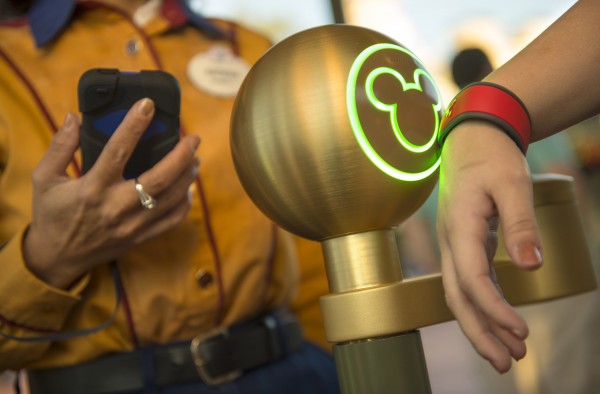
Part of the trick lies in the clever way Disney teaches you to use them—and, by extension, how to use the park. It begins when you book your ticket online and pick your favorite rides. Disney’s servers crunch your preferences, then neatly package them into an itinerary calculated to keep the route between stops from being a slog—or a frustrating zig-zag back and forth across the park. Then, in the weeks before your trip, the wristband arrives in the mail, etched with your name—I’m yours, try me on. For kids, the MagicBand is akin to a Christmas present tucked under the tree, perfumed with the spice of anticipation. For parents, it’s a modest kind of superpower that wields access to the park.
If you sign up in advance for the so-called “Magical Express,” the MagicBand replaces all of the details and hassles of paper once you touch-down in Orlando. Express users can board a park-bound shuttle, and check into the hotel. They don’t have to mind their luggage, because each piece gets tagged at your home airport, so that it can follow you to your hotel, then your room. Once you arrive at the park, there are no tickets to hand over. Just tap your MagicBand at the gate and swipe onto the rides you’ve already reserved. If you’ve opted in on the web, the MagicBand is the only thing you need.
It’s amazing how much friction Disney has engineered away: There’s no need to rent a car or waste time at the baggage carousel. You don’t need to carry cash, because the MagicBand is linked to your credit card. You don’t need to wait in long lines. You don’t even have to go to the trouble of taking out your wallet when your kid grabs a stuffed Olaf, looks up at you, and promises to be good if you’ll just let them have this one thing, please.
This is just what the experience looks like to you, the visitor. For Disney, the MagicBands, the thousands of sensors they talk with, and the 100 systems linked together to create MyMagicPlus turn the park into a giant computer—streaming real-time data about where guests are, what they’re doing, and what they want. It’s designed to anticipate your desires.
That’s obviously pretty cool. But why would Disney spent a billion dollars trying to improve a park experience that was already pretty great, as evidenced by the throngs of people there even during off-peak times?
Staggs couches Disney’s goals for the MagicBand system in an old saw from Arthur C. Clarke. “Any sufficiently advanced technology is indistinguishable from magic,” he says. “That’s how we think of it. If we can get out of the way, our guests can create more memories.” He offers a story about how a program called Fast Passes once guaranteed a ride time at premier attractions like Space Mountain. It used to be that those passes were issued at the rides themselves, and stamped with a designated return time. You had to be there when it opened, because passes went quickly and unless you were a scheduling savant, it was hard to hold passes for more than one ride at a time. You’d see families waiting outside for the park to open, then fathers sprinting for a kiosk to get enough passes for everyone in the family. “I used to be that sprinter,” Staggs says.
You can see why he—and Disney—would be so keen on the bands. Instead of telling your kid that you’ll try to meet Elsa or ride It’s a Small World, Franklin says, “you get to be the hero, promising a ride or a meet-and-greet up front. Then you can be freer to experience the park more broadly. You’re freed to take advantage of more rides.” There is an elegant business logic here. By getting people exploring beyond the park’s top attractions, overall use of the park goes up. People spend less time in line. They’re doing more, which means they’re spending more and remembering more. “The whole system gave Disney a way of understanding the business,” says Franklin, who stepped down last July as Disney’s executive vice president of next-generation experience. “Knowing we need more food here, how people are flowing through the park, how people are consuming the experiential product.”
It also allows Disney to optimize employees. The goal was to create a system that would essentially replace the time spent fiddling with payments and tickets for moments of personal interactions with visitors. The MagicBands and MyMagicPlus allow employees to “move past transactions, into an interactive space, where they can personalize the experience,” Crofton says. What started as a grand technology platform has inevitably changed the texture of the experience.
Meanwhile, the digital world—and the ease with which we carry it around in our phones—has filled our lives with new expectations and endless entertainment options. “I can’t think of a business that isn’t affected by more choice and more access to information and an increasing desire for personalization,” says Staggs. So if you’re a theme park, you have a strange dilemma that echoes the dilemmas we face in our digital lives. “Walt Disney World is vast. There’s more to do than you could do in a month,” Staggs says. “That choice is overwhelming.”
In fact, it’s called the paradox of choice: You make people happier not by giving them more options but by stripping away as many as you can. The redesigned Disney World experience constrains choices by dispersing them, beginning long before the trip is under way. “There are missions in a vacation,” Staggs says. In other words, Disney knows that parents arrive to its parks thinking: We have to have tea with Cinderella, and where the hell is that Buzz Lightyear thing, anyway? In that way, the park isn’t a playground so much as a videogame, with bosses to be conquered at every level. The MagicBands let you simply set an agenda and let everything else flow around what you’ve selected. “It lets people’s vacations unfold naturally,” Staggs says. “The ability to plan and personalize has given way to spontaneity.” And that feeling of ease, and whatever flows from it, just might make you more apt to come back.
Disney was already better at this than any of the competitors and by a mile. Going to one of the non-Disney parks in Orlando is always a big let-down, especially in the midst of a week going to the Disney parks. Not only had Disney figured out how to herd huge numbers of people through the queues more efficiently than anyone else even before the magic bands, but they’d figured out how to make the lines themselves relatively entertaining. Still, in an era where even five minutes of time not being entertained is intolerable because of the increased expectations created by our technology, Disney believed they needed to get even better.
Will this concept spread beyond theme parks? Kuang thinks it might.
Will the world at large ever become something akin to Disney World, loaded with sensors attuned to our every move, designed to free us? There are signs. It’s already starting to appear on Disney cruise ships, and Staggs says airlines, sports leagues, and sports teams have asked about the technology. “We’re just at the beginning of understanding what to do with this,” he says. What Staggs doesn’t share, but what former team members do, is that Disney already has conceived, designed, and engineered many more features that seem to border on science fiction—features even more ambitious than delivering your food to you without your having to ask.
The MagicBand contains sensors that let guests swipe onto rides and allow Disney to pinpoint their location. At Be Our Guest, they’re what enable the radios in the table and ceiling to triangulate your location so your server can find you. If Disney decides to install those sensors throughout the park, a new world of data opens up. They could have Mickey and Snow White find you. They might use the park’s myriad cameras to capture candid moments of your family—enjoying rides, meeting Snow White—and stitch them together into a personalized film. (The product teams called this the Story Engine.) But they might also know when you’ve waited too long in line and email you a coupon for free ice cream or a pass to another ride. And with that, they’ll have hooked the white whale of customer service: Turning a negative experience into a positive one. It recasts your memories of a place—that’s why casinos comp you drinks and shows when you lose at the tables.
Though Franklin wouldn’t comment on the particulars of these possibilities, he did offer an intriguing summary of them. “What people call the Internet of Things is just a technological underpinning that misses the point, ” he says. “This is about the experiential Internet. The guest doesn’t need to know how it happened. It’s about the magic of the food arriving.”
Not exactly the flying cars we were promised, but pretty cool nonetheless.









