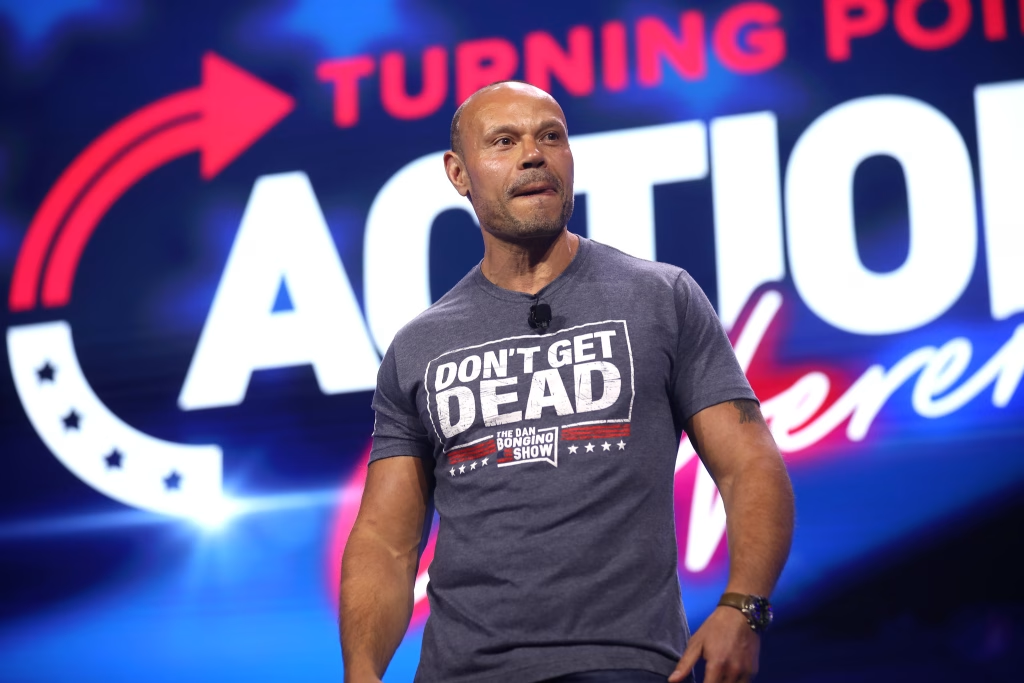
Via the AP: FBI Deputy Director Dan Bongino says he plans to resign next month as bureau’s No 2 official.
FBI Deputy Director Dan Bongino said Wednesday that he will resign from the bureau next month, ending a brief and tumultuous tenure in which he clashed with the Justice Department over the handling of the Jeffrey Epstein files and was forced to reconcile the realities of his law enforcement job with provocative claims he made in his prior role as a popular podcast host.
I am not surprised, given that roughly six months ago, he admitted to Fox and Friends he didn’t like the job. At the time, I wondered how long he would last.
“The biggest lifestyle change is family-wise,” Bongino lamented, explaining that he took the civil service job at the president’s behest.
“It was a lot, and it’s been tough on the family. People ask all the time, ‘Do you like it?’ No. I don’t,” he said. “But the president didn’t ask me to do this to like it — nobody likes going into an organization like that and having to make big changes.”
At one point during his Fox News interview, the former podcaster told an anecdote about a woman who said she missed his show.
Bongino said he told the woman, “I miss me too,” and then explained to his interviewers, “Part of you dies when you see this stuff behind the scenes.”
The video can be found here:
Tim Miller takes him to task in the video, which Bongino deserved at the time (and still does). In fact, I would recommend the video because Miller does a great job of detailing Bongino’s past statements and what he has to deal with as Deputy Director–note Bongino’s face when he was asked about the Epstein suicide. Miller also correctly called Bongino’s likely return to podcasting.
I am going to give Bongino credit for speaking the truth as to his former life versus his current life (and, I assume, his future life). Back to the AP piece linked above:
“I was paid in the past for my opinions,” Bongino said in a Fox News interview. “One day I will be back in that space but that’s not what I’m paid for now. I’m paid to be your deputy director and we base investigations on facts.”
This was a pretty candid admission. He knows he spewed something other than facts on his show. That means that he was okay, and probably still is, pretending like conspiracy theories and wild accusations are fine because they are just “opinions.”
He sounds like a poor undergraduate who thinks that having an “opinion” means it can’t be judged, but can only be accepted because, well, it’s just an opinion. A favorite gripe for students who get poor scores is that they just have a differing “opinion” from the professor. Even here on the site, sometimes commenters will counter with an argument bolstered by evidence and even assert that any disagreement is just a matter of opinion.
Side note: making a more sophisticated, analytical argument based on evidence hardl automatically makes one right, but there is a far site higher chance such an approach will be closer to right than simply making assertions because, well, that’s what one thinks is true.
A lot of unsophisticated thinkers categorize the world in “opinions” (personal views that are all equally valid) and “facts” (nuggets of information like the fact that a cow is a mammal or that the typical humanbody temperature is 98.6 degrees F). Such thinking ignores argument, analysis, and the careful deployment of evidence. It tends to reduce arguments to a version of Monty Python’s Argument Clinic sketch. He who says “No, it isn’t!” the most and the loudest wins!
One’s “opinion” might be that we should colonize the Sun, given the ample access to solar energy. The fact that such a statement is couched as “opinion” does not make it immune from criticism or shield it from being dubbed absurd and therefore dismissed.
Or, you know, you might assert that the basement of a certain pizza restaurant is being used to kidnap children, all the while ignoring the pesky lack of existence of a basement. Why clutter the head with facts and actually research when spouting opinions pays the bills and then some?
To pick a real academic example, I once had a master’s student who would literally roll his eyes when a certain International relations theory was mentioned in class. I told him that he was entitled to his view that the theory did a poor job of explaining state action, but he had to be able to demonstrate why, which requires more than just an “opinion” about the theoretical construct in question.
Likewise, we are awash with people with opinions, like Bongino (and Patel, Hegseth, RFK, Jr., etc.), who made a career out of rolling their eyes at things while not being able to actually explain much of anything.
Worse, people with provocative talk shows like Bongino’s often are barely even dealing in opinion, as much as they are trafficking provocation and fiction.
That is, of course, one helluva lot easier to do than be a serious law enforcement official who is bound by the facts.
I am going to again give Bongino some modicum of credit. He admitted that the job was hard, he had to face up to real facts like Epstein’s suicide, and he admitted (unlike some of his cohorts) that there is a difference between the “opinions” spouted by podcasters and the “facts” of being in government.
But that credit will be immediately withdrawn if (and, I think, when) he goes back to his old ways because the money is too good not to do so.