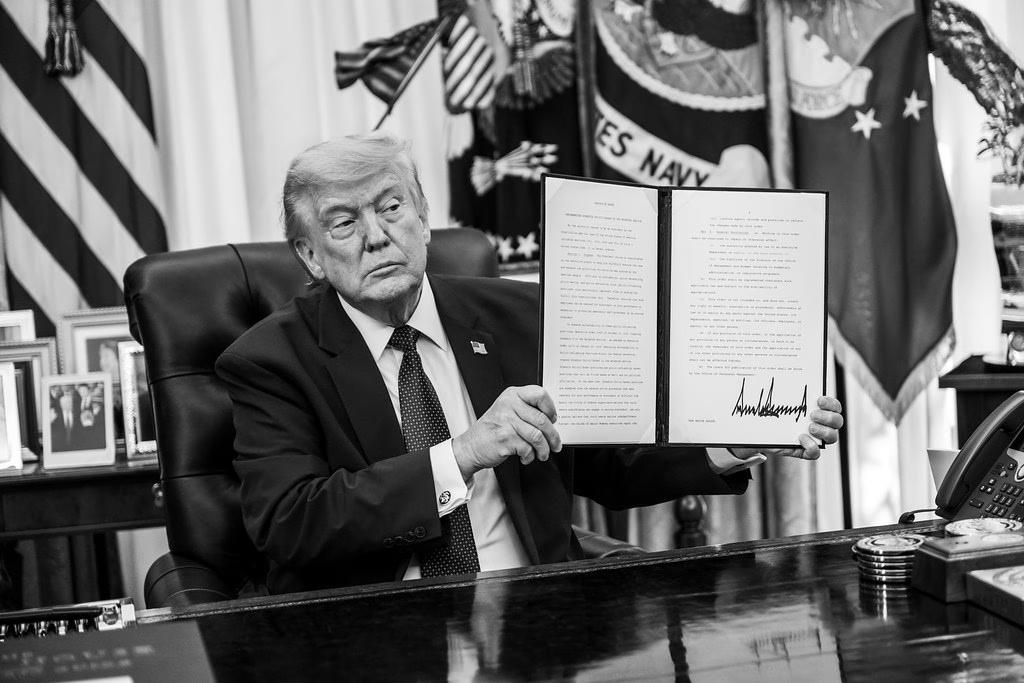
President Bush is flying halfway across the country to sign an emergency bill intervening in a matter that affects a single individual and that has been ongoing since his father was president. Meanwhile, patients in Texas in much better shape than Schiavo are being removed from life support against the wishes of the family under a law Bush signed as governor and supported and partly written by a pro-life group fighting to keep Schiavo alive.
Bush Returning to Washington Over Schiavo (ABC)
President Bush is changing his schedule to return to the White House on Sunday to be in place to sign emergency legislation that would shift the case of a brain-damaged Florida woman to federal courts, the White House said Saturday. “Everyone recognizes that time is important here,” White House press secretary Scott McClellan said. “This is about defending life.” After Terri Schiavo’s feeding tube was removed on Friday, members of Congress worked out a deal to pass legislation to allow federal courts to decide the 41-year-old woman’s fate and in the hopes of supporters of the woman’s parents restore the tube that was keeping her alive. The House and Senate hoped to act on the legislation Sunday, so Bush decided he needed to be in Washington so he could immediately sign the bill, McClellan said. “The president intends to sign legislation as quickly as possible once it is passed,” McClellan said.
So, now, we’re going to spend hundreds of thousands of taxpayer dollars to subvert the legal process and the wishes of both Michael and Terri Schiavo in this matter?
Meanwhile, as Duncan Black and Mark Kleiman point out, the state that he’s leaving, Texas, routinely allows hospitals to pull the plug despite the will of the patient once money runs out:
Hospitals can end life support (Houston Chronicle, March 8th)
A patient’s inability to pay for medical care combined with a prognosis that renders further care futile are two reasons a hospital might suggest cutting off life support, the chief medical officer at St. Luke’s Episcopal Hospital said Monday. […] If there is agreement on the part of all the physicians that the patient does have an irreversible, terminal illness,” he said, “we’re not going to drag this on forever … “When the hospital is really correct and the care is futile … you’re not going to find many hospitals or long-term acute care facilities (that) want to take that case,” he said. “Any facility that’s going to be receiving a patient in that condition … is going to want to be paid for it, of course.”
[…]
State law allows doctors to remove patients from life support if the hospital’s ethics committee agrees, but it requires that the hospital give families 10 days to find another facility.
Kleiman discusses the contrasts between the Sciavo case and that of Spiro Nikolouzos, a Texas patient profiled in the Chronicle piece, at some length. I must agree that I find the latter much more problematic. Perhaps Congress should involve itself in this, a much larger public policy problem, rather than involving itself in a single case that’s already been adjudicated.
HealthLawProf Blog has a whole series of posts on these issues written by law professors specializing in health care issues.
Update (0818): Michael Demmons sees a lot of inconsistencies in how conservatives are acting here vice their statements on other issues. I can’t disagree. I do take exception with this, however: “…that’s what’s important here—an election issue.”
One can’t take the politics out of politics and I’m sure that Members voting for the Schiavo legislation are cognizant that it will galvanize Christian conservatives. I don’t, however, think that Frist, Hastert, and company are primarily motivated by electoral politics here. A large number of conservatives are deeply moved by the Schiavo case and believe a great injustice is being done and Congress is taking desperate measures to intervene. The fact that they are doing so in a high profile case isn’t really surprising; cases that aren’t high profile tend not to get the attention of Congress. We can criticize the actions of politicians on the merits, as I have repeatedly on this issue, without questioning their motives.
Joe Gandleman sees another hypocrisy here:
I thought the President and GOPers didn’t like activist judges and were for smaller government. It seems here they’re moving this case to ensure activist judges handle it and are taking powers away from state courts and handing it over to the federal government.
I agree that this is a state issue rather than a federal one, although I don’t see any strong reason we can’t federalize patients’ rights issues given the longstanding fact that we regulate drugs and other medical issue at the federal level.
The judicial activism charge, though, puzzles me. Having judges adjudicate individual cases by applying the law isn’t judicial activism, it’s the raison detre of the courts. Judicial activism is when judges legislate from the bench, either by creating new constitutional rights or ignoring the Constitution to substitute their own will. If a court were to overturn the Texas law above, for example, on the grounds that the 4th Amendment right against unreasonable searches, as extended to the states via the 14th Amendment, created an implied right not to die, that would be judicial activism. For a judge simply to weigh the facts of the case and compare them to a law is judging.