
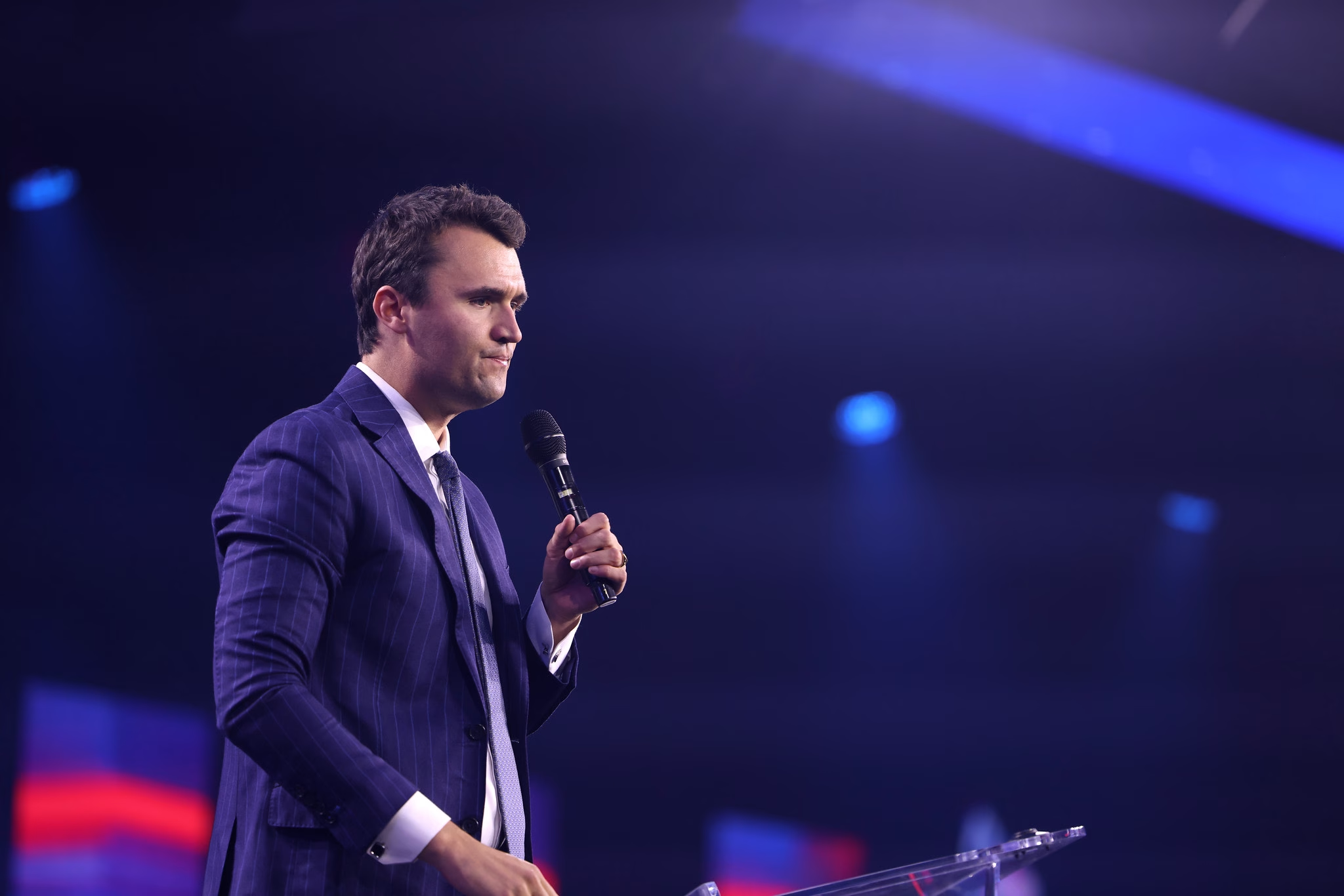
I listened to this morning’s episode of The Daily podcast, “Charlie Kirk’s Politically Charged Memorial,” on the way in this morning. The transcription is not yet available. The guest, Robert Draper, covers domestic politics for the NYT but did not write a story for the paper about the event that I can link to.
His colleague Elizabeth Dias, the NYT national religious correspondent, did under the headline “At Kirk Service, an Extraordinary Fusion of Government and Christianity.”
Marco Rubio, the secretary of state, paid tribute to Charlie Kirk by citing the gospel message of the death and resurrection of Jesus. Stephen Miller, a deputy White House chief of staff, envisioned a spiritual uprising in Mr. Kirk’s wake. Vice President JD Vance said Mr. Kirk’s influence had reshaped the balance of American politics and traced it back to Mr. Kirk’s faith.
Because of Mr. Kirk, he said, “I have talked more about Jesus Christ the past two weeks than I have my entire time in public office.”
At the memorial service of Mr. Kirk on Sunday in a packed football stadium in suburban Phoenix, the highest levels of U.S. government and evangelical worship were woven as one. Perhaps never before, at such a grand scale, had such a fusion taken hold in a public display. More than just a tribute in the style of Mr. Kirk’s evangelical tradition, the service represented a pinnacle event reflecting the degree to which conservative Christianity had melded with Republican politics in the Trump era.
The belief that Mr. Kirk is a modern-day Christian martyr was infused throughout the service. And it solidified in real time through testimonies from a who’s who of conservatives, planting Mr. Kirk’s story firmly into a line of Christians over history who lost their lives with their faith.
“We must remember that he is a hero to the United States of America. And he is a martyr for the Christian faith,” Mr. Vance said.
Benny Johnson, a right-wing podcaster, also tied that sense of martyrdom to a divine plan for America, and thanked the Trump administration for carrying out “that godly mission of wielding the sword against evil.”
Pete Hegseth, the secretary of defense, shared a message of Christian salvation, about the blood of Jesus washing away sins. “We always did need less government. But what Charlie understood and infused into his movement is, we also needed a lot more God,” he said.
So on this Sunday, looking around the stadium, he said, “I’d like to think we’re all in Charlie’s church.”
Near the close of the service, President Trump called Mr. Kirk a martyr. But he described him not as a Christian martyr but an American one. It was a clear sign of how the two themes had merged at times indistinguishably.
“Our greatest evangelist for American liberty became immortal,” Trump said. “He’s a martyr now for American freedom.”
Two things stuck out to me from the podcast.
First, Kirk is clearly a far bigger deal in some circles than I had ever realized. My impression of him was that of his Wikipedia intro: “an American right-wing political activist, entrepreneur, and media personality.” Mentally, I filed him in the same category as Ben Shapiro, another prominent conservative pundit who got his start as a teenager.
That he’s been compared to Martin Luther King, Jr. and others is just bizarre to me, in that he always struck me as more of an entertainer than a change agent. But, rather clearly, some are portraying him as a world-historical figure whose assassination will literally be a turning point in history.
Second, the fact that Kirk’s widow is preaching Christian forgiveness while the senior political leadership of the country is decidedly not is, while not exactly shocking given the rhetoric of the post few years, nonetheless stark. President Trump, who closed out the event, was especially blunt.
“He did not hate his opponents, he wanted the best for them,” Trump said. “That’s where I disagreed with Charlie. I hate my opponents, and I don’t want the best for them. I’m sorry.”
Trump noted at one point that Kirk referred to his political rivals as “the left,” adding that he preferred the term “radical left” or “radical-left lunatics.”
His tone was jocular, but there’s not much doubt he meant it.
BBC (“Trump hails Charlie Kirk as martyr as thousands fill memorial service“):
US President Donald Trump hailed the conservative activist Charlie Kirk as a “great American hero” and “martyr” during a speech to tens of thousands of mourners at a memorial service in Arizona.
Trump was the headline speaker at the packed event on Sunday, which saw top officials from his administration, including Vice-President JD Vance, praise Kirk’s political legacy after he was shot dead on 10 September.
Kirk’s wife, Erika, delivered a tearful speech at the State Farm Stadium near Phoenix, in which she said she had forgiven her husband’s alleged killer.
But the US president broke with her forgiveness message to say he disagreed with Charlie Kirk’s view of wanting the best for his opponent.
“I hate my opponent and I don’t want the best for them,” he said, adding: “I’m sorry, Erika.”
The president called Kirk “our greatest evangelist for American liberty” who was now immortal, adding: “He’s a martyr now for American freedom.”
I fear that Erika Kirk’s path will not the the outcome of this.









