
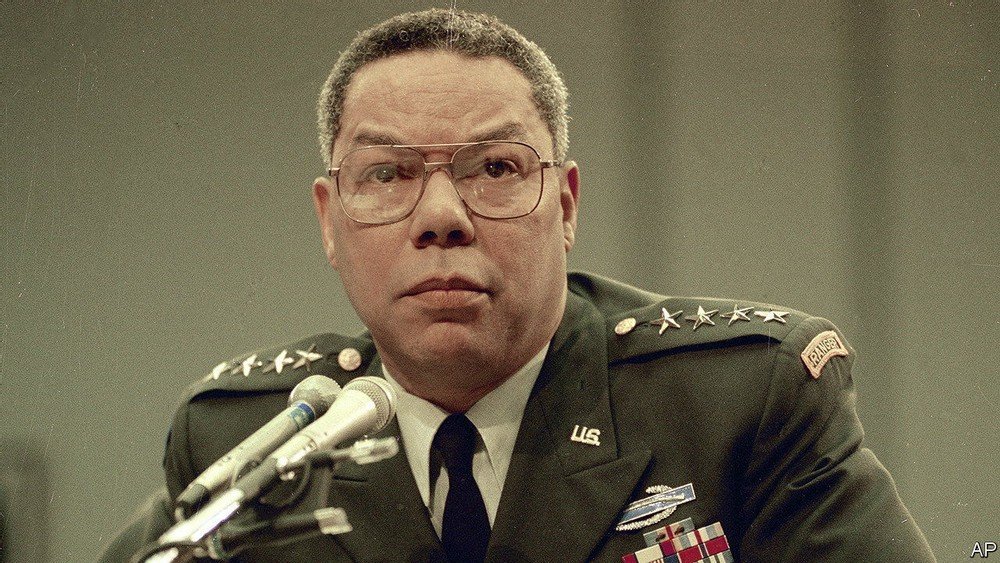

NYT (“Colin Powell, Who Shaped U.S. National Security, Dies at 84“):
Colin L. Powell, who in four decades of public life served as the nation’s top soldier, diplomat and national security adviser, and whose speech at the United Nations in 2003 helped pave the way for the United States to go to war in Iraq, died on Monday. He was 84.
The cause was complications of Covid-19, his family said in a statement, adding that he had been vaccinated and was being treated at Walter Reed National Military Medical Center, in Bethesda, Md., when he died there.
A spokeswoman said his immune system had been compromised by multiple myeloma, for which he had been undergoing treatment. He had been due to receive a booster shot for his vaccine last week, she said, but had to postpone it when he fell ill. He had also been treated for early stages of Parkinson’s disease, she said.
Mr. Powell was a pathbreaker, serving as the country’s first Black national security adviser, chairman of the Joint Chiefs of Staff and secretary of state. Beginning with his 35 years in the Army, Mr. Powell was emblematic of the ability of minorities to use the military as a ladder of opportunity.
His was a classic American success story. Born in Harlem of Jamaican parents, he grew up in the South Bronx and graduated from City College of New York, joining the Army through the R.O.T.C. Starting as a young second lieutenant commissioned in the dawn of a newly desegregated Army, Mr. Powell served two decorated combat tours in Vietnam. He was later national security adviser to President Ronald Reagan at the end of the Cold War, helping to negotiate arms treaties and an era of cooperation with the Soviet president, Mikhail S. Gorbachev.
As chairman of the Joint Chiefs, Mr. Powell was the architect of the invasion of Panama in 1989 and of the Persian Gulf war in 1991, which ousted Saddam Hussein from Kuwait but left him in power in Iraq. Along with Dick Cheney, the defense secretary at the time, Mr. Powell reshaped the American Cold War military that had stood ready at the Iron Curtain for half a century. In doing so he stamped the Powell Doctrine on military operations: Identify clear political objectives, gain public support and use decisive and overwhelming force to defeat enemy forces.
When briefing reporters at the Pentagon at the beginning of the gulf war, Mr. Powell summed up the military’s approach: “Our strategy in going after this army is very simple,” he said. “First, we’re going to cut it off, and then we’re going to kill it.”
It was a concept that seemed less well-suited to the messy conflicts in the Balkans that came later in the 1990s and in combating terrorism in a world transformed after the attacks on Sept. 11, 2001.
WaPo (“Colin L. Powell, former secretary of state and military leader, dies at 84“):
Colin L. Powell, who helped guide the U.S. military to victory in the 1991 Persian Gulf War as chairman of the Joint Chiefs of Staff, then struggled a decade later over the U.S. invasion of Iraq as a beleaguered secretary of state under President George W. Bush, died Oct. 18 at Walter Reed National Military Medical Center in Bethesda, Md. He was 84.
The cause was complications from covid-19, said his assistant, Peggy Cifrino. She said Gen. Powell, who was fully vaccinated, had Parkinson’s disease and multiple myeloma, a form of blood cancer that impairs the body’s ability to fight infection.
Born in New York to Jamaican immigrants, Gen. Powell rose rapidly through the Army to become the youngest and first Black chairman of the Joint Chiefs. His climb was helped by a string of jobs as military assistant to high-level government officials and a stint as national security adviser to President Ronald Reagan. Charming, eloquent and skilled at managing, he had a knack for exuding authority while also putting others at ease.
As the Pentagon’s top officer, he played a prominent role in restoring a sense of pride to the nation’s post-Vietnam military and began the reshaping of American forces after the end of the Cold War. His famous prescription for the use of force, dubbed by journalists the Powell Doctrine, called for applying military might only with overwhelming and decisive troop strength, a clear objective, and popular support.
His selection by Bush in late 2000 to be secretary of state transformed Gen. Powell from soldier to statesman and made him the first Black person to lead the State Department. But his four years as secretary proved his most difficult assignment.
A pragmatist and a strong believer in international alliances, Gen. Powell often found himself the odd man out in an administration dominated by neoconservative ideologues who were dubious about the usefulness of the United Nations and NATO and all too ready to employ U.S. military power.
Other than his well-known reservations about military intervention, Gen. Powell, as he often acknowledged, was not given to grand principles. He saw himself primarily as a problem-solver and expert manager.
AP (“Colin Powell dies, trailblazing general stained by Iraq“):
Colin Powell, the trailblazing soldier and diplomat whose sterling reputation of service to Republican and Democratic presidents was stained by his faulty claims to justify the 2003 U.S. war in Iraq, died Monday of COVID-19 complications. He was 84.
A veteran of the Vietnam War, Powell spent 35 years in the Army and rose to the rank of four-star general before becoming the first Black chairman of the Joint Chiefs of Staff. His oversight of the U.S. invasion of Kuwait to oust the Iraqi army in 1991 made him a household name, prompting speculation for nearly a decade that he might run for president, a course he ultimately decided against.
He instead joined President George W. Bush’s administration in 2001 as secretary of state, the first Black person to represent the U.S. government on the world stage. Powell’s tenure, however, was marred by his 2003 address to the United Nations Security Council in which he cited faulty information to claim that Saddam Hussein had secretly stashed weapons of mass destruction. Such weapons never materialized, and though the Iraqi leader was removed, the war devolved into years of military and humanitarian losses.
Powell was fully vaccinated against the coronavirus, his family said. But he faced several ailments, telling Washington Post journalist Bob Woodward over the summer that he had Parkinson’s disease. Powell’s longtime aide, Peggy Cifrino, said Monday that he was also treated over the past few years for multiple myeloma, a blood cancer that impairs the body’s ability to fight infection. Studies have shown that those cancer patients don’t get as much protection from the COVID-19 vaccines as healthier people.
In a Washington where partisan divisions run deep, Democrats and Republicans recalled Powell fondly. Flags were ordered lowered at government buildings, including the White House, Pentagon and State Department.
Powell became Chairman of the Joint Chiefs on 1 October 1989, when I was a young second lieutenant just reporting to Germany after finishing schooling at Fort Sill and Fort Benning. He was only 52, easily the youngest man to hold that post to this day and, indeed, younger than I am now. I’ll always remember him as “General Powell” but, obviously, his legacy will always be tainted by his selling of the Iraq nuclear program as a pretext to get UN Security Council authorization for the 2003 Iraq invasion.
Still, he’s certainly much more than that speech and he’s genuinely esteemed on both sides of the aisle, a rarity in modern politics.
WaPo Editorial Board (“The enduring impact of Colin Powell“):
To survey the triumphs and disappointments of post-World War II American history is to marvel at their entwinement with the biography of Colin Luther Powell, who died Monday at 84. The career of this remarkable soldier-statesman, the first Black person to serve as chairman of the Joint Chiefs of Staff, national security adviser and secretary of state, and the only person — period — to have served as all three, would have been unimaginable but for the greatest triumph of his era, the civil rights revolution. Yet Mr. Powell began his rise in a nearly all-White Army officer corps by serving in the disaster known as the Vietnam War.
His personal and professional outlook shaped in that crucible, Mr. Powell, as an increasingly influential adviser to Republican Cabinet officers and presidents, went on to help shape history himself: the United States’ triumph over the Soviet Union in the Cold War; the American victory in the 1991 Gulf War; the U.S. response to the Sept. 11, 2001, terrorist attacks, including the invasions of Iraq and Afghanistan.
This necessarily partial list barely does justice to Mr. Powell’s full impact on the country, which reached a kind of peak with the Powell-for-president boom in the mid-1990s. He demurred, but not before the phenomenon inspired many Americans, of all races, to take more seriously the possibility that Americans would elect a president of color. When that did happen in 2008, Mr. Powell played a part — breaking Republican ranks to endorse Democrat Barack Obama.
Mr. Powell left his imprint on popular culture with his “Pottery Barn rule,” first used in a 2002 meeting with then-President George W. Bush (and later leaked), regarding the risks Mr. Bush assumed by invading Iraq: “You break it, you own it.” The phrase, with its dovish implications, reflected Mr. Powell’s instincts. Having emerged from Vietnam and decided to remain in the Army — while many other young officers left — Mr. Powell devoted himself to rebuilding and restoring what had become, by the late 1970s, a deeply troubled institution. He vowed that he and fellow Army officers would prevent another Vietnam by “not quietly acquiesc[ing] in halfhearted warfare for half-baked reasons that the American people could not understand,” as he put it. He helped the Pentagon not only restore training and discipline but also develop demanding criteria for the use of force: clear, attainable objectives; public and international support; a plausible exit strategy.
The “Powell Doctrine” pressured civilian policymakers to think long and hard before putting troops in harm’s way. Critics saw it as an elaborate rationalization for inaction. At times during Mr. Powell’s chairmanship of the joint chiefs between 1989 and 1993, it was, as when the United States hesitated to stop “ethnic cleansing” of Bosnia’s Muslims. Yet successful military operations in the same period — the Gulf War, the 1989 invasion of Panama — benefited from Mr. Powell’s insistence that their costs and benefits be thoroughly weighed and that, when used, force should be deployed swiftly and overwhelmingly.
Mr. Powell lost internal George W. Bush administration arguments over whether to invade Iraq. Then — ever the team player — he agreed to lend his credibility to claims that war was necessary because Saddam Hussein had weapons of mass destruction. He laid out the intelligence to the U.N. Security Council, but it was faulty; no chemical or biological weapons were found. Mr. Powell was left to absorb blame for a war that eventually went sour — as he had privately warned. This bitter experience left what he later called a “blot” on his record, which, with characteristic understatement, he described as “painful.”
The Economist (“Colin Powell was the most prominent American soldier of his generation“):
COLIN POWELL was driving to his army base in Fort Benning, Georgia, in the early 1960s when he decided to stop at a drive-in restaurant. He had returned from Vietnam in 1963 with a Purple Heart and Bronze Star. The puzzled waitress asked whether he was a Puerto Rican or, perhaps, an African student. “No,” he replied. “I’m a Negro. I’m an American. And I’m an Army officer.” The waitress suggested he wait around the back where he might be passed a burger from the back window.
Mr Powell, who had suffered from blood cancer and Parkinson’s disease, died from covid-related complications at the age of 84 on October 18th. He would recall that moment in a memoir, decades later. “My eye was on an Army career for myself and a good life for my family,” he wrote. Within three decades he would become not only the most senior black military officer in American history, but also the most prominent American soldier, of any race, of the late 20th century.
Mr Powell was born in the Harlem district of New York in 1937, growing up in a working-class Jamaican family in the south Bronx. At the City College of New York, he joined the Reserve Officers’ Training Corps and was commissioned as a second lieutenant in 1958. That was less than a decade after the army had been desegregated by President Harry Truman. After serving as a platoon leader in West Germany, he chose to stay in the army. “I did not know anything but soldiering,” he wrote later. “And for a black, no other avenue in American society offered so much opportunity.”
There followed two gruelling tours of Vietnam, one from 1962 to 1963 and then, in the unit responsible for the notorious My Lai massacre, in 1968. By then, Mr Powell’s star was rising and he was sent to a fellowship in the Nixon White House in 1972. The job was a “defining experience”, he would tell an interviewer, teaching him that politics was “greased by compromise and consensus”. The role gave him proximity to power and put him on the path to becoming a senior adviser to Caspar Weinberger, Ronald Reagan’s secretary of defence, and then, in 1988, Mr Reagan’s national security adviser, at a time when the office had been roiled by the Iran-Contra scandal.
In 1989, having become one of the youngest four-star generals in American history during peacetime, at the age of 52, Mr Powell beat off competition from more than 30 others to become the chairman of the joint chiefs of staff—the principal military adviser to the president, and a position whose importance and authority had been bolstered by far-reaching military reforms earlier in the decade.
When Iraq invaded Kuwait in 1990, General Powell was discomfited by President George H.W. Bush’s commitment to responding with force. At his desk in the Pentagon, he is said to have displayed an epigram from Thucydides, the Greek historian: “Of all manifestations of power, restraint impresses men most.” But his approach to waging the war which ensued—with overwhelming force—became the basis of what would become known as the Powell doctrine, the notion that America should go to war only when, among other conditions, vital national security interests were at stake, the objectives clear and attainable, all other options exhausted and an exit strategy in place.
“Powell has become a folk hero,” wrote the Los Angeles Times in April 1991, “a living, breathing recruiting poster with a beer-barrel chest, a blacksmith’s arms and the bearing of a centurion.” Some in Congress even spoke of granting him a fifth star, an honour last granted to Omar Bradley in 1950. As he approached retirement two years later, victorious in war—though sullied by a fiasco in Somalia—and at the helm of America’s armed forces during what, in hindsight, would turn out to be a relatively brief spell of uncontested military supremacy, there were rumblings that he would stand against Bill Clinton for the presidency in 1996.
He ruled that out in 1995, admitting that he lacked the “fire in the belly”. But he went on to endorse George W. Bush in 2000, and was rewarded by being made secretary of state, in charge of American diplomacy. It was, it turned out, a poisoned chalice. Mr Powell became the public face of the Bush administration’s dubious case for war against Iraq in 2003. A speech at the UN in February 2003, in which he declared, wrongly, that “there can be no doubt that Saddam Hussein has biological weapons”, was a “blot” on his record, he admitted after his retirement in 2005.
In one sense, Mr Powell’s career reflected the arc of American military history. He cut his teeth in a force that endured stinging defeat in Vietnam, oversaw its revival in the deserts of Kuwait and, from the cabinet, saw its renewed humiliation in Iraq. In politics, too, the trajectory was one of disillusionment. “I believe I can help the party of Lincoln move once again close to the spirit of Lincoln,” he declared in 1995, when announcing that he had joined the Republican Party. But after the invasion of the Capitol by supporters of President Donald Trump on January 6th, Mr Powell conceded defeat. “I can no longer call myself a Republican,” he acknowledged.
Condoleeza Rice (“Colin Powell’s greatest legacy is in the people he inspired“):
Tributes to Colin will rightly cite his impact as a statesman and a soldier. They will note that he changed how we think about the use of military force. The Powell Doctrine holds that if you use military force, use it overwhelmingly to get the job done.
Some will cite his role in controversial decisions concerning the Balkans or, most certainly, Iraq. No one spends so many decades in public life — confronted with difficult and consequential choices — without criticism.
But tributes must acknowledge his tireless work as the country’s chief diplomat: strengthening relations with allies at difficult times; ending the civil war in Sudan; and leaving the State Department stronger and more efficient than when he arrived.
And it should be beyond question that Colin was a man of integrity. He was deeply principled, shaped by bedrock beliefs that guided him throughout his life.
Colin was, first and foremost, a military man who believed in the institution and its place in democracy. At a 1990 conference for military officers from all over Europe, I saw his passion on display.
When it came time for Colin to speak, he put aside his prepared remarks and talked about what it meant to be a military officer in a democracy. It was a magnificent moment — and the right message for young Eastern European officers who were about to experience democratic change.
Colin loved soldiers and always held them to the highest standards. Yet he also took time to understand their struggles — personal and professional — and to comfort them when they suffered. The U.S. military was his second family, and he cherished the opportunities that it had given him and many others.
Still, Colin was not blind to America’s many challenges. He saw those flaws firsthand. Colin’s wife, the former Alma Johnson, was the daughter of R.C. Johnson, the principal of the largest Black high school in Birmingham, Ala. Her uncle was principal of the second largest, Ullman High School, where my father was the guidance counselor. Alma and I were children of the segregated South. Colin was shocked at encountering Jim Crow Alabama when he visited Alma. But he knew that racism stained American life well beyond the South.
In 2003, sitting in Buckingham Palace during President George W. Bush’s state visit to Britain, Alma, Colin and I drank a toast to our ancestors. “They would never have believed it,” I said. “No, but they are smiling now,” he said.
Eugene Robinson (“How Colin Powell shouldered the special pride and burden of many Black ‘firsts’“):
There is a special pride, but also a special burden, in being “the first Black [fill in the blank].” Colin L. Powell shouldered that responsibility while giving the impression that the weight was as light as a feather.
Powell, who died Monday from complications of covid-19, long knew how his obituaries would someday describe him: “the first African American secretary of state” and “the first African American chairman of the Joint Chiefs of Staff” and the “first African American national security adviser to the president.”
In his 1995 memoir, “My American Journey,” Powell wrote: “My career should serve as a model to fellow blacks, in or out of the military, in demonstrating the possibilities of American life. Equally important, I hoped then and now that my rise might cause prejudiced whites to question their prejudices, and help purge the poison of racism from their systems, so that the next qualified African-American who came along would be judged by merit alone.”
That was the easy part. Powell went on: “I am also aware that, over the years, my career may have given some bigots a safe black to hide behind. ‘What, me prejudiced? I served with/over/under Colin Powell!’”
Indeed, Powell’s rise to the apex of American power has been cited by many politicians over the years as a sign of the nation’s supposed colorblindness — as alleged proof that we have managed to leave racism behind. But Powell was acutely race-conscious, aware that he was always being scrutinized and judged in ways that a White man would not have to endure.
[…]
Thinking of his role in the civil rights struggle, Powell identified less with activists who marched in the streets than with those who played more of an inside game — less with a firebrand organization like the Student Nonviolent Coordinating Committee than with the smooth, polished, boardroom-friendly National Urban League.
“I have swallowed hard under racial provocations, determined to succeed by surpassing,” Powell wrote in “My American Journey.” “Had I been more militant, would I have been branded a troublemaker rather than a promotable black? One can never be sure. But I agree with Whitney Young,” he wrote, referring to the longtime leader of the National Urban League.
Powell’s public persona was not so much as someone who had defeated racism as transcended it. He was named to his groundbreaking “first” posts by Republican presidents, and in 1995 proclaimed himself a Republican — breaking with the overwhelming majority of Black Americans, who were and are Democrats. His presence allowed the GOP to portray itself as diverse and welcoming. But he was comfortable with the party’s views — back when it was the party of George H.W. Bush, George W. Bush, Richard B. Cheney and John McCain.
That political choice reflected Powell’s firm belief in old-school integration as the only way forward for African Americans. He said often that the nation was better, and African Americans would make more progress, when both the Democratic and Republican parties were strong. “The black agenda has been given over to the Congressional Black Caucus,” he wrote disapprovingly in his memoir. “The concerns of African-Americans stand in danger again of riding in the back of the bus.”
To me, this philosophy has long been better in theory than in practice — given that so many GOP policies, such as voter suppression, are overtly hostile to the interests of people of color. But to his credit, Powell knew his priorities: He supported Barack Obama over McCain in 2008, seeing the historic opportunity to elect our first Black president. And he was appalled and repulsed by the rise of Donald Trump, finally announcing after the Jan. 6 insurrection at the Capitol that he no longer considered himself a Republican.
The true test of any “first Black” achiever is how he or she handles making a consequential error. Powell’s was his United Nations speech in 2003 that gave gravitas and credibility to the false notion that Saddam Hussein had an active program to produce weapons of mass destruction. That set the stage for the disastrous war in Iraq.
Powell regretted that speech but refused to let it define him. He moved on. The first rule of being the “first Black” anything: Look to the future, not the past.
Rest in peace, General.









