
Says Murphy:
First, the sample from one group is far too small to mean much. Second, turning this voodoo into a television spectacular completely distorts whatever limited research value a group might provide. Research technique is supposed to leave respondents alone and unmolested, not plopped down in front of live TV cameras. No wonder the respondents in these groups are really thinking about their key lighting and asking how you get an agent. Their minds are on anything but what they really think about the candidates.
Silver agrees and adds,
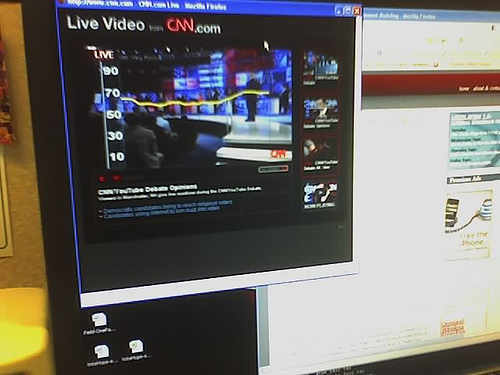
It’s not that the squiggly lines aren’t fun to watch. Rather, they’re too much fun to watch. It’s hard to avert your eyes from them. It’s hard to separate your own, independent reaction from theirs. And it’s certainly hard to integrate back into to the non-squiggly universe once you’ve gotten hooked on the squigglys.
[…]
The problem is that the squigglys may give thirty random strangers from Bumbleweed, Ohio just too damned much power to influence public perception. The squigglys influence the home viewers, the home viewers participate in the snap polls, the snap polls influence the pundits, the pundits influence the narrative and — voilà ! — perceptions are entrenched.
Daniel Davies, however, loves the dials.
I love the crawler and think that it really helps you understand what’s going on in the debates — in particular, it helps you take one step back from your own prejudices. It’s also just about the only input into debate commentary that comes more or less unmediated; the anonymous “undecided” focus group participants might be dumb or irrational, but they’re at least not pushing an agenda. Raw data is always good to have — although Nate’s sample size points are well made, I actually doubt how much potential there is for practical error to be introduced, given that one doesn’t actually look to the crawler for straightforward yes/no answers to questions, just for an overall impression of how the participants are going over.
Thus far, CNN seems to be the only network using the technique. Those of us who have access to their high-definition broadcast are also treated to pie charts wherein their talking heads score the debates. The latter is just ridiculous, not only because they have four Democrats to two Republicans but because Paul Begala and Bill Bennett aren’t the target audience.
I tend to side with Davies on the squigglys. It’s a very interesting insight into the minds of so-called undecided voters. (I say so-called because few people who haven’t made up their minds at this point will actually muster up the enthusiasm vote. Dave Schuler is a definite outlier in the group.) It’s an in-your-face reminder to those of us who are political junkies that what seem to us as banal talking points are being heard for the first time by a large slice of the country.
Ken Levine may think these people are dolts unworthy of judging his sublime artistry but the fact of the matter is that they are the only judges that matter. A network can’t sustain the high cost of producing and broadcasting a sitcom if it only appeals to the critics and a political candidate can’t get enough votes to win office by appealing only to political junkies. Like it or not, Joe Six Pack gets the final say.