
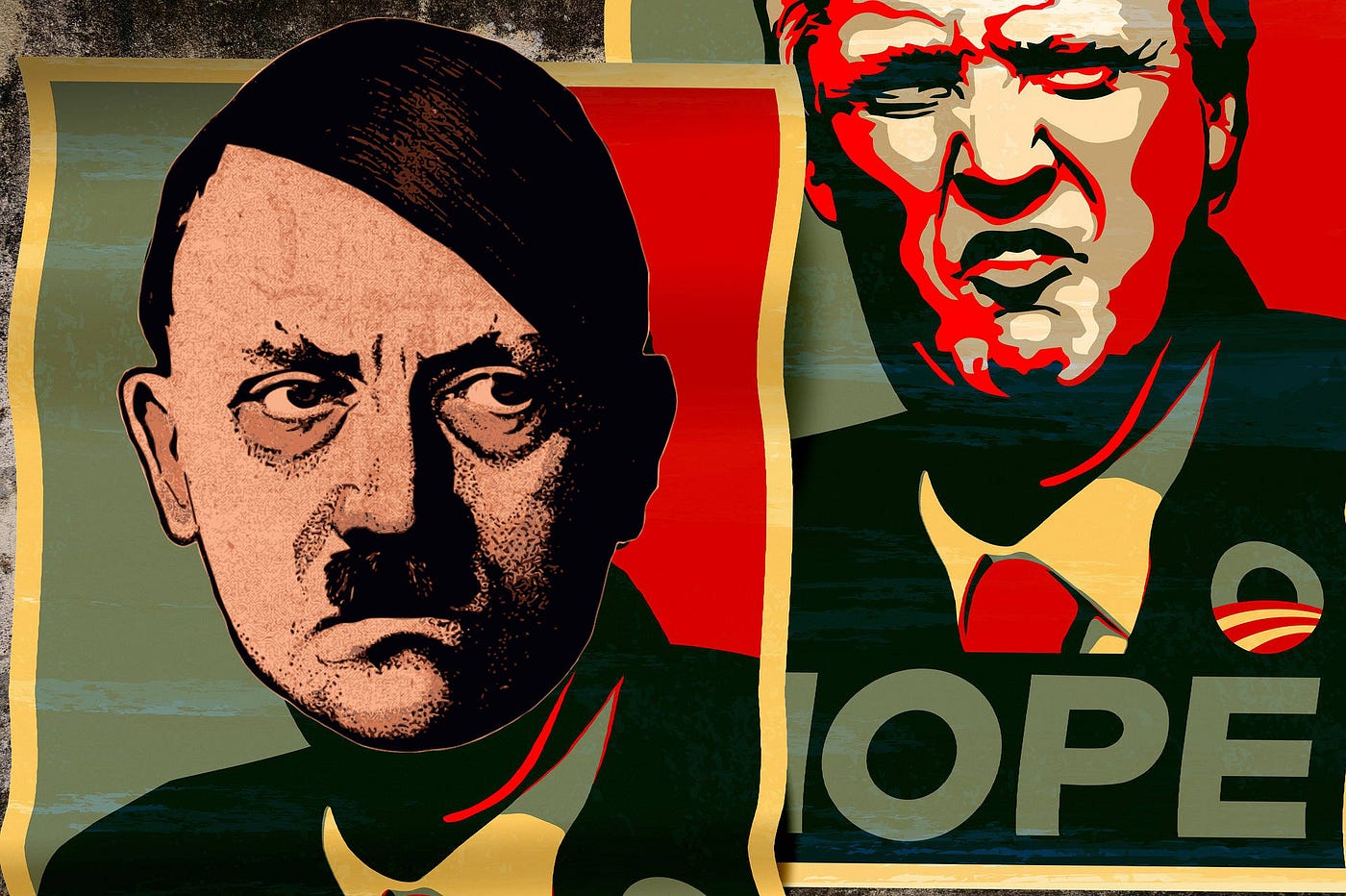

This is Part II of a multi-part series. Part I can be found here: Defining and Discussing Fascism (Part I).
Some ancillary posts include the following.
Let me start with this: asserting that someone is a fascist, or engaging in fascistic politics, and accusing someone of being Hitler are not synonymous, even if sometimes they are treated as such. While it is true that Hitler was a fascist, not all fascists are Hitler. Neither Franco nor Mussolini had clean hands, but neither of these fascist leaders were are awful as Adolph Hitler. I note this not to exonerate anyone’s crimes, but to acknowledge the truly grave category of Hitler’s.
Further, when it comes to Hitler comparisons, there is a difference between comparing Hitler at the end of his life, with all the commensurate horrors that that life entailed, and Hitler the burgeoning politician who led the Beer Hall Putsch and who went on to write Mein Kampf.
So, sure, if the comparison is about the scale of mass murder, then no one is Hitler until they kill millions.
Moreover, I think that we should consider Nazism as a subset of fascism wherein antisemitism was the basis of the Us v. Them narrative. Moreover, it was a specific theory of race as spelled out in Hitler’s Mein Kampf.
Speaking of which, what about Hitler’s basic politics and rhetoric? Surely, if someone ends up a mass murdering totalitarian, it matters where they started. Moreover, if we can detect ideas similar to those espoused by said mass murderer in the mouth of a contemporary politician, perhaps we should pay attention.
I am not, as a general matter, a fan of Hitler comparisons. I don’t think, for example, that just because a charismatic politician can elicit responses from crowds, they are a fascist, let alone Hitler. As James Joyner noted in a review of Hitler comparisons at OTB, we have all been skeptical of the notion. I, myself, criticized Hitler comparisons to both Obama and Palin. I would note, however, as James did a while back, that the coiner of “Godwin’s Law” stated that yes, it is okay to make Hitler comparisons in regards to Trump (feel free to click through to find out why).
So, what are the appropriate comparisons?
I think a lot of people initially wanted to compare Trump’s rallies, and his cultivation of a cult of personality, as being sufficient for a comparison to Hitler. I think these conditions are similar (we associate Hitler with rallies and Nazism in particulate focused on the Führerprinzip, i.e., the leadership principle), but, of course, a lot of politicians have held rallies and cultivated personalistic politics. None of that is, on its face, fascistic, let alone Hitleresque in and of itself.
Two things matter, and they are linked: the ideas and the rhetoric. If one has read Mein Kampf or even has a passing knowledge of Hitler’s rhetoric, it is hard to miss the echoes, if not the dead-on parallels.
Let’s start with a pretty clear example.
“All great cultures of the past perished only because the originally creative race died out from blood poisoning,” Hitler, Mein Kampf (314).*
“They are poisoning the blood of our country” Donald J. Trump.
The “they” in question are immigrants (video here). He is specifically asserting that many immigrants are criminals because they have bad blood/genes.
Along the same lines:
“How about allowing people to come to an open border, 13,000 of which were murderers, many of them murdered far more than one person, and they’re now happily living in the United States. You know now a murder, I believe this, it’s in their genes. And we got a lot of bad genes in our country right now,”–also Donald J. Trump.**
This is classic othering based on nationality and ethnicity. It is the same argument that Hitler made about Jews, gypsies, and others he saw as being part of the wrong “race.” He argues in Mein Kampf that race-mixing is what leads to the degradation of a society. In other words: instead of focusing on behavior and individual responsibility, Trump, like Hitler before him, is trying to scapegoat others based on the group they belong to. For Hitler, it was Jews (and others). For Trump, it is immigrants.
Well, at least some immigrants. He clearly demonizes Latin American immigrants and Haitians–folks from countries he has called “shithole countries” in the past. He would like more immigrants from “nice” countries like Norway. One can only imagine why he prefers such places. We know he has no problem with immigrants from Czechoslovakia and Slovenia.
Dehumanizing a whole group of people and then blaming them for the ills of the country is Hitlerian. Noting that if too many such people are let in, “we won’t have a country” any longer is Hitlerian. Again, his focus is not on ideals or ideals but on groups of people. He is trying to make Us fear Them because They bring crime and disease.*** Moreover, he repeatedly claims that if he isn’t elected specifically, that is what will happen, we won’t have a country anymore (indeed, he has stated, that “I alone can fix it“).
For example, back in May via NBC news, Trump says people crossing the border bring ‘very contagious disease’ with them.
“They’re coming in as terrorists. Many, many terrorists are coming in, and people are coming in with very contagious disease,” Trump said Wednesday evening in an interview with New York radio station WABC.
“You know, like it’s all of a sudden you see there’s a run on tuberculosis. There’s a run on things that we haven’t talked about for years in this country,” he added.
Add in the threat of mass deportations as the solution to problems because We need to get Them out of here is likewise Hitlerian. A mainstay of Hilter’s rhetoric was the need for “living space” (lebensraum) for the Aryan Germans. And while Hitler was arguing for territorial expansion, the logic is the same: space for the “right” people, even if means displacing the “wrong” people.
For example, via Reuters: Trump links immigrants to high US housing prices, researchers disagree
Immigration “is driving housing costs through the roof,” Trump told a rally in the battleground state of Arizona in late September, standing in front of a backdrop that read: “Make housing affordable again.”
Is it true that in Springfield, OH rents have been going up because of an influx of migrants coming to meet labor demands? Yes. But that is a direct result of market forces. A previously depressed real estate market is having to adapt to the influx of workers who have been attracted to the area because of local industrial needs as the result of an improving local economy. This is causing some short-term pain, but the gains for the community will be long-term. Coming in and removing legal immigrants in Springfield might drive housing costs down, but it would also create a broader set of economic problems.
But more to the point: even if one can factually find location wherein immigration can be linked to incrased housing costs it is simply a blatant lie that US housing costs will be effected by mass deportations.
And speaking of mass deportations, the notion of deploying law enforcement (and perhaps the military) to round up persons of specific ethnicities to expel them from the country so as to solve the alleged social ills they cause isn’t death camps, to be sure, but it is certainly an adjacent policy. Such moves would be a massive human rights violation and would absolutely result in American citizens being swept up. As I noted in a recent tab-clearing post, anti-electoral fraud activists are preaching that “Hispanic-sounding last names” leads to a probable “suspicious voter.” We know how this will go if the mass deportation process is actually initiated. And there will be camps. There will have to be.
Now, we can all say that he won’t do it, that he really doesn’t mean it. But does that matter? Does it make it less concerning? Less evil?
What kind of risk are people willing to take that he is just spouting off?
By the way, we have done mass deportation before. The most significant example was called “The Trail of Tears.” There was also the Mexican Repatriation from the mid-1920s into the 1930s when many American citizens of Mexican descent were expelled from the United States. One author estimates that roughly 60% of those expelled were citizens. From an interview on Fresh Air.
FRANCISCO BALDERRAMA: Well, conservatively, we’re talking about over 1 million Mexican nationals and American citizens of Mexican descent from throughout the United States, from the American Southwest to the Midwest to the Pacific Northwest to the South, even Alaska included. This occurred on a number of different levels through a formal deportation campaign at the federal government, then also efforts by major industries as well as efforts on the local and state level. Conservatively, we are able to estimate that 60 percent of them were U.S. citizens of Mexican descent.
Back to Mein Kampf, Hitler argues that Jews infiltrate a country by migration and act as a “parasite in the body of other peoples.” Hitler talks about how Jews “misused” “host nations” and acted as “the typical parasite, a sponger who is like a noxious bacillus keeps spreading as soon a favorable medium invites him” (320). Hitler also sees Marxism as a Jewish ideology. “Marxism itself systematically plans to hand the world over to the Jews” (324).*
Trump, back in November, echoed this kind of rhetoric:
“We pledge to you that we will root out the communists, Marxists, fascists, and the radical left thugs that live like vermin within the confines of our country,” he told a New Hampshire crowd.
His whole spiel, noted above, that “we won’t have a country” decidedly rhymes with Hitler’s concern about the infiltration of Jews into Germany and the threat that they would destroy Germany.
The idea that immigrants are “vermin” (which is synonymous with parasites) who are taking over from within and who have to be rooted out sounds a whole lot like Hitler’s concerns about Jews in Mein Kampf. This strikes me as a comparison that should not be ignored.
There is also the whole “enemy within” rhetoric, as WaPo noted back in November of 2023:
“But we can see already how our racial peoples which are today still hostile to us will one day recognize the greater inner enemy,” Hitler said in a January 1941 speech in Berlin, according to the Jewish Virtual Library.
“For never in our history have we been conquered by the strength of our outside enemies but only through our own failings and the enemy in our own camp,” he wrote in “Mein Kampf.”
“Had they really believed in what they did, they ought to have recognized that the strength of a nation lies, first of all, not in its arms but in its will, and that before conquering the external enemy the enemy at home would have to be eliminated,” he also wrote.
Clearly, Trump is less sophisticated than Hitler in his theories about how the world works, but so what? Does that make any of this less disturbing?
I would also add, referencing Hitler’s attempted coup, the Beer Hall Putsch, that there is a comparison to be made between Hitler’s failed coup attempt, and his later rise to authoritarian power and Trump’s failed insurrection on January 6th (you know, the “day of love“) and his “joke” that he only wants to be a dictator on day one. Let’s also note that Hitler went to jail for his failed coup, while Trump sees a return to power as a way to forestall potential jail time for his.
All of this is to say that while I fully understand that Trump is not Hitler of 1945, he sounds way too much like Hitler of 1925 for my personal comfort. And I suppose that it is all well and good that Trump is less systematically ideological than Hitler, and that he is considerably older and therefore has less time, therefore, to do damage. But that doesn’t mean that his rhetoric is unimportant. Moreover, there are clear parallels between the words of the two men in a way that screams to me: pay attention!
I fully understand that Trump is not going to perpetrate a new Holocaust. But that really isn’t the issue. The issue is the kind of damage a man who thinks this way can do in office. Consider the mass cruelty of family separation in the first term. The attempted Muslim ban. The way he abused office for his own enrichment (and his family’s). His disdain for veterans. The inept response to the Covid pandemic. The pardoning of war criminals (and the pardoning of political allies like Roger Stone). The praise and love for dictators and the commensurate disdain for democratic allies. The current threats of politically-inspired investigations of political opponents (including the press). His fomentation of an insurrection (including his incitement of the crowd against his own Vice President and his general disdain for his well-being).
The list is long (and the list above is incomplete!) and it is not comforting. Moreover, he learned in his first term how to use power more efficaciously in his second, should he get it.
I would repeat family separation as a clear illustration of how the Us v. Them mentality as it pertains to immigrants can lead to policies that are purposefully inhumane. At least 5,000 children were separated from their families as part of an intentional deterrence policy perpetrated by the first Trump administration. As of the most recent numbers I can find, over 1,000 families were still not reunited as of early 2023. See, also, Forbes: Trump’s Family Separation Immigration Policy: How History Could Repeat.
Let’s cut to the summary.
- I am not saying that Trump is to be compared to 1945’s Hitler after the implementation of the Final Solution. Nor am I saying he is a genocider-in-waiting. But, of course, if one feels the need to clarify this point, it means the subject of discussion is a problem. No one felt it necessary to say, “Well, at least we don’t think Gerald Ford will commit genocide!”
- I am saying that he spouts (and has for years) rhetoric and a coherent (for him, anyway) point of view that very much fits Hitler’s in terms of demonizing a specific other and threatening substantial violence in the direction of that other. This, alone, should be disqualifying in American politics, but, alas, it is not.
- He has already demonstrated a willingness to abuse power, to unleash political violence, and to harm the vulnerable.
Or, if you prefer the tl;dr version: I am ultimately quite comfortable saying that Trump is a fascist politician whose political rhetoric directly echoes and occasionally sounds almost like direct quotes from Mein Kampf. So, he’s only like Hitler in those ways.
I think, too, when thinking about these comparisons there is additional question of whom does this rhetoric excite and who will be empowered by it?
That linkage to broader white nationalism will have to wait for part III.
Additional reading.
- Via NPR: Why Trump’s authoritarian language about ‘vermin’ matters.
- Anne Applebaum in The Atlantic: Trump Is Speaking Like Hitler, Stalin, and Mussolini.
- Via the AP: Trump says he didn’t know his immigration rhetoric echoes Hitler. That’s part of a broader pattern.
- Via Reuters: J.D. Vance once compared Trump to Hitler. Now they are running mates.
- Via ABC News: Donald Trump’s history with Adolf Hitler and his Nazi writings: ANALYSIS.
*All quotations from Mein Kampf are from a translation by Ralph Manheim in Terrnace Ball and Richard Dagger, Ideals and Ideologies: A Reader. The page numbers correspond to the copy. I am not sure which edition of the book it is from. I think the book is either one I ditched when I moved out of my university office or is in the box of books that need new shelves.
**It probably deserves its own post, but the 13,000 number is bogus. See Reason: No, 13,000 Migrant Murderers Are Not Running Loose.
***He also used xenophobic rhetoric about Covid-19, caling it the “Kung-Flu“. See, also, via ABC News: Trump’s ‘Chinese Virus’ tweet helped lead to rise in racist anti-Asian Twitter content: Study. Trump is quite willing to use xenophobia and directly treat ethnic groups, even citizens, as a target for his hateful rhetoric, which we know can inspire followers to act violently.









