

Republicans are suddenly targeting — and Democrats in some cases are conceding — House seats that were until recently considered out of play, Jeff Zeleny reports for NYT.
As Republicans made new investments in at least 10 races across the country, including two Democratic seats here realin eastern Ohio, Democratic leaders took steps to pull out of some races entirely or significantly cut their financial commitment in several districts that the party won in the last two election cycles.
Representatives Steve Driehaus of Ohio, Suzanne M. Kosmas of Florida and Kathy Dahlkemper of Pennsylvania were among the Democrats who learned that they would no longer receive the same infusion of television advertising that party leaders had promised. Party strategists conceded that these races and several others were slipping out of reach.
With three weeks remaining to save its majority, the Democratic Congressional Campaign Committee has increased its spending on two New York races, along with at-risk seats in Colorado, Georgia, Illinois, Kentucky and Massachusetts, setting up a map of competitive districts that is starkly different from when the campaign began.
The strategic decisions unfolded at a feverish pace on Monday over an unusually wide playing field of nearly 75 Congressional districts, including here in Ohio, a main battleground in the fight for the House and the Senate.
This is attributable to an anti-incumbent tide that’s benefiting Republicans and, in turn, generating a massive fundraising advantage.
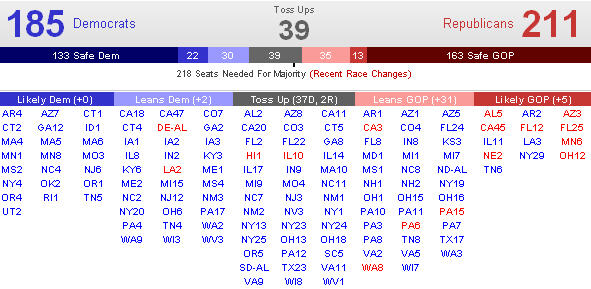
Republican confidence seems well advised. Three weeks out, RealClearPolitics projects 212 Republican seats, 185 Democratic seats, and a whopping 39 tossups. If the GOP gets 1/3 of the tossups, they’ll retake the majority.

Nate Silver, who uses a formula to assign the tossups, figures the Republicans will wind up with 226.5 seats and the Democrats 208.5. (Obviously, there are no half seats.)
Recall that the Democrats currently hold 255 seats, to 178 for the GOP.









