A new Gallup poll shows President Biden remains quite popular, at least given the polarized political climate, while Congress is down even from a pitiful starting point. Looking inside the numbers, it’s mostly Democrats who have become disillusioned by the inability of a Congress nominally controlled by Democrats to get anything done.
Fifty-six percent of Americans approve of the job President Joe Biden is doing overall, essentially unchanged from 54% in May. Biden’s approval rating has averaged 56% since he took office, with his monthly approval ratings straying no more than two percentage points from that level.
The June 1-18 poll was partially conducted while Biden met with world leaders in Europe on his first foreign trip as president, from June 9-16.
According to the poll, Biden enjoys nearly universal approval from Democrats (95%) as well as from a solid majority of independents (55%), versus 11% of Republicans. His rating also features a significant gender gap, with 65% of women versus 47% of men approving. That gap is similar to the gender pattern in Biden’s ratings all year and is the reverse of the gender gap under President Donald Trump, who earned higher support from men than women.
The racial gap in Biden’s ratings is even wider than the gender gap, with 74% of non-White Americans versus 48% of White Americans approving. At the same time, Biden receives approval from majorities of all major age and household income groups.
Gallup’s topline is slightly higher than the RealClearPolitics average of 52.3% but it’s nonetheless remarkable when one considers that former President Donald Trump didn’t spend a minute above 48% in his four-year term and was in fact underwater all but the first two or three days.
But the real story is Congress:
While Americans’ support for Biden is holding firm, their approval of Congress slipped to 26% this month, from 31% in May. It is now 10 points below this year’s high of 36% recorded in March, around the time Congress passed the largely popular CARES Act, which provided $1.9 trillion in new COVID-19 economic relief.
The mechanics of the recent decline in congressional approval are clear, as support fell sharply among Democrats, to 38%, down from 54% last month.
Democrats’ approval of the job Congress is doing had doubled between January and February, as their party effectively took full control in Washington, D.C., following Democratic victories in two U.S. Senate runoff elections in Georgia, and after Biden was sworn in as president. Approval from political independents was also slightly elevated at that time.
However, after remaining fairly high from March through May, Democrats’ support for Congress has plunged between May and June after Congress failed to pass an infrastructure package, which had been Biden’s legislative priority this spring.
The abrupt shift in Democrats’ views of the Democratic-controlled Congress echoes what occurred with Republicans in 2017 after the then-Republican-led Congress failed to make good on Trump’s directive to repeal and replace the Affordable Care Act. After rising from 20% in January of that year to 50% in February, Republicans’ approval of Congress sank to 28% by May and 16% by August, spanning several unsuccessful attempts to pass a repeal bill.
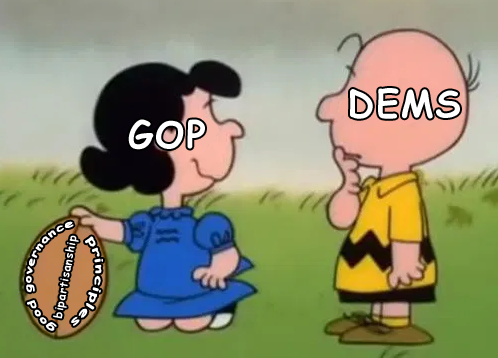
The inability of Congress to do much of anything, largely because of the de facto 60-vote threshold to pass most bills through the Senate, is well-known by most OTB readers, not least because Steven Taylor and I have beaten the topic like a rented mule. But most Americans spend far less time reading and thinking about politics and are like Charlie Brown, continually shocked when the football is snatched away at the last minute by his nemesis.
Rather than blame Lucy for her cruelty, though, most blame Chuck for falling for the trick yet again. And maybe that’s right. Certainly, Jamelle Bouie does. In his latest NYT column, “Democrats Should Act as if They Won the Election,” he blames the majority party for failing to do what’s necessary to get their agenda passed—namely, ending the filibuster.
We don’t need to rehash the argument as to why that would be good for democracy here, having made it so frequently of late. But, while my initial instinct was that it’s weird to blame Democrats for rules that have been in place for decades, he points out that, when routinely stymied by Dixiecrats in the early 1960s, House Speaker Sam Rayburn ruthlessly employed the tools at his disposal to pack the offending committee with more sympathetic members. But things were different:
In 1961, the prospect of gridlock and the possibilities opened up by a new administration motivated a coalition of liberals and moderates to change the rules and clear a path that would, in just a few short years, allow Congress to pass some of the most important legislation in its history.
Today, liberals see the opportunity of the moment. But moderates don’t appear to be frustrated enough with gridlock and inaction to change the rules of the chamber.
That’s right, I think. Partly, it’s genuine sentimentality for a Washington that hasn’t existed in a quarter-century, if it ever did. Partly, though, it’s a function of not being on board with the policy preferences of the party leadership.
Bouie’s final prediction, though, assumes that the voters are paying more attention than they are:
The first step toward victory is a government that can act. So, sure, moderate Democrats can keep the filibuster if they want. But they should prepare for when the voting public decides it would rather have the party that promises nothing and does nothing than the one that promises quite a bit but won’t work to make any of it a reality.
Democrats are likely to lose seats in 2022 because the President’s party almost always does. And because Republicans will disproportionately be drawing the House districts after a Census in which Republican-leaning states gained seats. And because Democrats have more vulnerable Senate seats.
I doubt that failing to get popular legislation passed because Republicans filibustered will do much to increase support for Republicans. But it’s possible, indeed, that Democrats will be less enthusiastic about showing up to the polls if they think their polices won’t get enacted regardless of the outcome.