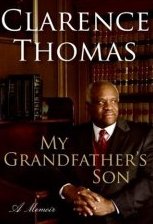
 The Heritage Foundation held a dinner last night honoring Supreme Court Associate Justice Clarence Thomas on the publication of his memoir, My Grandfather’s Son. The small gathering included Virginia Lamp Thomas, the Justice’s wife, and a group of bloggers and other opinion journalists.
I was honored to be in attendance along with bloggers Ed Morrissey, Paul Mirengoff, LaShawn Barber, Mary Katharine Ham, Erick Erickson, Jack and Charmaine Yoest, Sasha Volokh, Tim Graham, and Richard Miniter and print journalists Bill Kristol, Kate O’Beirne, and James Taranto. Rebecca Hagelin and Robert Bluey were our hosts. (The hyperlinks, which I’ll update as time permits, go to reflections on the evening or the book.)
The event was on the record but, in keeping with the tradition of the bench, Thomas scrupulously avoided answering any questions about cases that might come before the Court. Mostly, the conversation was on the human side of the equation: Reflections on the confirmation process, both in general and his particular case; his surprisingly warm treatment in the black community and how that contrasts with the media portrayal; the collegiality on the Court; what it was like to wrench up painful memories in writing the book, and so forth.
Thomas has a hearty laugh and seems to be genuinely enjoying his life. He’s still understandably bitter about the ordeal of his confirmation hearings and has little use for the press corps. Indeed, he turned down an interview request with the Supreme Court correspondents about the book and considers many of them to be “clowns.” He wishes that the blogosphere had been around sixteen years ago to counter the monopoly on information and commentary enjoyed by an elite few in those days.
The Justice shared several anecdotes, some of which are doubtless in the book and others of which I’m sure my dinner companions will share in their posts. What most amused me, simply because of the incongruity, was the fact that Thomas owns a bus, behind which he pulls a car. He apparently harbored notions of being a professional truck driver once upon a time and enjoys the rituals of the truck stop and the interactions with the other drivers. Perhaps because no one expects to see a Supreme Court Justice pull up next to them in the big rig parking lot, he’s seldom recognized and is able to enjoy the camaraderie.
The other thing that stuck with me was a conversation with Bush 41 counsel C. Boyden Gray that took place several years after Thomas was on the bench. Contrary to what most — including Thomas and myself — thought at the time, his selection to replace Thurgood Marshall on the Court’s “black seat” was not tokenism. Indeed, the fact that Thomas was black actually hurt him because Bush didn’t want it to look like he was simply looking for a black man to keep the Court’s quota of one filled. In fact, the administration had hoped to appoint Thomas to replace William Brennan on the Court and was grooming him for that by appointing him to the Court of Appeals.
Unfortunately, Brennan retired sooner than expected and Thomas was deemed to be insufficiently seasoned to make it through confirmation. That the next vacancy was Marshall’s seat proved awkward but they didn’t want to take the chance of not getting another shot (and they wouldn’t). Ultimately, their confidence in Thomas’ grace under pressure and that he would therefore not become “another Souter” prevailed.
The book, which I’ve just started reading, is similarly personal. As the title suggests, it’s ultimately about being raised by his grandparents and what a poor and semi-literate man who lived most of his life in the Jim Crow era taught him about personal responsibility, integrity, and hard work. That upbringing made him the man he is and therefore the judge that he is.
While I strongly disagree with him on some important cases, notably those involving the detention of declared terrorist suspects, meeting him added to my respect for him as a man who’s simply trying to do an important job with honor. (Indeed, with rare exceptions, meeting with people with whom I disagree reminds me that they’re decent human beings who merely have different experiences and perspectives.) He tries to stay as close to the text of the Constitution as possible but professes to have no “judicial philosophy.” Having served many years in the executive branch, though, he tends to concern himself with practical matters and be less influenced by grand theory than those who come from the professoriate.
He’s right, I think, that the selection process places too much importance on academic pedigree and too little on personal character. He thinks this is why judges tend to “evolve” once on the bench. Those who have never been “under fire” often wither under the steady barrage of criticism and are seduced by awards from law schools and praise from the likes of Linda Greenhouse. It takes a strong man, indeed, to remain true to one’s own beliefs in that environment, concerned only about the man in the mirror.