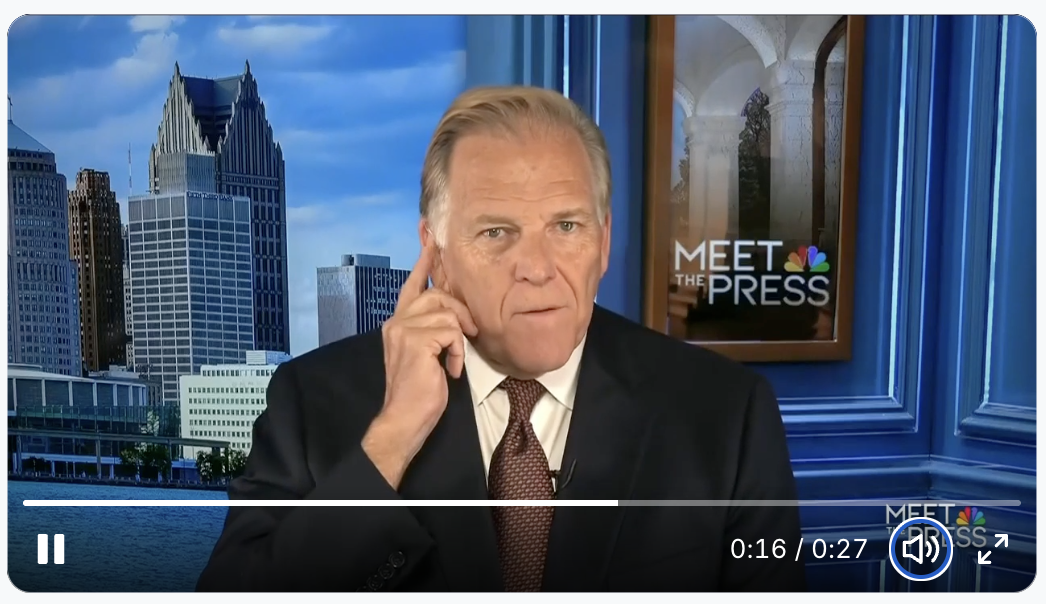
For the second time in as many days, Donald Trump took to Twitter this morning and proceeded to undermine the legal arguments being made by his own Justice Department in their attempt to defend the Executive Order barring travel from six predominantly Muslim nations, and once again it appears that he was provoked mostly by what he was watching on television:
WASHINGTON — President Trump rebelled on Monday against his own advisers who “watered down” his original executive order barring visitors from select Muslim-majority countries from entering the United States and who insisted on calling it something other than a travel ban.
Returning to one of the issues that animated the early days of his presidency and generated a court battle that has now gone to the Supreme Court, Mr. Trump argued that it was a mistake to revise the first order he signed and suggested that his administration should return to a “much tougher version.”
In a series of Twitter posts just two days after a terrorist attack killed at least seven people in London, Mr. Trump seemed to reject everything his own administration has done to win court approval for restrictions on entry from countries that he designated, both in terms of vocabulary and in terms of its provisions.
“People, the lawyers and the courts can call it whatever they want, but I am calling it what we need and what it is, a TRAVEL BAN!” he wrote.
It was his own staff who insisted it was not a travel ban. Sean Spicer, the White House press secretary, spent much of one early briefing telling reporters not to call it that. “It’s not a travel ban,” Mr. Spicer insisted. “When we use words like travel ban, that misrepresents what it is.”
At the time, John F. Kelly, the secretary of homeland security, also rejected the phrase. “This is not a travel ban,” he said. “This is a temporary pause that allows us to better review the existing refugee an visa vetting system.”
Mr. Trump seemed to be reacting to a segment on “Morning Joe” on MSNBC on Monday that, just a few minutes before the president’s tweets, highlighted the administration’s past statements on whether the order was a travel ban. The issue was renewed on Saturday night when Mr. Trump responded to the London attack by arguing again for the order, which he called a travel ban. “We need the courts to give us back our rights,” he wrote that night.
On Monday, Mr. Trump expressed frustration that his administration rewrote his original order, which was thrown out by the courts, it in an effort to pass judicial muster. The second version was also rejected, and the administration last week appealed to the Supreme Court.
“The Justice Dept. should have stayed with the original Travel Ban, not the watered down, politically correct version they submitted to S.C.,” he wrote.
He added: “The Justice Dept. should ask for an expedited hearing of the watered down Travel Ban before the Supreme Court — & seek much tougher version!”
Mr. Trump’s tweets may undercut the administration’s efforts to revive the revised executive order. His lawyers have asked the Supreme Court to ignore statements by Mr. Trump during the presidential campaign, when he called for a “Muslim ban,” in assessing the constitutionality of the executive order. They have also said that the revised order addressed any judicial objections to the earlier one by deleting explicit references to religion.
But in calling the revised order “politically correct,” Mr. Trump suggested that his goal was still to make distinctions based on religion. And in calling the revised order “watered down,” he made it harder for his lawyers to argue that it was a clean break from the earlier one.
Mr. Trump’s language suggested that the decision was somehow made by someone other than him, even though the Justice Department acts on the president’s orders in matters of policy such as this. The second version he criticized on Monday took Iraq off the list of countries that would be affected and made clear that the restrictions did not apply to those who hold green cards or valid visas. It also eliminated a provision that seemed to prioritize Christian refugees for entry.
The revised version, like the first, barred all refugees from entering the country for 120 days and from Syria indefinitely. It barred entry for 90 days for any visitors from six countries: Iran, Libya, Somalia, Sudan, Syria and Yemen.
“In any event we are EXTREME VETTING people coming into the U.S. in order to help keep our country safe,” Mr. Trump wrote on Monday. “The courts are slow and political!”
Here are the tweets in question, in chronological order:
People, the lawyers and the courts can call it whatever they want, but I am calling it what we need and what it is, a TRAVEL BAN!
— Donald J. Trump (@realDonaldTrump) June 5, 2017
The Justice Dept. should have stayed with the original Travel Ban, not the watered down, politically correct version they submitted to S.C.
— Donald J. Trump (@realDonaldTrump) June 5, 2017
The Justice Dept. should ask for an expedited hearing of the watered down Travel Ban before the Supreme Court – & seek much tougher version!
— Donald J. Trump (@realDonaldTrump) June 5, 2017
In any event we are EXTREME VETTING people coming into the U.S. in order to help keep our country safe. The courts are slow and political!
— Donald J. Trump (@realDonaldTrump) June 5, 2017
These tweets appear to have been motivated by a segment during the first hour of MSNBC’s Morning Joe:
When is a travel ban not a travel ban? Trump WH in their own words. pic.twitter.com/xZo6ntGCJI
— Morning Joe (@Morning_Joe) June 5, 2017
As The Washington Post’s Amber Phillips notes, Trump’s tweets are most notable because they clearly undermine the case Justice Department lawyers are attempting to make on appeal while providing further ammunition to Plaintiff’s attorneys seeking to argue that the Executive Order is a ban on Muslims regardless of how it is characterized by the President’s lawyer now. As Phillips notes, the tweets are potentially troubling for any lawyer seeking to defend the Executive Order. For one thing, they amount to yet another attack on the integrity of the judicial system, something that Trump has a long history of doing, since it basically says that it doesn’t matter to him what the Courts say, which is about as close to a reprise of Andrew Jackson’s infamous quip in response to an adverse Supreme Court ruling on the Indian Removal Act that “Mr. [Chief Justice John] Marshall has made his ruling. Let him enforce it.” In other words, it’s about as close as a sitting President can get to an open confrontation with a co-equal branch of the Federal Government on the eve of what will be the Supreme Court’s first real opportunity to rule on a Trump Administration action. While the Justices are largely limited to ruling on the law as applied to the case before them, they are also human beings who will be aware of what the President has said when considering his Administration’s position. This is likely to have at least some impact on how even those sympathetic to those arguments ultimately rule.
The second way that Trump’s tweets today are effectively undermining his case is the fact that he’s suggesting that policies currently in place are keeping the country secure. In one Tweet, Trump argues that his Administration’s policy of “extreme vetting,” which he chose to capitalize for some reason, suggests that policies already in place that are not impacted by the stays imposed by Federal Courts in Hawaii and Maryland are keeping the country secure. That, in turn, suggests that the travel ban that is embodied in the Executive Order is unnecessary to national security. This undermines the argument that Administration lawyers have made on appeal that the ban is motivated by national security needs, not by a desire to ban Muslims from entering the country. After all, if “extreme vetting,” whatever that may be, is sufficient to keep the nation secure then the argument that the travel ban is necessitated by national security is undermined even further than it already has been by the fact that government lawyers have been unable to provide any Court with evidence to support the argument that travelers from the six nations at issue are a unique security risk as compared to travelers from any other nation on Earth.
The biggest manner in which Trump has undermined his own Administration’s case, of course, comes from the fact that he refers to it often and frequently as a “ban” even as his own spokespersons and the Justice Department attorneys handling the appeal of his Executive Order. In both cases, the position that the White House and the Justice Department have taken is that the Executive Order does not constitute a ban either on Muslims entering the country or on travel. Instead, they’ve argued that it is merely a means of screening people arriving into the United States in order to enhance the ability to prevent likely terrorists from being able to slip through the dragnet that existing law provides. Trump continuing to refer to the E.O. as a “ban” only serves to provide more ammunnition to the lawyers around the country seeking to keep the stay in place.
One could ask why Trump does these things, but the truth of the matter is that there really doesn’t seem to be a rational explanation. Whether its foreign policy or dealings with the Courts, his continued Twitter habit continues to backfire on him, to completely wreck whatever messaging strategy his advisers may have for the week ahead, and to undermine his own position either on the world stage or before the nation’s highest court. In a rational universe, not only would a President not be doing these things, but he or she would not be utilizing a public network such as Twitter at all. The fact that none of his top advisers, including his own daughter and son-in-law, can’t control him in any manner when it comes to this behavior indicates that we’re dealing with a President who doesn’t know how to be President and doesn’t care to learn.