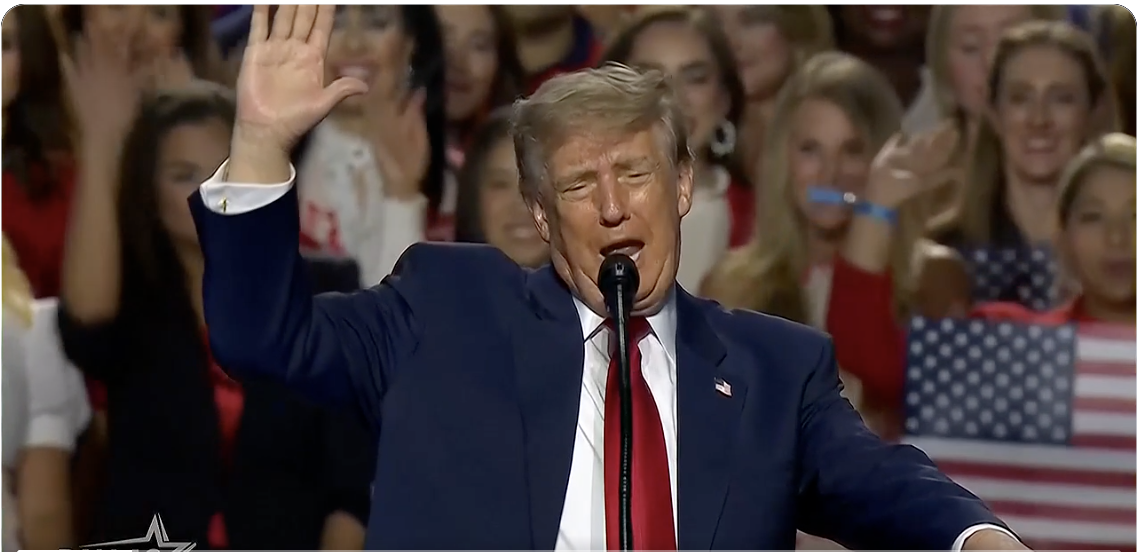
Daniel Larison takes a look at President Trump’s foreign policy, and finds a disaster:
One of the running themes in Trump’s foreign policy is his tendency to give client governments blank checks and free gifts. For all of Trump’s constant complaining about how the U.S. has been taken advantage of by other countries, he is remarkably eager to give certain governments whatever they want without condition or reciprocity. Trump’s Riyadh speech gave the Saudis and their allies a green light to act however they pleased. He backed their war on Yemen to the hilt, and started the process of reneging on the nuclear deal that they resent. He has repeatedly endorsed reckless Saudi behavior and encouraged more of it, and in exchange he has obtained precisely nothing for the U.S. By recognizing Jerusalem as Israel’s capital, Trump gave away something that the U.S. had refused to provide for decades, and in return he got absolutely nothing.
As we have seen from his moves in blowing up the nuclear deal, recognizing Jerusalem and moving the U.S. embassy there, and withdrawing from the Trans-Pacific Partnership, Trump has consistently put his misguided campaign pledges ahead of existing U.S. commitments. He probably doesn’t understand the implications of what he’s doing, and he doesn’t care about the consequences of following through on these pledges. The fact that he is bucking an overwhelming international consensus in each case doesn’t concern him, and he probably considers that to be a reason to do the things he does. In each case, Trump has abruptly broken with previous U.S. commitments in such a way that the U.S. bears extra costs without getting anything for our trouble.
(…)
Running throughout all of the Trump administration’s foreign policy is the president’s evident disdain for diplomacy. If a successful agreement exists and is functioning as it should, Trump wants to undermine or reject it. If there is a chance at making progress in resolving an ongoing conflict, Trump prefers to escalate U.S. involvement in the war while giving diplomacy short shrift. While he will pay lip service to pursuing “peace” from time to time, he reliably takes actions guaranteed to stir up resentment and hostility. All of these failings bode very ill for U.S. foreign policy in the coming year, and what makes them even more troubling is the knowledge that none of them can be fixed while Trump is president.
As Larison also notes in his piece, one of the major themes of Trump’s foreign policy has been one in which he has consistently neglected America’s relationships with long-time allies such as the United Kingdom, France, and Germany while simultaneously cozying up to authoritarian rulers who have little if nothing to offer the United States in either the short or long term. The list of people he has cozied up to has included everyone from President Erdogan in Turkey and President el-Sisi in Egypt to the leaders of Saudi Arabia and President Rodrigo Duerte of The Phillippines. He has also failed to offer even the slightest criticism for the actions of Vladimir Putin’s Russia and sought to curry favor with the leadership in China while at the same time pushing away from strengthening the position of the United States in the Pacific by pulling out of the Trans-Pacific Partnership, a move that will only serve to strengthen China while weakening our relationship with numerous nations in the region who would arguably far more reliable allies on at least some issues than Beijing will ever be. Closer to home, he has managed to sour our relationships with our closest neighbors by pursuing idiotic ideas such as the utterly unnecessary border wall and the threats to pull the United States out of the North Atlantic Free Trade Agreement unless Mexico and Canada agree to changes in a treaty that has been of great benefit to the United States in the two decades that it’s been in effect.
Things don’t get any better when you look at some of the specific foreign policy decisions that the President has made.
Most recently, of course, there’s the President’s decision to recognize Jerusalem as the capital of Israel and take the beginning steps toward moving the U.S. Embassy from Tel Aviv to Jerusalem. As I noted at the time, this decision was clearly not rooted in any examination of the impact that it might have on the peace process going forward, or even on the safety of Americans abroad in either short or long term. Instead, it was largely based on Trump’s decision to appease the far-right base that supports him for whom unblinding and unquestioning support for the State of Israel is a primary issue and to appease the government of Israeli Prime Minister Benjamin Netanyahu. In a different context, the decision could have been justified as a good idea if Trump had tied it to concessions from the Israeli government regarding the expansion of settlements or some other issue. Instead of doing that, though, Trump simply blindly went forward with a decision seemingly without thinking or caring about the consequences of that decision further down the road, or perhaps without caring. Moreover, he did this notwithstanding the apparent advice of his senior foreign policy advisers such as Secretary of State Tillerson, Secretary of Defense Mattis, and National Security Adviser H.R. McMaster.
Trump demonstrated similar short-sightedness with regard to his decision to decertify Iranian compliance with the nuclear deal, a decision that every other party to the agreement that led to the deal disagreed with and which was not supported by any available evidence. Trump made this decision notwithstanding the fact that the International Atomic Energy Agency has certified that Iran has in fact complied with all of its obligations under the deal and the fact that American allies such as the United Kingdom, France, and Germany urged him not to do it and have said both publicly and privately that they would not support any effort to reopen negotiations, nor would they support reimposing sanctions absent evidence that the Iranians were not complying with the deal. As with the Jerusalem decision, Trump’s decision here appears to have been based principally on satisfying the demands of his base and currying favor with the Israeli government,
None of this should be a surprise, of course. During the campaign, Trump demonstrated quite clearly that he was essentially ignorant when it came to foreign policy and that he didn’t really care to educate himself on the issue. Instead, he claimed throughout the campaign that he was his own best foreign policy adviser and once said that he got his information about foreign policy by watching television news shows. As pathetic as that was when he was a candidate for office, it’s downright dangerous now that he’s President of the United States. Fortunately, we’ve managed to make it through most of the first year of Trump’s Presidency without hitting a major foreign policy crisis, but that’s unlikely to last for very long. Whether it’s in the Middle East, Eastern Europe, on the Korean Peninsula or elsewhere, it’s inevitable that something will pop up that will require us to rely on the President’s judgment to get us through. Based on what we’ve seen so far, it doesn’t seem likely that this President will handle it very well at all.